
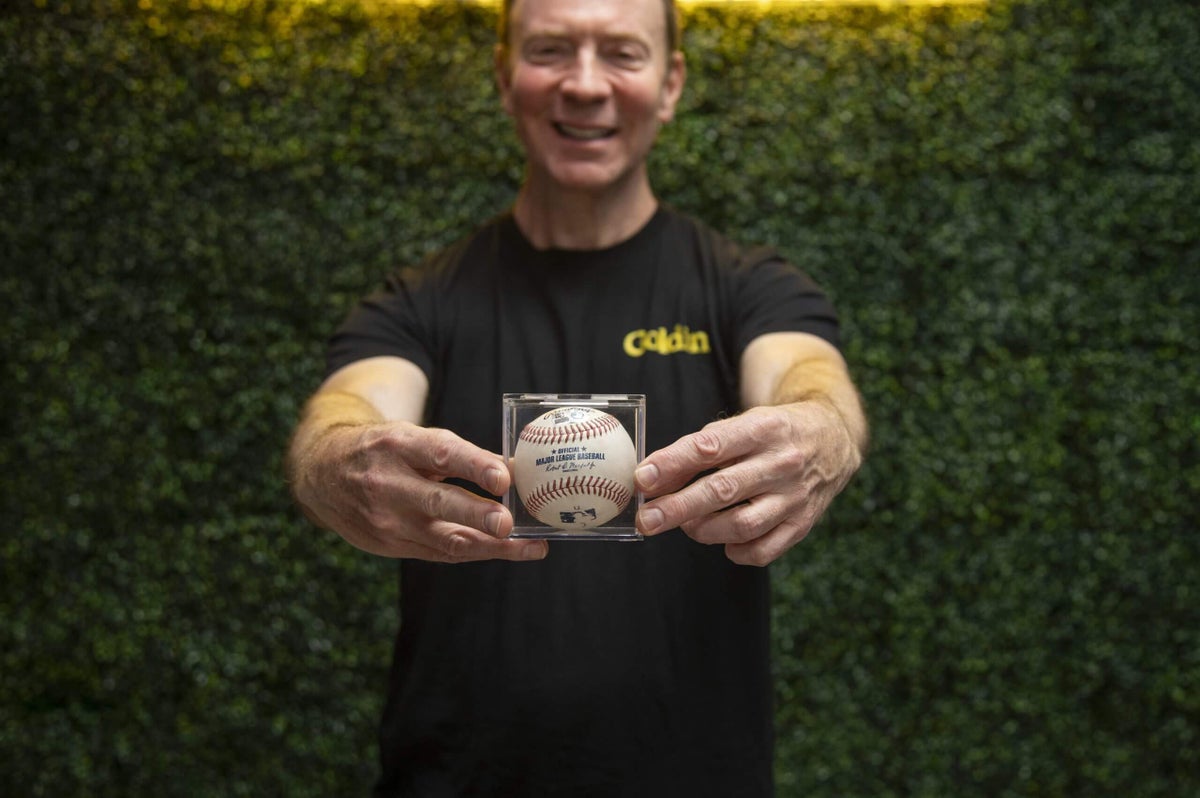
RUNNEMADE, N.J. — The consignment of Shohei Ohtani’s 50th home run ball from the Los Angeles Dodgers slugger’s 50/50 season in October 2024 felt simple for Goldin Auctions. Until it wasn’t.
Selling what eventually became the most expensive baseball in history turned into legal gymnastics for Ken Goldin and his auction house. What started out as a direct message from the consignor to a Goldin social media account and a seamless contract signing spiraled into an ownership balancing act and possible auction shutdown.
The final result ended swimmingly for Goldin, with the ball selling for a record-breaking $4.39 million to Taiwan-based investment firm UC Capital. While Goldin secured its $792,000 commission, the other $3.6 million in proceeds from the sale has yet to be pocketed by any of the three people battling over original ownership of the ball. Each party was involved in the scrum that took place once the ball reached the stands at Miami’s LoanDepot Park.
A mediation report in the case was filed in Miami-Dade County Circuit Court on Dec. 17. The result: No agreement.
It started when Dave Amerman, Goldin’s head of revenue and sports consignment, received a direct message from Christian Zacek, the person who left LoanDepot Park with the Ohtani home run ball. Goldin said Zacek only wanted to work with him. It took just a few days for the Goldin team to receive a signed deal, retrieve the ball and produce and air several videos announcing it would be up for auction.
“All was wonderful. All was terrific,” Goldin said. “And then two days later, you get these cease and desist letters.”
Two other parties — Max Matus and Joseph Davidov, who each claim to have grabbed the ball before losing possession due to separate physical assaults — contested the consignor for ownership of the ball, spurring both challengers to send Goldin separate cease and desist letters in an attempt to stop the auction.
“Everybody’s suing everybody,” Goldin said. “My auction is running. I am going full steam ahead like a bull in a China shop. I’m on TV. I’m promoting the ball. I’ve got people from Japan flying over to do interviews with me. … The bidding for the ball at that point was maybe $1.5 million, maybe $2 million. Now people are starting to get out there like ‘Could the auction be halted?’”
Goldin implored his legal team to set up a meeting with everyone claiming rights to the ball. After some resistance, all sides agreed to hear Goldin out.
“I said to them (the two parties fighting for a claim of the ball), ‘Do either of you want to keep this ball or do you want to own it so you can make the most money possible?’ And luckily, they said that they want to make the most money possible by selling the ball,” Goldin said.
All three sides sat down with Goldin to allow the auctioneer to state his case to sell the ball immediately, even as the legal battle over the ball was ramping up.
“I told the story about the Barry Bonds lawsuit years ago for one of his home run balls (his record-setting 73rd in 2001) when it was tied up in court and went for much less than it would have,” Goldin said. “I said you guys might be splitting $500,000, maybe $1 million each if it went three ways or whatever the court decides. Would you rather get 50 percent more like $2 million or would you rather get a 100 percent of $250,000 to $500,000 (if the ball is sold after the ownership dispute is settled in court)?
“Because if this thing goes to courts and two years from now this ball goes up for auction. Who the hell knows what it’s going to get? Because it’s hot now.”
Bonds hit his single-season record 73rd home run on Oct. 7, 2001. By the time the legal battle over ownership of the ball between Patrick Hayashi and Alex Popov ended in a judge ruling that both men had to split proceeds from its sale evenly, it went to auction more than a year and a half later. On June 26, 2003, the Bonds ball sold for $450,000 — a fraction of the $3.005 million Mark McGwire’s 70th home run ball sold for just a few months after he hit it in 1998.
Unified in their desire for maximum profit, all three parties agreed to allow Goldin to sell the Ohtani ball, paving the way for the auction to continue. Just over a month after Ohtani hit the ball, the auction resulted in a record sale that exceeded expectations.
“As a businessman, you are just using logic,” Goldin said. “I just felt that they needed to hear from me as the auctioneer, as the guy who is the ‘King of Collectibles’ that you are screwing yourself if you do not let this ball sell now. The court’s going to decide what your ownership is, you’re not going to win the case arguing with me. So let’s put your arguments aside. Let me get the most money possible for the ball.”
And here’s what Goldin couldn’t say out loud at the time: The ownership squabble attracted more attention to the ball.
“I’m not going to lie, the dispute itself was amazing. Holy s—!” Goldin said. “I mean everyone was covering it. … I think that the ball went for more money (because of the dispute).”
The Athletic maintains full editorial independence in all our coverage. When you click or make purchases through our links, we may earn a commission.