

It’s become an annual tradition in Milwaukee: A pitcher acquired in a minor transaction breaks out as a consistent middle reliever who can handle occasional high-leverage work for a couple of seasons. It was Hoby Milner in 2022, Joel Payamps the following year, Jared Koenig after that, and Grant Anderson in 2025.
None of them truly emerged out of nowhere, though. The Brewers brought each of them in because they saw qualities that could make them effective: Milner and Anderson’s deception; Payamps’s sweeping slider; and Koenig’s velocity spike upon becoming a full-time reliever. The front office constructs strong bullpens by continually stockpiling intriguing pitch qualities throughout the organization. Not all of those guys pan out, but if you collect enough spaghetti to throw at the wall, some will stick to round out an eight-man bullpen.
Easton McGee fit that mold from the moment the Brewers signed him to a two-year, minor-league deal in November 2023, making him a name to watch in his first full season back from Tommy John surgery. Sure enough, he joined the 40-man roster in May and spent the summer riding the bullpen shuttle between Milwaukee and Nashville.
The results were unimposing. In 14 ⅔ low-leverage innings, McGee pitched to a 5.52 ERA and 103 DRA-. The real accomplishment of his season was that he showcased the qualities in his post-surgery arsenal that could yield future success.
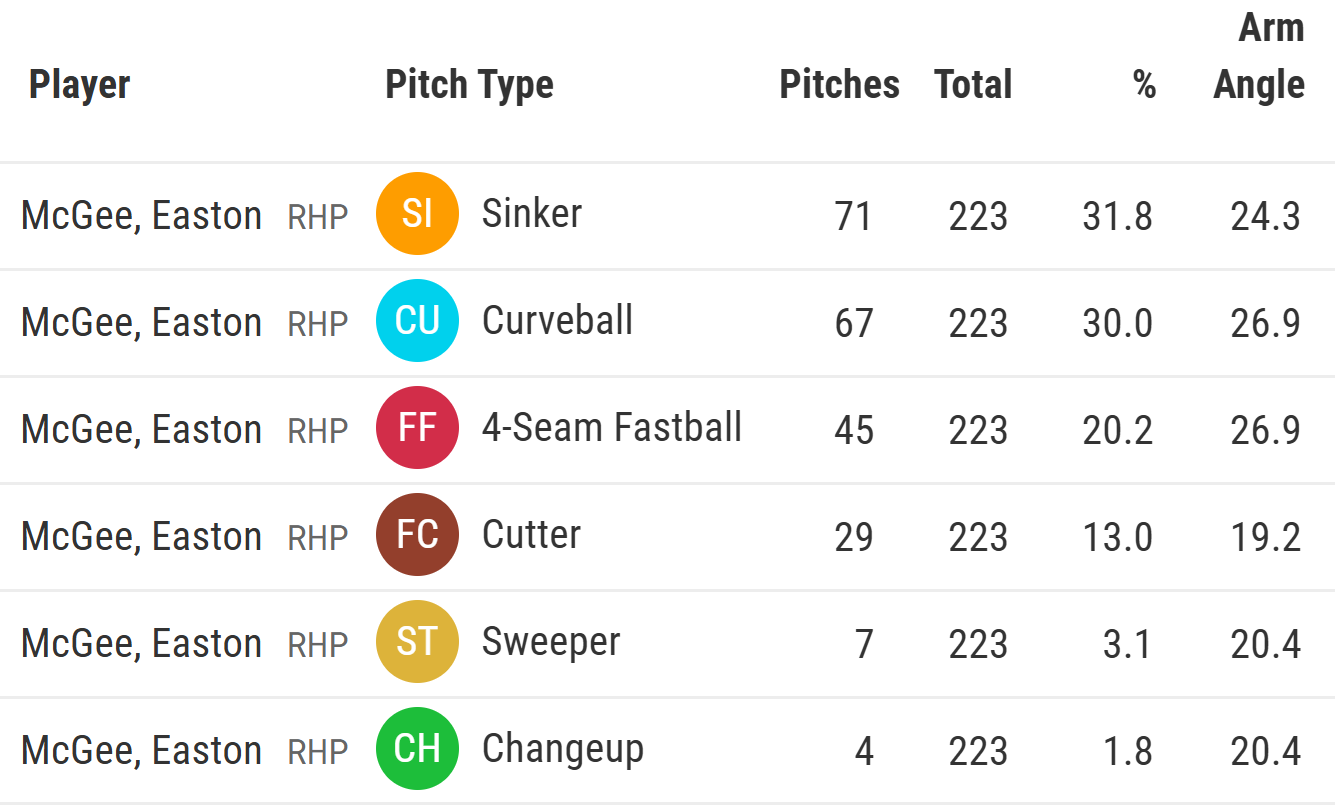
A former starter, McGee throws five pitches with distinct shapes, plus a rarely-used changeup. Between Triple-A and the big leagues, his sinker induced ground balls on 57.8% of batted balls, while his four-seamer produced a 31.1% whiff rate. Both pitches jumped from averaging 90 mph to 93 mph with the move to the bullpen. A more consistent cutter gave McGee the fully-developed trio of fastballs the Brewers love, and he has two big breaking pitches to choose from based on the angles he wants to play in a given matchup.
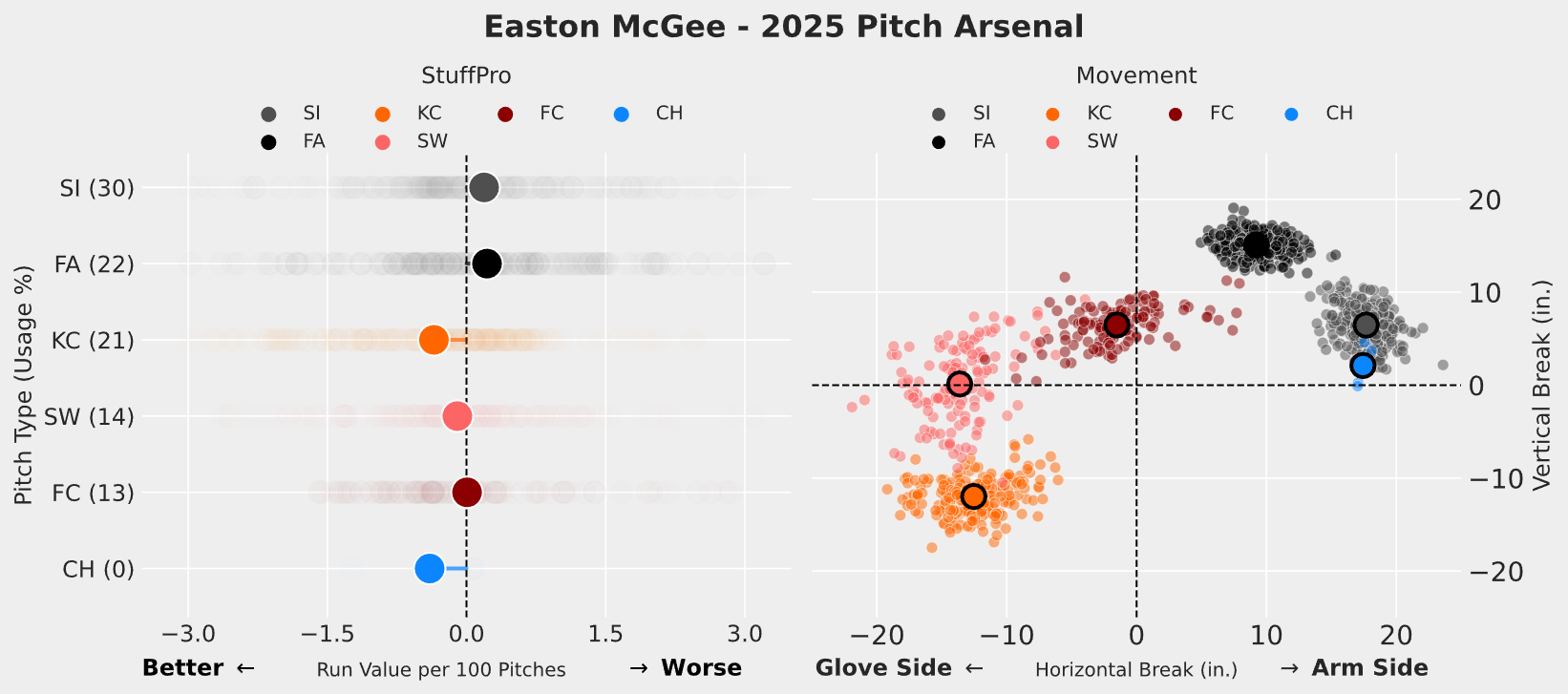
Pitch grading models see McGee’s stuff as average, but some of the movement he creates is more impressive from his arm angle. He stands 6-foot-7, but his low-three-quarters delivery pushes his average release height (5.5 feet) below the league norm for right-handed pitchers (5.8 feet).
From that slot, one would expect McGee to be a sinker-slider guy, and those two pitches made up his primary mix to righties in 2025. However, his four-seamer and curveball are arguably his most deceptive offerings. The former had two more inches of carry than usual for his arm angle, while the latter had three more inches of unexpected depth.
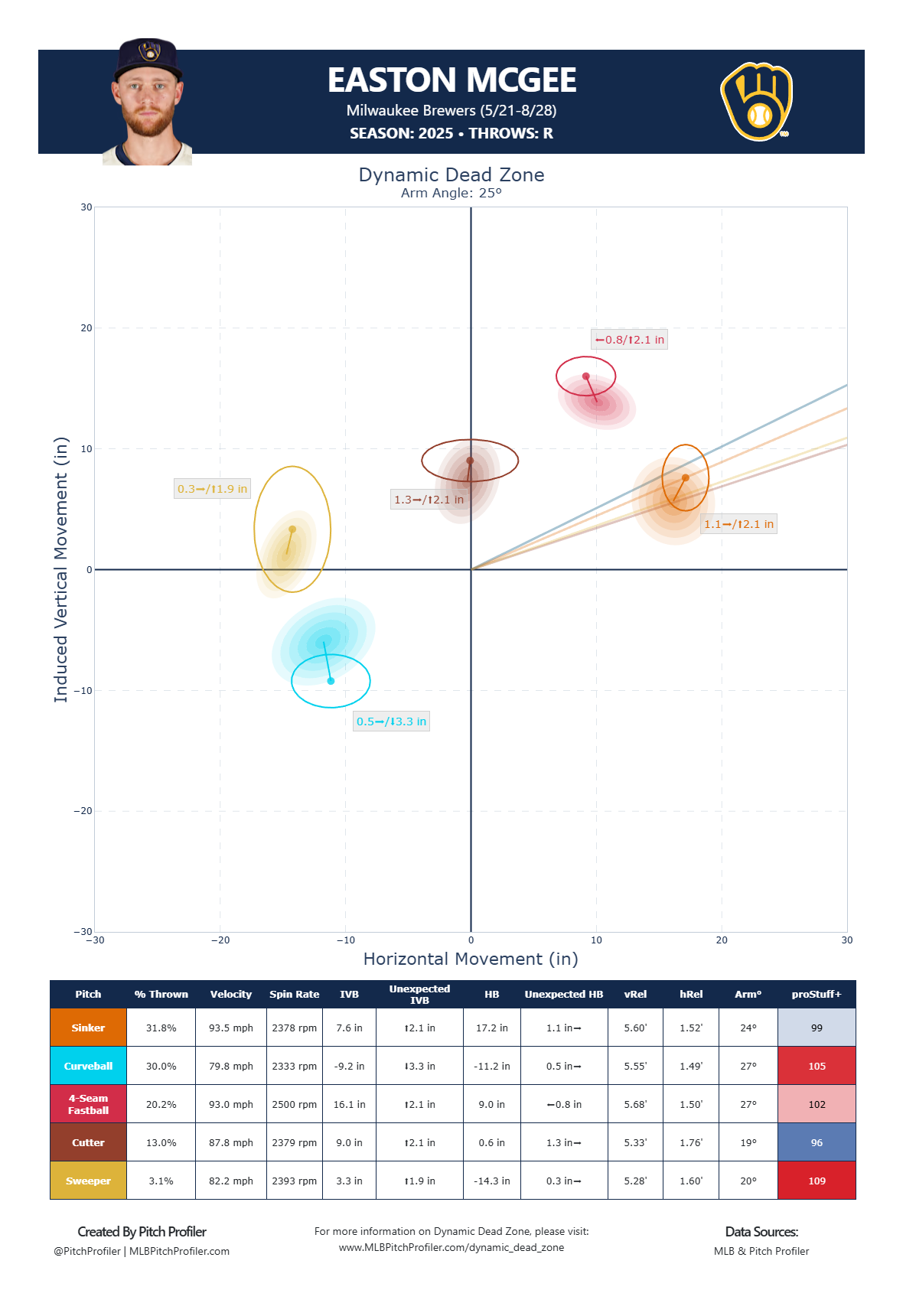
McGee could join Anderson as a sinkerballer by trade who leans more heavily on an effective high four-seamer over time. He already used his curveball more frequently in the big leagues, perhaps because it’s the only secondary offering he throws from a nearly identical arm slot to his fastballs.
The right-hander still has some hurdles to clear before a breakout season. His delivery puts him at risk of struggling with platoon splits, which was already the case in his debut. While righties managed just a .252 xwOBA against McGee, his low slot is a much easier look for lefties, who tagged him for a .366 xwOBA.
To hedge those splits, McGee must find a way to be deceptive most of the time, not just with a particular pitch. Given the array of shapes in his arsenal, that may be a matter of deciding which pitches to use, learning how to sequence them, and developing more consistent release points. If McGee makes those strides, don’t be surprised if he ascends from the roster bubble to become a regular contributor.