
Throughout the heyday of the Buck Showalter Orioles, Baltimore’s bats became synonymous with one thing: power, and lots of it. Between 2013 and 2016, an Oriole led the American League in home runs for four straight seasons. In 2016, the O’s led all of baseball with 253 home runs as the Birdland Power Company lit up the Baltimore sky with their constant fireworks.
The Mike Elias Orioles looked to follow a similar blueprint, building a lineup full of long-ball threats. The peak of that power output came in 2024, when the O’s were second in MLB with 233, led by Anthony Santander’s 44 taters and Gunnar Henderson’s record-setting 37 homers.
Advertisement
And then, last year, the power just dried up. The Orioles dropped from second to 11th in homers and no player finished with more than 17 long balls. Pundits often point to the Orioles’ lack of pitching as their biggest weakness, but their power outage also precipitated the O’s downturn last year. With 2026 just around the corner, the lack of power is something the O’s are trying to fix to make 2026 a better year.
The relative youth of this Orioles team makes it hard to say whether 2024 or 2025 was the true outlier with Baltimore’s power output. But seeing a team drop from a .435 slugging percentage one year to a .394 slugging percentage the next year certainly falls outside of normal year-to-year variance.
Any attempt at explaining the Orioles’ dip in offensive output has to start on the injured list. The poster child for the Orioles’ injury woes was big offseason signing Tyler O’Neill. The Baltimore front office bet on O’Neill as the cost-effective replacement for the departing Santander, a bet that completely failed to pay off in 2025. The 30-year-old outfielder spent more days on the IL (97) than base hits, and finished with 35 fewer home runs than Santander gave the O’s in 2024.
The injury shockwave was felt beyond the O’Neill for Santander swap. Oblique injuries limited Adley Rutschman to 90 games in 2025, and consequently saw his homer output drop from 19 to 9 and his slugging percentage from .391 to .366. Colton Cowser spent 72 days on the IL between an early-season broken finger and a late-season concussion, resulting in a home run regression from 24 to 16. Ryan Mountcastle also saw an injury-related dip in power production, as a two-month stay on the IL with a hamstring strain coincided with his home runs dropping from 13 to seven and his slugging dipping from .425 to .367.
Advertisement
The Orioles’ offense was undoubtedly dealt a blow when their slow start led them to trade Ryan O’Hearn, Ramón Laureano—the team’s leaders in slugging percentage—as well as Cedric Mullins and Ramón Urías at the Trade Deadline. However, the offense was already on the road to deep regression by the time we got to July.
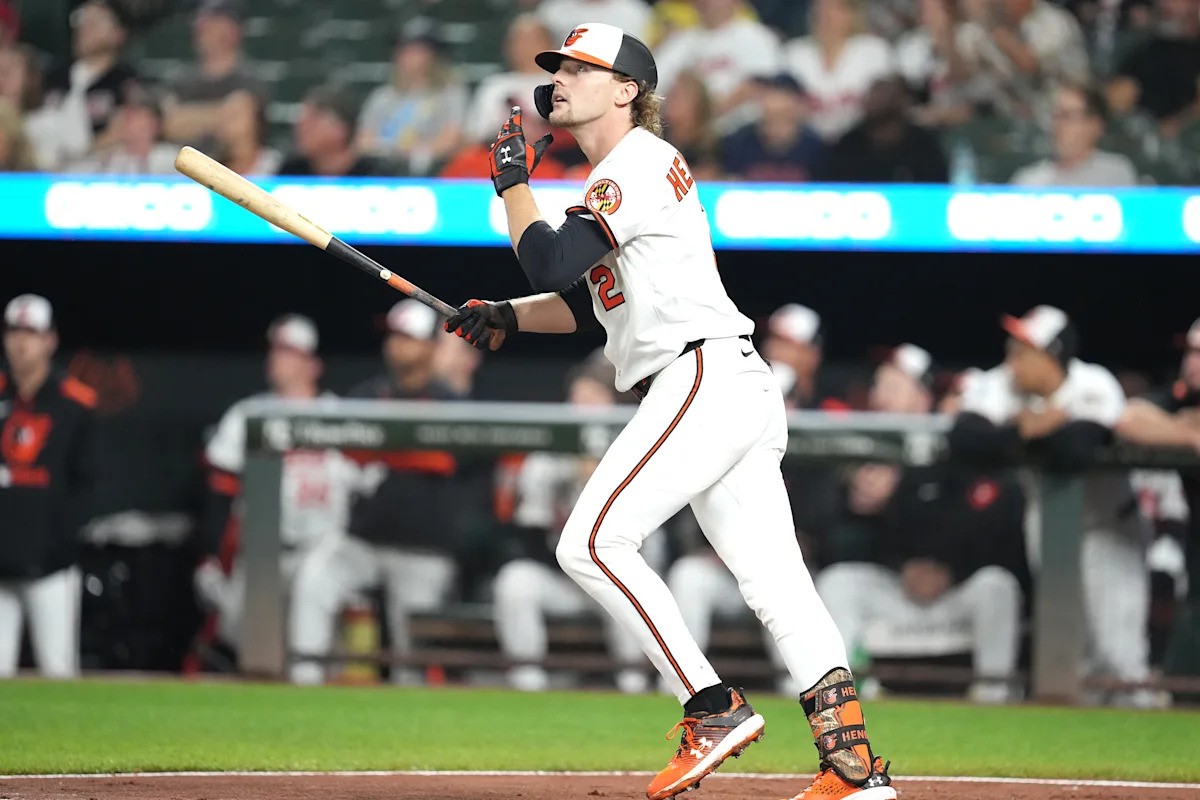
In addition to getting healthier, the Orioles and Birdland alike will be hoping for a rebound from shortstop Gunnar Henderson. The 2025 season was a stark reminder that progression with young players—even ones as good as Henderson—is far from linear. In 2024, we saw the star shortstop put up one of the best seasons by an Oriole this century, breaking Cal Ripken’s single-season record for home runs by a shortstop.
This past season, Gunnar just wasn’t the same Gunnar. The key metrics that usually go along with big power output—exit velocity, hard hit rate, bat speed—were all still for the Orioles’ Country Boy last season. But his barrel rate, launch-angle sweet-spot percentage and chase rate all trended in the wrong direction, leading to a drop in Henderson’s expected slugging percentage from .492 to .417.
Gunnar’s statistical profile paints the picture of a hitter who was pressing. After the star shortstop missed most of Spring Training and the first week of the regular season with an intercostal injury, it felt like he was always trying to play catch-up. It took until June for Henderson to really play like the All-Star caliber player he is, at which point the Orioles’ season was mostly a lost cause.
Advertisement
After the fire sale at the Trade Deadline, his slugging percentage dipped from .464 through the end of July to .387 over the final two months of the year. Whether the result of a superstar talent trying too hard to carry a team in need of a spark, the 24-year-old taking his foot off the gas for a team clearly out of contention, or something in between, Henderson finished 2025 as he started it: lukewarm.
There’s enough evidence to suggest that the leader of the Orioles lineup can rebound to 2024 form in 2026. To do so, he’ll have to lock back in against breaking balls in particular. After crushing breaking balls in 2024 (to the tune of a .298 average and .708 slugging percentage), Henderson was a completely different hitter against breaking balls this past season. His average dropped all the way to .228 against curves, sliders, and sweepers; his slugging went down to .415 and his swing and miss rate jumped up by nearly four percent. If he can get his timing back on hitting breaking pitches, 30+ home runs should be a realistic expectation for Henderosn in 2026.
While a healthier team and a Gunnar Henderson bounce back are reasonable to expect in the coming year, the front office is clearly not resting on its laurels when it comes to fixing Baltimore’s power problem. The two big offensive additions this offseason—OF Taylor Ward and 1B Pete Alonso—combined for 74 home runs last year. By themselves, both more than doubled the team-leading 17 home runs hit by co-leaders Henderson, Jackson Holliday and Jordan Westburg. If power was the lineup’s problem in 2025, it’s clearly the front office’s mission to build a more potent group for 2026.