
Fifty years ago, Major League Baseball was forced to adopt a rule change that would drastically change the sport forever. This wasn’t a traditional rule change like the universal DH, larger bases, pace of play initiatives or the shift ban. This was a change that would finally put more power in the hands of players when it came to where they played and how much they were paid. This rule change, of course, was the elimination of the reserve clause, which created modern free agency. Prior to free agency, a team held the rights to a player even after their contract expired. After a contract expired, the team could offer the player a new contract, trade them, reassign them to the minors, or sell the rights to another team. This left players with little-to-no negotiating power, as they could only ask for a trade/release or refuse to play. Since its inception in 1975, free agency has evolved and changed due to updated CBAs, but the bottom line remains the same: players now have much more influence in who they play for. Here is a list of the most impactful Cubs free agent signings of all time:
10. Rod Beck
The 1998 season was a good one in which to be a Cubs fan. With a record of 90-73 (including winning a one-game playoff with San Francisco), the Cubs returned to the postseason for the first time since 1989. Sammy Sosa and Mark McGwire each broke Roger Maris’s single-season home run record, with McGwire winning the home run race but Sosa winning the MVP.
On the pitching side, Kerry Wood made his debut, and struck out 20 batters in his fifth career start. The one-year deal given to seemingly washed-up ex-closer Rod “Shooter” Beck seems like an afterthought, but his 51 saves were second in the NL, trailing only future Hall of Famer Trevor Hoffman. He was also a great example of durability out of the pen, leading the NL in games pitched with 81. Though Beck was not an All-Star with Chicago, his 81 strikeouts and 1.3 WAR were the third-highest marks of his 13-year career. Beck was also a fun player to watch. He had a lazy-looking windup (it was slow and incorporated a pretty high leg kick), but he thrived off deception, so the unique delivery helped him fool hitters with his nasty forkball. Modern Cubs fans are used to feeling uneasy in the ninth inning, so it’s nice to look back to a time where they had a proven closer to lock it down.
9. Shota Imanaga
Imanaga is the only current Cub who makes this list, and his inclusion speaks to what he represents outside of his pure stats. The two-time NPB All-Star was posted by his former team, the Yokohama Bay Stars, after the 2023 season. He spent much of his free agency in the shadow of countryman Yoshinobu Yamamoto, before signing with the Cubs in January 2024. The four-year, $53-million deal that brought Imanaga to the Cubs had some unique aspects that made it far from the traditional free-agent contract, and we saw this play out this offseason. After Year 2 of the deal, the Cubs had the option to extend the contract to five years, but if the Cubs declined to extend him, he could opt out. The Cubs did not extend him, and Imanaga ended up opting out, though he accepted the qualifying offer for $22.025 million over one year, instead.
Imanaga will be back in the rotation in 2026, and while the end of his 2025 campaign rang some alarm bells, his time in Chicago as a whole has exceeded expectations. He has a 24-11 record, a 3.28 ERA, and 291 strikeouts across 318 MLB innings. His 2024 season alone cemented him on this list, as he went 15-3 with a 2.91 ERA, accumulated 3.0 WAR, and made the All-Star team. He also finished fourth in NL Rookie of the Year voting and fifth for the NL Cy Young. Imanaga quickly became a fan favorite, as he and Justin Steele formed one of the best rotation duos in baseball. Hopefully, he regains some of his 2024 form for next season, but regardless of how 2026 goes, the Cubs would not have turned a corner without the help of Imanaga.
8. Moisés Alou
Alou’s most memorable moment as a Cub is probably the most infamous moment in franchise history, but let’s focus on the impact he made on the field. Before the 2002 season, the Cubs signed the 35-year-old to a three-year deal worth $27 million. (This was during a time when a player in his mid-30s could secure a multi-year deal, play almost every day, and be counted on as a middle-of-the-order bat.)
In his three seasons with the team, Alou slashed .283/.353/.484, making an All-Star team in 2004 while finishing seventh in the league in home runs (39). He spent most of his Cubs tenure hitting behind Sammy Sosa, forming a powerful heart of the order that also included a young Aramis Ramírez. He was a key reason why the Cubs made it back to October in 2003, their first time since 1998.
7. Alfonso Soriano
After Alou departed following the 2004 season, left field was a bit of a revolving door for the Cubs. Todd Hollandsworth was the Opening Day left fielder in 2005, but he was more of a bench bat during his years as a Cub. Prospect Matt Murton won the job in 2006, but he quickly proved that he wasn’t going to be the force in the lineup that many thought he would be. For the 2007 season, GM Jim Hendry needed to make some impactful changes to vault the team back into contention. One of those was signing lovable yet hot-tempered manager Lou Piniella, and the other was handing out the largest free-agent contract in franchise history (at the time) to Alfonso Soriano—an eight-year deal worth almost $136 million, nearly double what his former team, the Washington Nationals, were looking to give him. The five-time All-Star and four-time Silver Slugger was just coming off the fourth 40/40 season in MLB history, and the Cubs needed another star to pair with Derrek Lee and Ramírez. Although he was a streaky hitter prone to swing and miss, he still launched 181 home runs as a Cub, which is good for 12th on the Cubs’ all-time home run list. In six and a half seasons with the team, Soriano slashed .264/.317/.495, made two All-Star teams, and played a key role in two playoff runs. Soriano is likely the second-most loved left fielder the team has had since 2000, trailing only Ian Happ.
6. Dexter Fowler
In 2014, we saw the debuts of some of the eventual championship core. Anthony Rizzo was already entrenched at first base, but Javier Báez and Kyle Hendricks were called up for the first time. With Kris Bryant, Kyle Schwarber, Addison Russell, Albert Almora Jr., and Willson Contreras on the way, Cubs fans could start to buy into Theo Epstein’s vision.
Before acquiring Fowler from Houston for 2015, the Cubs had been using a merry-go-round of mediocre options in center field, such as Arismendy Alcantara, Emilio Bonifacio, Junior Lake and Ryan Sweeney. Fowler slashed a respectable yet unspectacular .250/.346/.447 in his first season in Chicago, but helped the team reach the postseason for the first time since 2008. The seven-year veteran brought leadership to a young, emerging team looking for a catalyst at the top of the order. It was rumored that Fowler was going to leave the Cubs to join the Orioles on a four-year deal, but that contract never got across the finish line.
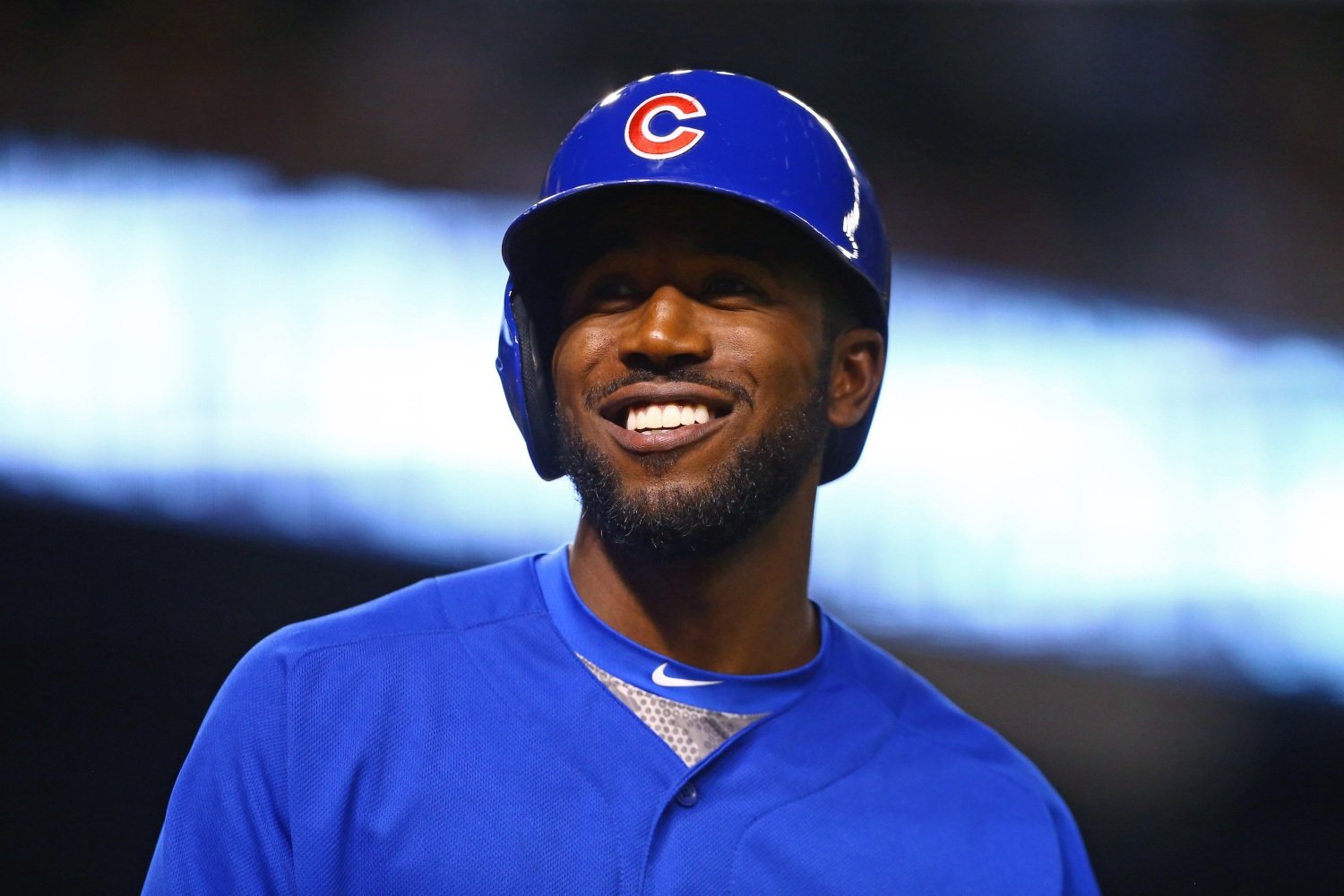
Instead, Fowler chose to surprise Cubs players and fans by returning on a one-year deal. Joe Maddon famously told Fowler “You go, we go”, and Fowler took that seriously. He had the best season of his career, he slashed .276/.393/.447 and had 4.0 WAR on the season, while making his first and only All-Star team. He had the lowest chase percentage in baseball, only swinging at 19.4% of pitches outside the strike zone. This was essential for a lineup that had a few free swingers in it. Even if he was not the catalyst or leader that he was, Fowler would be on this list, because he gave us one of the greatest greatest Cubs home runs of all-time, and became the first Black player to start a World Series for the Cubs.
Are you interested in Cubs history? Then check out the Chicago Cubs Players Project, a community-driven project to discover and collect great information on every player to wear a Cubs uniform!