
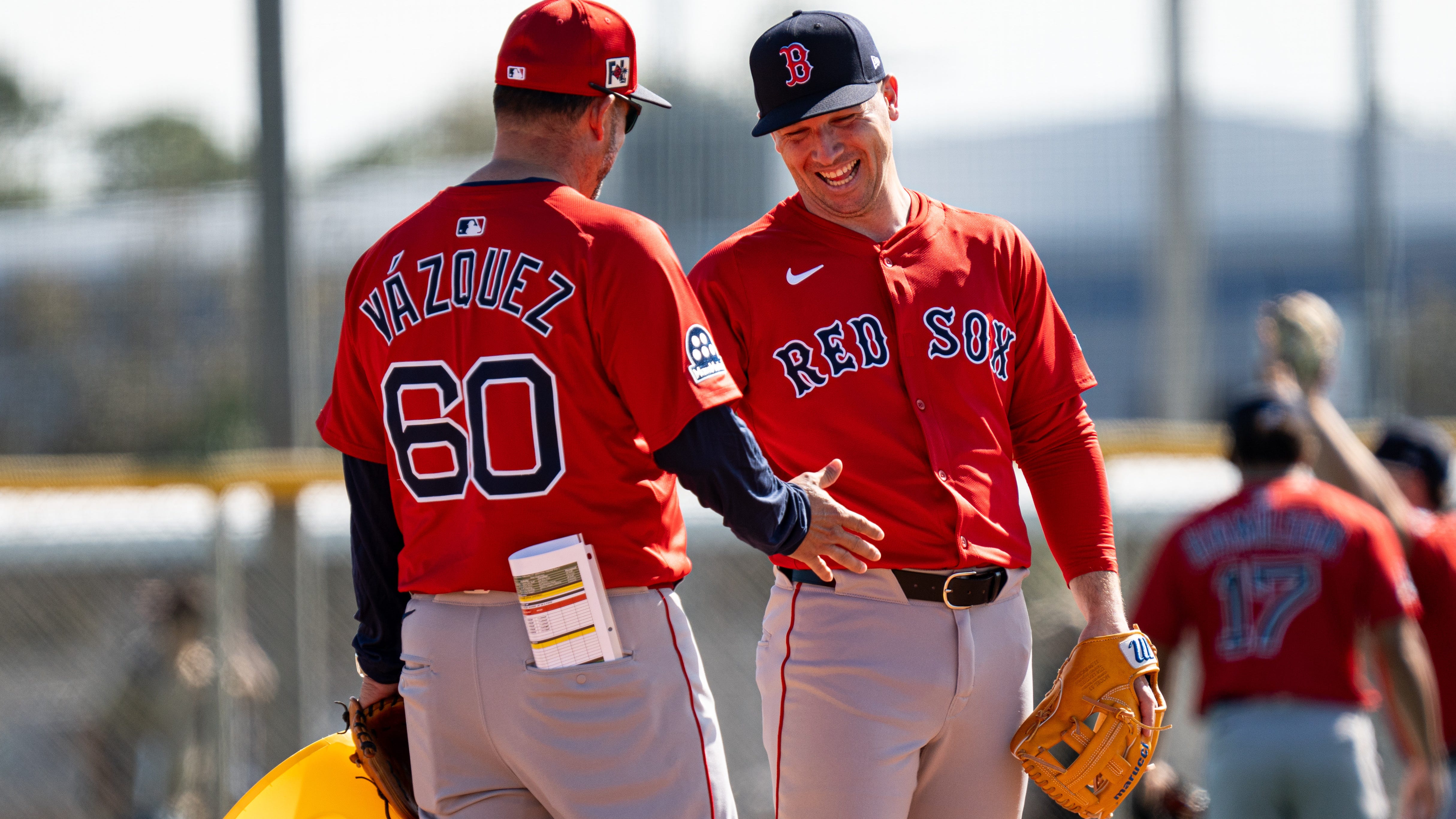

Red Sox broadcaster Will Flemming on Alex Bregman and Detroit Tigers
Boston Red Sox radio voice Will Flemming joins “Days of Roar” to discuss what the Detroit Tigers would get by signing third baseman Alex Bregman.
Dear Detroit Tigers fans,
Happy holidays!
The Tigers have made three notable moves in the 2025-26 offseason: signing right-hander Drew Anderson to a one-year, $7 million contract, right-handed reliever Kenley Jansen to a one-year, $9 million contract and right-handed reliever Kyle Finnegan to a two-year, $16.75 million contract. With 49 days until pitchers and catchers report to spring training, it’s time to start looking ahead to the 2026 season.
[ MUST LISTEN: Make “Days of Roar” your go-to Tigers podcast, available anywhere you listen to podcasts (Apple, Spotify) ]
Here are five things the Tigers should have on their holiday wish list, as discussed during the latest Days of Roar podcast episode:
Saves became an official statistic in 1969.
Since then, there has never been an Opening Day roster with three pitchers who recorded at least 20 saves in the previous season. As long as everyone stays healthy, the Tigers will become the first team to do so with Kenley Jansen (29 saves), Kyle Finnegan (24 saves) and Will Vest (23 saves) on the 2026 Opening Day roster.
Only Jansen is a newcomer from the 2025 team.
The Tigers strengthened their weak bullpen by creating a three-headed monster with Jansen, Finnegan and Vest for high-leverage situations in 2026. But they didn’t address their biggest problem.
The bullpen still struggles to miss bats.
The Tigers’ bullpen ranked 27th out of 30 teams with a 23.9% whiff rate in 2025, including a 28th-ranked 24.2% whiff rate in the seventh, eighth, ninth and extra innings.
The trio of Jansen, Finnegan and Vest won’t solve that problem, as none of them are elite at missing bats: Vest had a 26.7% whiff rate (61st percentile), Jansen had a 25.8% whiff rate (54th percentile) and Finnegan had a 24.6% whiff rate (44th percentile).
The Tigers have watched elite swing-and-miss relievers sign elsewhere – such as Devin Williams with the New York Mets and Ryan Helsley with the Baltimore Orioles – but there’s still one more option in free agency.
It’s Seranthony Domínguez.
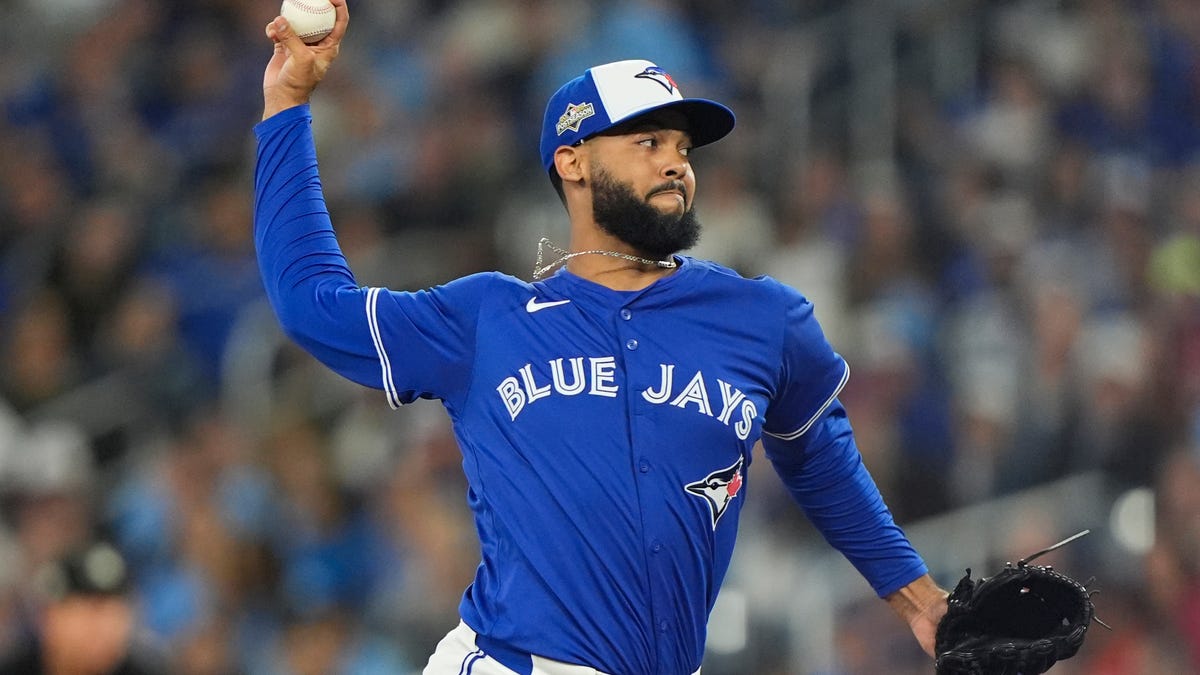
In 2025, the 31-year-old right-handed reliever posted a 3.16 ERA with 36 walks and 79 strikeouts across 62⅔ innings in 67 games for the Orioles (43 games) and Toronto Blue Jays (24 games). He recorded just two saves along the way, both for the Orioles.
Domínguez ranked in the 94th percentile with a 33.3% whiff rate, leading to an elite 30.3% strikeout rate – the type of bat-missing production the Tigers lack throughout their bullpen. The downside: He had a career-worst 13.8% walk rate due to poor command.
Too many walks could lead to Domínguez’s downfall, just as they did for former Tigers closer Alex Lange, but his high-strikeout, high-walk profile should keep his market in check, lining him up for a one-year contract worth no more than $10 million.
The Tigers need his swing-and-miss ability.
The Tigers have five starters locked in: Tarik Skubal, Jack Flaherty, Casey Mize, Reese Olson and Troy Melton. Every non-Skubal starter comes with questions, but Flaherty is the biggest wild card.
Nobody knows what to expect.
The 30-year-old right-hander returned to the Tigers in 2026 by exercising his $20 million player option, but his performance could swing between a No. 1 starter as a frontline option and a No. 5 starter as an innings eater.
The Tigers have seen both versions of Flaherty throughout his 49 starts in the Old English “D,” paying him $9.3 million in 2024 and $25 million in 2025. He posted a 2.95 ERA with a 4.6% walk rate and 32% strikeout rate across 106⅔ innings in 18 starts in 2024, then a 4.64 ERA with an 8.7% walk rate and a 27.6% strikeout rate across 161 innings in 31 starts in 2025.
The nine-year MLB veteran, who owns a 3.80 ERA over nearly 1,000 career innings, hasn’t been the same since the Tigers shipped him to the Los Angeles Dodgers at the 2024 trade deadline. The three biggest changes from 2024 to 2025: His fastball velocity decreased, his whiff rate plummeted and his walk rate skyrocketed.
For Flaherty, it all starts with his lower-body mechanics.
A return to 2024 dominance – not continued 2025 struggles – would give the Tigers one of the best one-two punches in baseball with Skubal and Flaherty atop the rotation in 2026. If not, Skubal will be leading a flurry of average mid-rotation starters.
Colt Keith develops into an All-Star
The Tigers are relying on internal development to improve their offense in 2026, which means everyone should expect significant growth from the young players in the organization: Riley Greene into a superstar, Colt Keith into an All-Star and Kevin McGonigle into an everyday player. If those developments don’t happen, it’s fair to wonder whether the Tigers can properly project their own players – because the front office is putting all of its eggs in that basket.
The Tigers showed their commitment to young players in January 2024, signing Keith to a long-term extension before his MLB debut. He agreed to a team-friendly deal: six years, $28.64 million with club options for $10 million in 2030, $13 million in 2031 and $15 million in 2032. The 24-year-old is under team control for the next seven seasons, meaning he won’t reach free agency until after his age-30 season.
So far, Keith has been only average.
The good news: Keith made improvements from 2024 to 2025 in average exit velocity (87.8 mph to 90 mph), walk rate (6.5% to 10.3%) and OPS (.689 to .746), though his batting average (.260) and strikeout rate (19.8% to 21.8%) worsened. His overall performance was better in 2024 than 2025, but he still needs to take a leap into above-average territory.
The jump needs to happen in 2026.
The Tigers are preparing for Keith to be their primary third baseman, especially as a left-handed hitter against right-handed pitchers. (Hao-Yu Lee, a right-handed hitter, projects to receive some playing time against left-handed pitchers.)
With Keith at third base, the Tigers need the type of All-Star-caliber production that a certain free-agent third baseman would’ve been able to provide – because they have chosen to rely on internal developments rather than external additions.
It’s fair to expect greatness from Keith, given his prospect pedigree, contract status and elite upside. An All-Star season would validate the Tigers’ strategy of growth from within in 2026. If not, the Tigers will need to explain why Keith didn’t take a significant step forward in his age-24 season.
Parker Meadows becomes one of MLB’s best center fielders
Parker Meadows has more upside than any Tigers position player.
Need proof? There’s no better example than what happened in 2024, when the Tigers made their magical run to the postseason. In August and September, Meadows – fueled by a swing change – played 47 games and hit .296 with six home runs and an .840 OPS. More notably, he was worth 2.1 fWAR during that stretch with above-average offense in the leadoff spot and elite defense in center field – a 162-game pace of 4.6 fWAR. Had Meadows produced that over a full season in 2025, he would’ve ranked as the fourth-best center fielder in the big leagues.
But that’s not what happened in 2025.
Instead, Meadows dealt with two injuries that limited him to 58 games. A musculocutaneous nerve issue in his right arm sidelined him for nearly all of spring training and the first 60 games of the regular season, then a right quad strain cost him another 34 games. He hit just .215 with four homers and a .621 OPS, worth 0.2 fWAR with below-average offense in the nine-hole and below-average defense in center field – a 162-game pace of 0.6 fWAR.
Here’s the question: If Meadows stays healthy in 2026, will he be a 4.6-fWAR player (comparable to Dodgers center fielder Andy Pages in 2025) or a 0.6-fWAR player (comparable to Colorado Rockies center fielder Brenton Doyle in 2025)?
The Tigers are about to find out.
If Meadows rediscovers his upside and sustains above-average performance, the Tigers will feel confident in him as their everyday center fielder for the next five seasons, as he won’t reach free agency until after the 2030 season. A resurgence from Meadows would push Max Clark to a corner outfield spot in late 2026 or early 2027. If not, the pressure shifts to Clark to emerge as the center fielder of the future.
The Tigers need a Christmas miracle.
The Blue Jays, Boston Red Sox, Arizona Diamondbacks and Chicago Cubs are in the hunt for free-agent third baseman Alex Bregman, while the Tigers appear to be in wait-and-see mode as lukewarm interest continues. If Bregman’s market crashes, the Tigers could jump into the mix in mid-January. For now, he is expected to sign a long-term contract with one of those four teams – not the Tigers.
Bregman is an elite talent.
The 31-year-old is one of 14 players to be worth at least 3.5 fWAR in each of the past four seasons, joining Aaron Judge, Freddie Freeman, Trea Turner, Francisco Lindor, José Ramírez, Julio Rodríguez, Kyle Tucker, Corey Seager, Eugenio Suárez, Nico Hoerner, Juan Soto, Shohei Ohtani and Cal Raleigh. Not only is Bregman valuable for his offense and defense, but he also provides leadership behind the scenes.
The Tigers finished as the runners-up for his services last offseason – Bregman turned down a six-year, $171.5 million contract with an opt-out after 2026 – but they’re now on the outside looking in this offseason, seemingly waiting to see if his market falls apart.
Contact Evan Petzold at epetzold@freepress.com or follow him @EvanPetzold.
Listen to our weekly Tigers show “Days of Roar” every Monday afternoon during the season and Tuesday afternoon during the offseason on Apple, Spotify or wherever you listen to podcasts.