
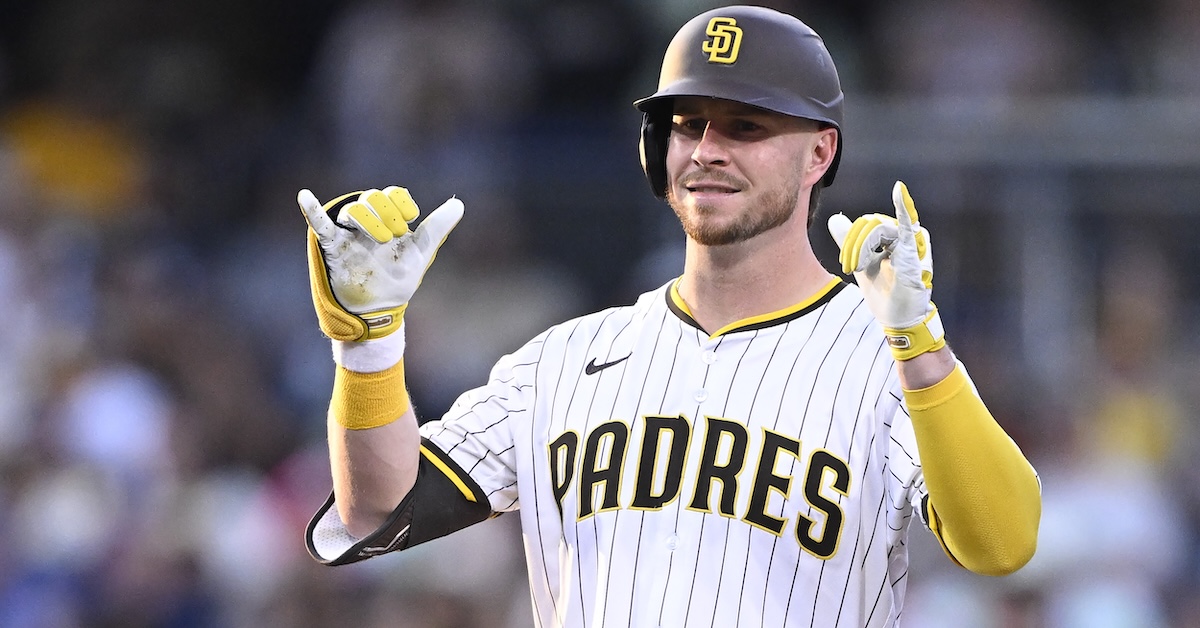
 Denis Poroy-Imagn Images
One day after boom-or-bust Japanese slugger Munetaka Murakami was officially introduced as a new member of the White Sox on a two-year, $34 million pact, FanSided’s Robert Murray reported that the Pirates have inked fellow left-handed first baseman Ryan O’Hearn to a two-year, $29 million deal.
This framing device will eventually lose its White Sox trappings, but they’re initially connected just because the South Siders were linked to O’Hearn early in the offseason, before they pivoted from a reliable and proven big leaguer to an attention-grabbing international signing. Murakami has a deeply volatile profile with significant bust potential, but a famed home run hitter and two-time MVP of NPB picking a relative MLB backwater is intriguing not only for beleaguered White Sox ticket sales employees, but also for outlets like this one that observe the league at large. How the talents of a legendary Japanese slugger with apparently bottom-of-the-scale contact ability translate to MLB is fascinating, whereas pondering whether a 32-year-old hit-over-power first baseman like O’Hearn can keep a later-career breakout going is more the usual fare. Even for the largest position player free agent signing in Pirates franchise history, O’Hearn is newsworthy mostly in terms of how well he might fill a short-term need for a role player.
Where these two moves line up again is that, within the cold lines of a spreadsheet, these could be fairly similar quality first base bats who received similar deals, despite their 15-spot disparity (12th vs. 27th) in the FanGraphs Top 50 free agents rankings. Steamer boiled down Murakami’s absurd NPB exploits into a 118 wRC+, 2.3 WAR projection, and sees O’Hearn following the past three years of above-average hitting with a 112 wRC+ and 1.1 WAR, where the large WAR discrepancy can be at least partially explained by playing time. From a more risk-averse perspective, O’Hearn has bettered his 2026 projections in each of his last three seasons, producing a 121 wRC+ and 6.1 WAR overall from 2023-25, and is a more reliable bet than the guy with Joey Gallo contact rates who has never played in MLB before. The new Pittsburgh first baseman is also just less marketable, and the disparity in fanfare is a helpful reminder that this is an entertainment product.
For where the White Sox will try to court Japanese baseball fans into watching more Chase Meidroth than they ever anticipated, the excitement for O’Hearn is more that it represents a sustained run of the Pittsburgh Pirates – yes, the Bob Nutting-owned Pittsburgh Pirates – doing things. Some things, at least.
O’Hearn’s reported agreement comes on the heels of Pittsburgh’s bringing in power-hitting second baseman Brandon Lowe and outfielder Jake Mangum in a three-team trade with the Rays and Astros, acquiring Jhostynxon Garcia, a 45+ FV prospect who is major league ready, in a swap with the Red Sox, and making an unsuccessful bid for Kyle Schwarber in free agency that, presumably, at least one or two people involved thought might actually work. At the very least, it showed Pittsburgh’s desire to add a proven bat for its own sake. And instead of Schwarber, O’Hearn wound up being the first multi-year free agent signing by the Pirates since Iván Nova’s three-year deal in 2016. With apologies to Lowe, who is coming off a 31-homer season and his second All-Star appearance, the Pirates still haven’t landed a big fish, but they have spent the last month swapping out players who can’t hit with two who can (Lowe and O’Hearn), one who might (Garcia), and one who might do a little bit of hitting and some other useful things (Mangum).
That’s a nice start, but probably still an insufficient one considering the context. Just this past year, the Pirates offense scored the fewest runs in all of baseball. The Rockies had a lower team wRC+, but you’d be surprised how little credibility claiming something is “better than the 2025 Rockies” buys from modern fanbases. Normally such a paucity of scoring would be enough of an emergency in its own right to merit a major offseason response, but scoring the fewest runs in the sport while Paul Skenes is double-dipping with a Cy Young Award and an ERA title in his first full season in the majors means every season from here on out is a fight to avoid wasting a generational talent until the day he leaves. And if Skenes does leave without a slew of playoff starts for the Pirates on his ledger, to say nothing of Bubba Chandler or the returning-from-injury Jared Jones, a Pittsburgh player development operation that has systemically failed to produce viable bats will shoulder a lot of the blame. And so while O’Hearn isn’t tasked with transforming a franchise’s offensive reputation all by himself – that’s top prospect infielder Konnor Griffin’s job – this isn’t the low stakes assignment for an over-30 hitter on a rebuilding team it might appear to be, and there are some challenges for him to maintain his recent form.
You Aren’t a FanGraphs Member
It looks like you aren’t yet a FanGraphs Member (or aren’t logged in). We aren’t mad, just disappointed.
We get it. You want to read this article. But before we let you get back to it, we’d like to point out a few of the good reasons why you should become a Member.
1. Ad Free viewing! We won’t bug you with this ad, or any other.
2. Unlimited articles! Non-Members only get to read 10 free articles a month. Members never get cut off.
3. Dark mode and Classic mode!
4. Custom player page dashboards! Choose the player cards you want, in the order you want them.
5. One-click data exports! Export our projections and leaderboards for your personal projects.
6. Remove the photos on the home page! (Honestly, this doesn’t sound so great to us, but some people wanted it, and we like to give our Members what they want.)
7. Even more Steamer projections! We have handedness, percentile, and context neutral projections available for Members only.
8. Get FanGraphs Walk-Off, a customized year end review! Find out exactly how you used FanGraphs this year, and how that compares to other Members. Don’t be a victim of FOMO.
9. A weekly mailbag column, exclusively for Members.
10. Help support FanGraphs and our entire staff! Our Members provide us with critical resources to improve the site and deliver new features!
We hope you’ll consider a Membership today, for yourself or as a gift! And we realize this has been an awfully long sales pitch, so we’ve also removed all the other ads in this article. We didn’t want to overdo it.
For a first baseman who went from looking to be on his way out of the league at age-28 to making an All-Star team at 31, O’Hearn’s operation at the plate doesn’t look that drastically different. He hasn’t activated a dormant elite tool so much as he’s just become proficient at a lot of little elements. He straightened up his posture at the plate during his time in Baltimore and installed a mechanism for starting his hand load earlier and in a more relaxed fashion, significantly improving his inner-half plate coverage. The alterations have enabled O’Hearn to quietly become one of the better fastball hitters in the league, as his .395 xwOBA against four-seamers this year was superior to all of his new Pittsburgh teammates save for Bryan Reynolds.
Despite that proclivity, O’Hearn’s breakout hasn’t been rooted in tapping into the 60-grade raw power of his prospect days. His 90th-percentile exit velocity of 103.1 mph this year was a tick below the major league average, and he launched only 17 home runs over his 544 plate appearances (both career highs). Instead, he largely makes his bones by spraying a lot of good — but not great — contact all over the yard. The aging curves post-age 32 are not friendly to hitters of pretty much any stripe, but if a fatal flaw emerges from O’Hearn’s bedrock of solid-but-unspectacular contact rates and swing decisions, it might be one that the incomplete nature of the Pirates position player crop accidentally exposes.
Almost strictly a platoon hitter up until 2025, O’Hearn hit .278/.358/.474 against southpaws in 109 plate appearances, but that strong performance is likely some combination of fool’s gold and a .358 BABIP. The influx of spin he sees against same-sided pitching spikes his chase rates into the 30s, and O’Hearn’s historical contact performance against breaking balls suggests a far more unstable route to viable production. He struck out 24.7% of the time against lefties this year, and as established, he doesn’t have standout power to counter his increased whiffs. Rather than a platoon partner, the current Pirates roster offers something closer to the other half of a 1B/DH pairing with fellow lefty Spencer Horwitz, whose finishing kick (.314/.419/.581 over his last 35 games) redeemed his first year in Pittsburgh, but he also has his own defensive limitations. While this author can only offer a novice understanding of Pirates lore and culture, it generally seems that despite current levels of uncertainty, the notion of franchise legend and noted right-handed swinger Andrew McCutchen’s returning to absorb some DH opportunities at age 39 can’t be dismissed until maybe a couple innings into the season opener.
Outfield work is an avenue to getting O’Hearn plate appearances if such a crunch emerges, as he’s played 20+ games in a corner in each of the past three seasons. But given his speed and arm limitations, it’s more of a safety valve for a late-August getaway day game where multiple regulars are hurting than a path to hidden value. Luckily for everyone, O’Hearn is coming off the strongest season of first base glove work of his career (+4 DRS, +6 OAA), which theoretically should clarify where he would be best used. But efficient usage of role players is one of the luxuries of having a complete roster, and the fact that the Pirates outfield had a collective 84 wRC+ this year doesn’t provide every assurance that they can ward off the temptation to stick their newly acquired established bat out there. Just drawing from the names already mentioned here: Lowe has played 110+ games only once over the past four seasons, García and Mangum swing at a lot of things, if not quite everything, and Horwitz is coming off an awful first half, so the prospect of the Pirates’ over-relying on O’Hearn before Griffin arrives and fixes the offense forever lies just beyond the horizon.
But stick O’Hearn at DH or at the defensive spot where he’s plus and line him up largely against right-handed pitchers — or simply fastball-reliant hurlers of either handedness because his tweaks have made him capable against lefty sinkers on his hands — and there’s a path to a 2-WAR season here. That’s a piece you can round out a strong roster with, but it might not be the paradigm-shifting statement of seriousness that one might expect given O’Hearn’s suddenly vaunted place in Pirates free agent history.