
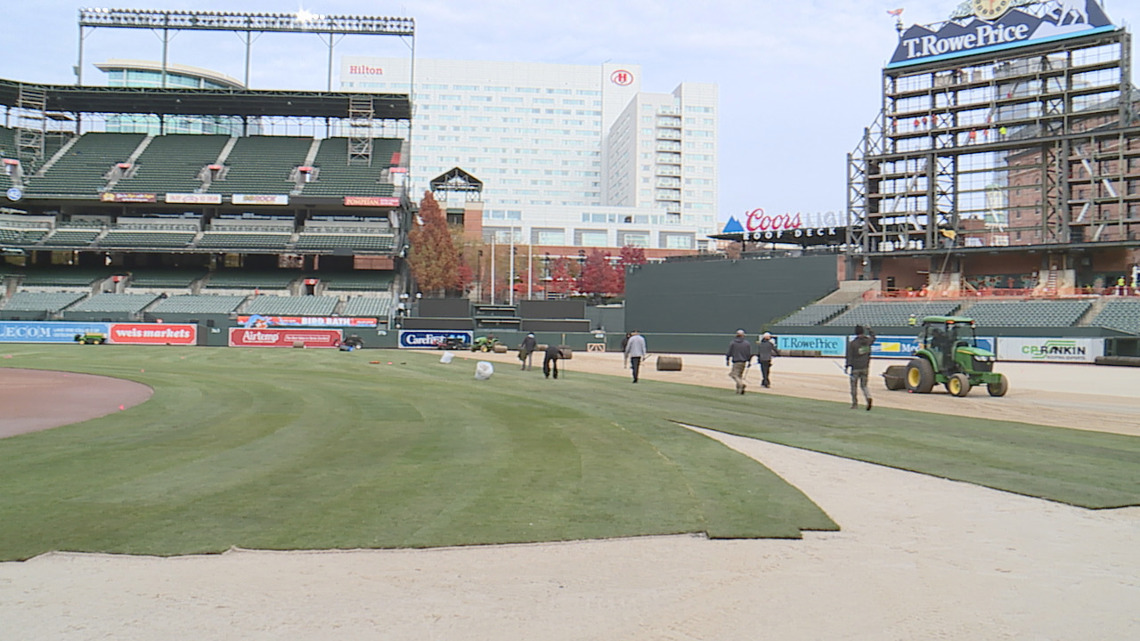
The Baltimore Orioles replaced the playing surface at Camden Yards in November, installing sod grown on Maryland’s Eastern Shore.
BALTIMORE — Christmas came early for the Baltimore Orioles as they rolled out a new playing surface in mid-November.
Replacing a major league playing surface is no small task, and for those responsible, the process begins long before the first blade of grass touches the dirt.
“A lot of people don’t understand the amount of time that it takes to do this,” said Eddie Moore, owner of Collins Wharf Sod. “This grass was planted about 14 months ago.”
The sod’s journey took it from a family-run farm on the Eastern Shore of Maryland to one of baseball’s most recognizable ballparks.
Brad Bradford, Collins Wharf Sod’s specialty grass supervisor, said the job carries special meaning.
“It’s a special thing to know that the team you really love will have grass that you helped take care of on their field,” Bradford said. “The only teams that I’d have a problem really growing grass for are the Yankees and the Red Sox, but I’d still take care of it well, if they want it.”
For the Orioles, the replacement came sooner than expected. After the Los Angeles Rams used Camden Yards for a week of NFL practices in October, the wear and tear proved too much for a surface designed primarily for baseball.
“If possible, a field can last anywhere from eight to 10 years,” explained Orioles head groundskeeper Nicole Sherry. “We try to maintain it as best we can throughout every season, but this is [new field] number five [while I’ve been here],”
Sherry said the Rams’ visit offered a rare learning opportunity.
“It was really interesting as a turf manager to see the other side of sports,” she said. “I’ve been focused on baseball for my whole career, but to see the impact that football has on turfgrass was really incredible.”
The new grass chosen for Camden Yards carries a reputation of its own. It’s the same variety golf fans saw challenge players at Oakmont Country Club, though trimmed for baseball rather than tournament rough.
“[Oakmont is] using the same grass that we’re sending here to Camden Yards,” Bradford said. “The only thing is they let it grow up to where you can’t hit the ball out of it, and we had this stuff mowed down where you can actually play ball on it. Still the same variety, just different heights.”
Once installed, the work only intensifies. Sherry said the offseason is critical to ensuring the surface is ready when spring arrives.
“We have a lot to a lot of work to do after the fields installed to get that grass and the roots growing for the offseason, and just be ready for the spring when it comes out of dormancy,” explained Sherry.
And after the season starts, the work continues.
“[The grass] can impact play greatly,” she said. “[The team is] out there every single day practicing, and then that’s where we get our eyes on what could we tweak a little bit to make it better for the athletes. We’re pretty keen on what needs to occur for the field to provide a great surface for the players.”
For Moore, returning to Camden Yards carries personal significance.
“It was a childhood dream of mine,” he said. “We got to [provide grass to Camden Yards for] the first time in 2005, and 20 years later, we’re here again.”
Collins Wharf Sod has worked with organizations across professional sports, including major golf venues and several major league teams, but Moore said this project stands apart.
“We’ve been a lot of special places,” he said. “But this definitely ranks up there.”
He credits his team back home for making it possible.
“We’ve got a special team back home,” Moore said. “The people that work with us, they’re amazing. They’re the ones that make this happen.”
For everyone involved, the result is more than just grass. It’s the foundation beneath every pitch, swing and celebration, and one of the best views in baseball, built from the ground up.