
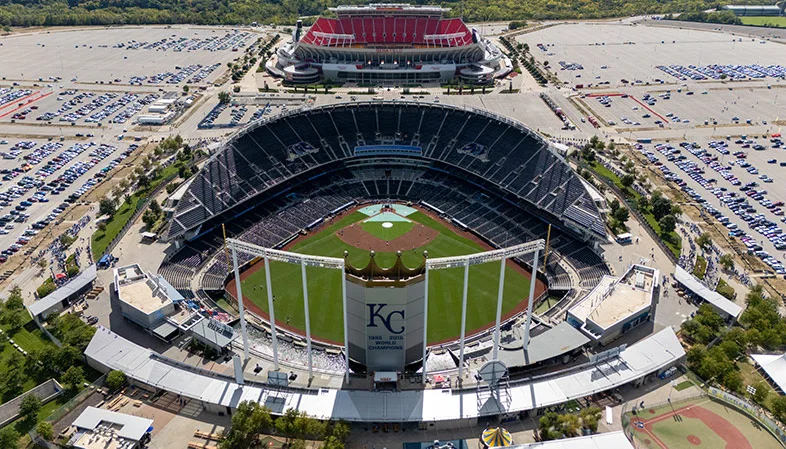
The Kansas City Chiefs’ plans to build a new stadium and entertainment district in Wyandotte County and a new team headquarters and training facility in Olathe became official on Monday with an announcement from state, local and team leaders.
But questions about the Royals and that team’s plans to move — possibly to Overland Park or even elsewhere in Kansas — remain unanswered as a key deadline looms.
In a written statement shared with the Post, Royals Chairman and CEO John Sherman congratulated the Chiefs for the move, but offered no information about his own team’s plans at this juncture.
“On behalf of the Kansas City Royals, I want to wish the Hunt family and the entire Chiefs organization all the best on this important day,” Sherman said in the statement. “Though a few more miles may separate us in the future, let’s continue our work as we build a world-class championship sports legacy for the Kansas City region.”
What are these special stadium incentives?
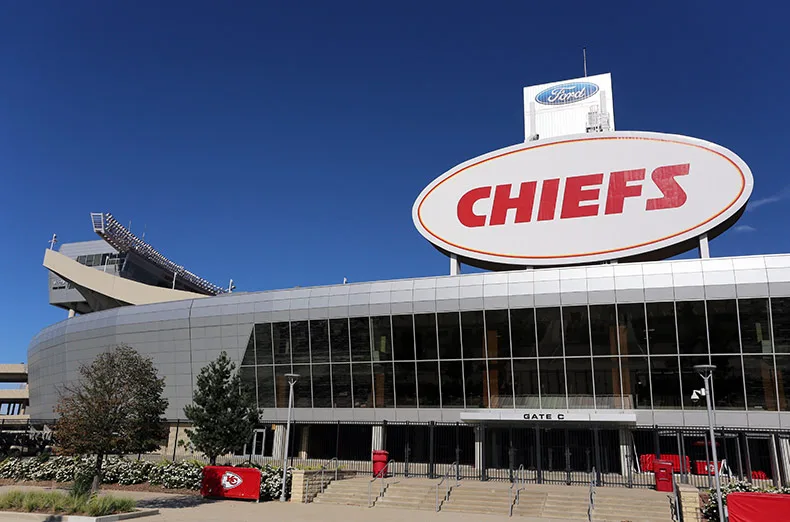 GEHA Field at Arrowhead Stadium in Kansas City, Missouri. Photo credit Shutterstock.
In a move that has proven to reinflame old economic border war tensions, Kansas has allowed a special incentive package to entice one or both professional sports teams to the state. That deal, enshrined in a state law passed during a special legislative session last year, expires in summer 2026.
The special offering would allow STAR bonds to cover up to 70% of the cost of constructing a new professional sports stadium. (STAR bond financing is usually capped at 50% of a project’s costs.) The debt from those bonds and the interest they’d accrue are meant to be repaid over time with sales taxes raised from within the project’s established boundaries.
On Monday, the Legislative Coordinating Council — a group of leaders from both chambers of the Kansas Legislature — unanimously voted to establish a special STAR bond district, setting in motion a multiyear process to build a new stadium.
So far, the Chiefs are the only professional sports team in the Kansas City metro that has submitted a proposal to receive those special stadium incentives.
What happens at this point for the Royals is really in the hands of the baseball team’s ownership and the Legislative Coordinating Council, since that body has indicated it will not consider stadium incentive proposals submitted after Dec. 31, 2025, a fast-approaching deadline.
Last week, Senate President Ty Masterson, currently the chair of the Legislative Coordinating Council, said the Royals were “fully committed to Kansas,” but added that the team’s “location proposal continues to evolve” and that “it will not be finalized or considered this year or during the upcoming legislative session.”
If the Royals decide to relocate to Kansas after that deadline — either to Overland Park or another community on this side of the metro — then the team may have to do so without the special incentive package. That said, they could still be eligible for standard STAR bonds or other incentives.
Aspiria in Overland Park floated as a potential Royals home
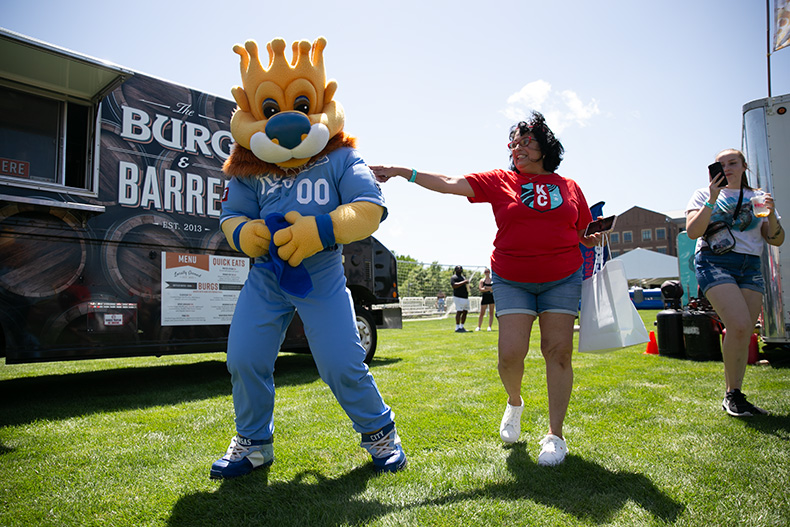 Royals mascot Sluggerrr made an appearance at a World Cup pep rally earlier this summer at the Aspiria campus in Overland Park. Photo credit Leah Wankum.
In the past year or so, the Aspiria site has been identified as one of at least three possible locations for the team’s future ballpark as it plans to vacate Kauffman Stadium when its lease runs out in early 2031.
Aspiria, located at 119th Street and Nall Avenue, is the former world headquarters of the Sprint Corporation, and the telecommunications giant had hopes of developing the campus as a dedicated office park.
Eventually, the 200-acre campus was sold off to a Wichita-based developer with a mixed-use vision for the site, though that’s been slow to materialize and has evolved.
This past spring, an affiliate of the Royals acquired the mortgage on the wider Aspiria campus, seeming to confirm what until that point had largely been speculation about the team’s consideration of the site. (Occidental Management, the developer, still maintains ownership of Aspiria through an affiliated LLC as of Monday morning, according to county land records.)
But pushback from neighbors has grown more intense in the past several weeks. In a recent informal poll of readers, the Post found that roughly 60% of the more than 5,000 respondents did not want to see a new Royals stadium near 119th Street and Nall.
Additionally, T-Mobile said it would relocate its 3,500 employees currently housed at the Aspiria campus if a stadium were to be built at the site, and an association representing Jewish community centers across the country warned that a baseball stadium could have a “devastating” impact on The J.
What are city leaders saying?
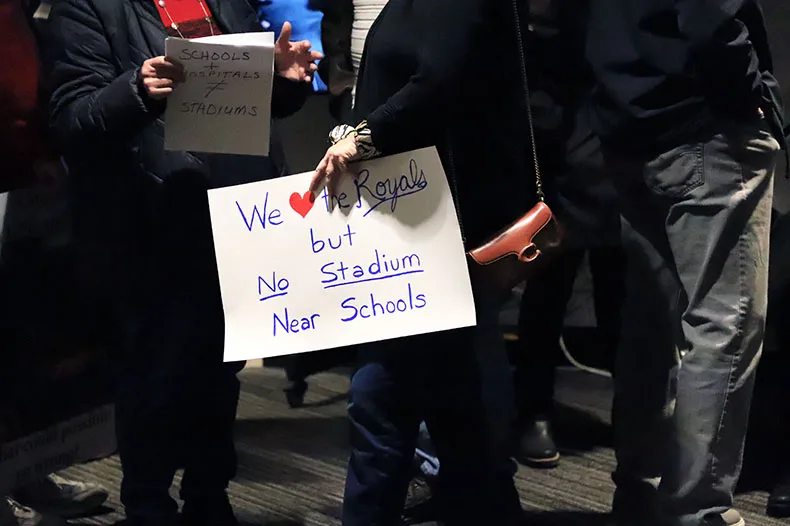 Around two dozen Overland Park and Leawood residents crowded into the lobby of Overland Park City Hall in December to push back on potential plans to put a new Royals stadium at the Aspiria campus. Photo credit Kaylie McLaughlin.
City officials in Overland Park have been mostly mum on the issue aside from offering qualified support for a potential stadium. Until recently, the issue has mostly stayed out of public meetings at city hall, as well.
Last week, Mayor Curt Skoog said that so far, no formal applications for development of a stadium or associated incentives have been submitted to the city. However, he was clear that any that might be submitted would be subject to the same review process as any other development application.
“The city of Overland Park has a robust development review process. All development proposals must go through that process. It will evaluate issues like traffic, parking, pedestrian, access and noise. The community will have opportunities to share their thoughts and concerns,” Skoog said, echoing previous written statements. “Any stadium development must be good for Overland Park, Johnson County and the state of Kansas. I hope we will learn more from the state of Kansas and the team in the near future.”
All that said, the exact approval process will depend largely on the development plan and the type of application.
The Aspiria campus is already zoned for mixed-use development, which means a stadium would likely not require a rezoning, according to the Unified Development Ordinance.
However, a revised preliminary development plan approval would likely still require consideration from the Overland Park Planning Commission and the Overland Park City Council, which could come with a public hearing.
Keep reading: Leawood City Council joins growing chorus of those opposed to Royals stadium in neighboring Overland Park