DL Hall had some injury problems with the Baltimore Orioles, but his stock rose as a top 100 prospect from some elite swing-and-miss pitches. His fastball was given an 80 grade by Baseball America, and it appeared that his command, once an Achilles heel, took large strides in the back half of 2023. The Brewers had every right to dream on his upside as a potential top-of-the-rotation starter.
Alas, this hasn’t materialised. Hall’s fastball has slowed down by a tick on average, but it’s important to remember his time with Baltimore in the big leagues was in a bullpen role. If we break it down to his Triple-A results, when he was prolific in racking up strikeouts, you can see the fastball shape actually improved with the Brewers, seeing slight increases in velocity, spin rates, and a lower vertical approach angle:
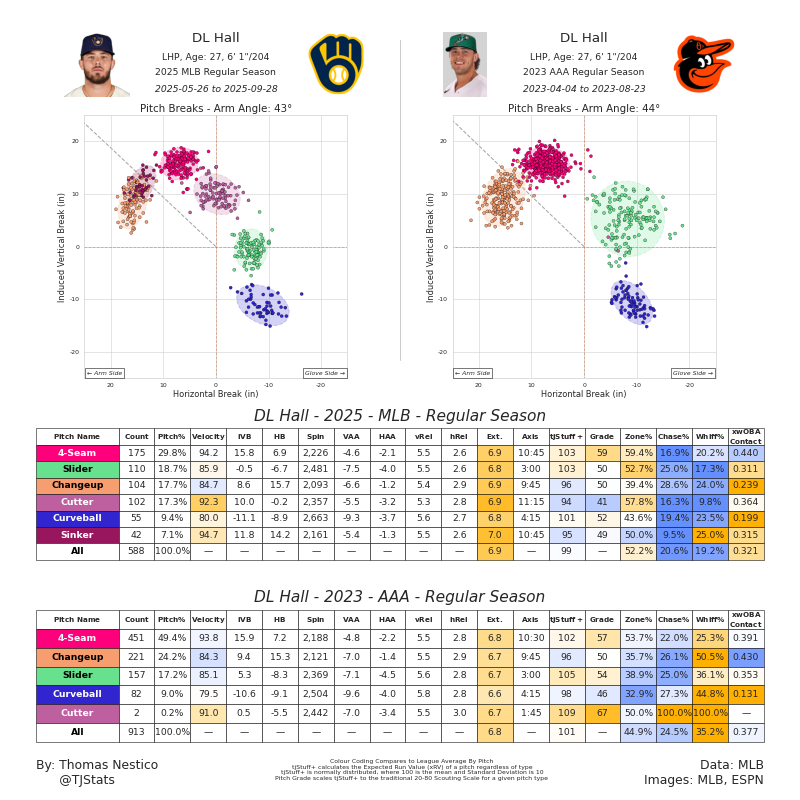
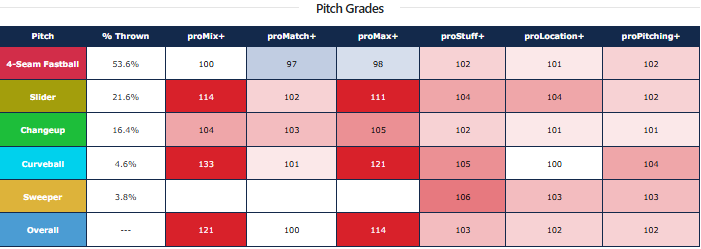
Thomas Nestico’s model gives us a great basis for comparison, but I think Jeremy Maschino’s at Pitch Profiler might give an even better indication as to what’s changed for DL Hall since 2023, and why he’s causing hitters to swing and miss a whole lot less.
To really analyse the difference between DL Hall’s 2023 arsenal and the plethora of strikeouts and ugly swings it induced, compared to the 2025 pitcher we saw for the Brewers, first, we have to deconstruct what made him so effective.
Hall’s Slider Has Lost Its Seam-Related Movement
Below is the breakdown of DL Hall’s pitch movement, separated by Magnus (i.e., spin-related effects) and non-Magnus (seam-oriented movement). I wrote about the subject here earlier this month if you need a recap, however if you’re up to speed, let’s dive in!
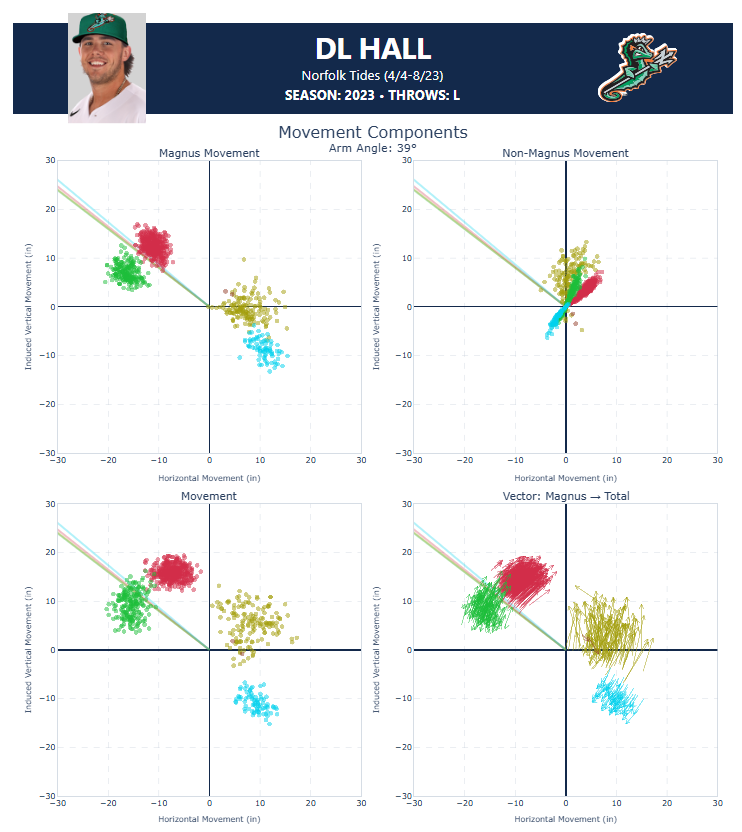
The large benefit of non-magnus movement is that it’s more deceptive to the hitter. They can pick up spin out of a pitcher’s hand, but non-magnus is far more difficult to anticipate. Some pitch types are affected more than others, but it’s interesting to note the amount of additional rise DL Hall achieved through seam orientation in 2023 at the Triple-A level, far more than is common for a slider (seen in yellow).
Let’s contrast that with 2025:
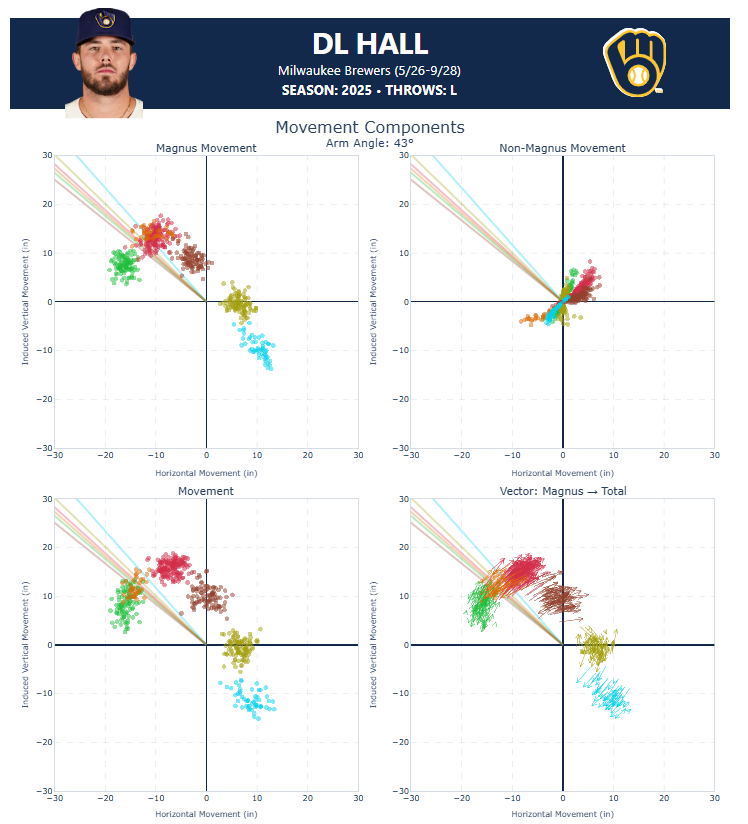
The non-magnus-affected movement has almost disappeared, while the spin-related movement is essentially the same as in 2023. In essence, because of the way the baseball’s seams are interacting with the air resistance, DL Hall is getting less late movement on his slider. It’s affecting his Stuff+ grades, dropping from 107 to 101 per Pitch Profiler, and is getting considerably less swing-and-miss as a result.
Is DL Hall In The Dead Zone?
A “Dead Zone” pitch moves exactly as a hitter expects and finds it easy to square up. Jeremy Maschino attempts to quantify this dead zone to also include the arm angle a pitch is thrown from, which drastically affects what should be considered dead zone. For example, from your average arm angle (say your three-quarter slot), getting 20″ of induced vertical break (IVB) would be considered exceptional; however, if you have a high delivery point like Trevor Megill, that IVB is considered far less of an outlier and thus easier to hit.
Below is Hall’s dynamic dead zone in 2025, with the circles showing his actual movement and the shaded areas showing what a hitter might expect out of the hand:
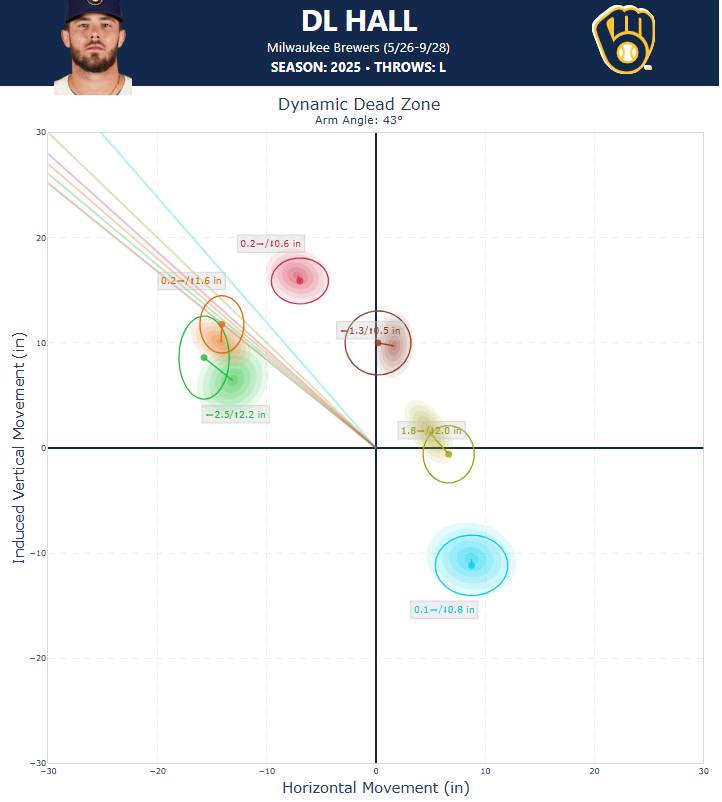
Immediately noticeable is that the fastball (red) and curveball (blue) are moving exactly as expected for his delivery, but he does get some additional movement on the changeup (green) and slider (yellow). You might also note some dispersion in the arm angles from which each of these pitches is thrown (these aren’t large differences, but they are further separated than his almost imperceptible release point in 2023).
These movement patterns are dwarfed by his 2023 iteration:
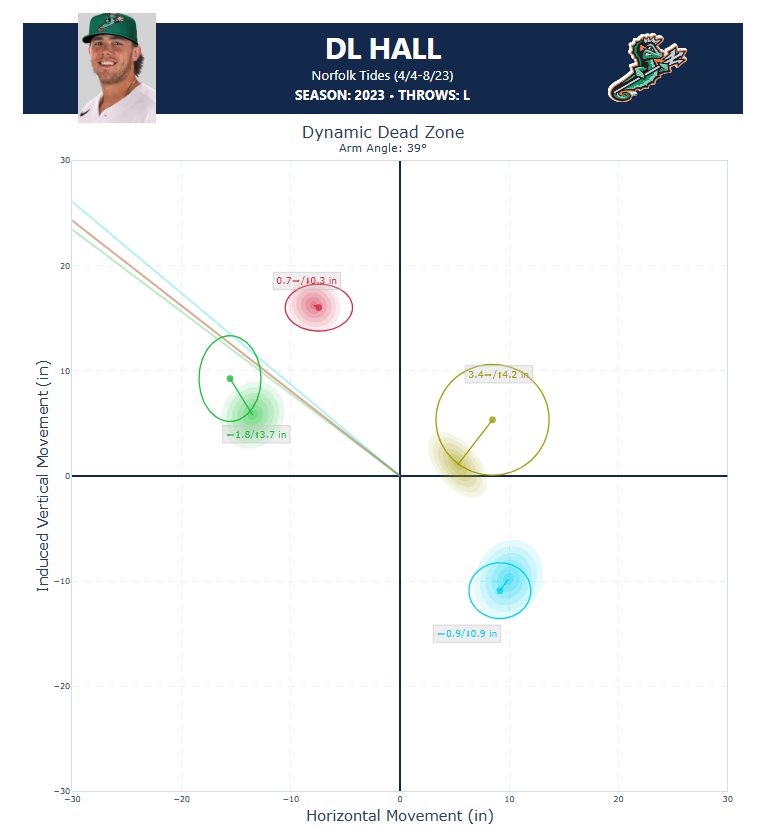
You can see that the curveball and fastball remain quite dead zones in terms of their movement, but the slider and changeup are massively changed. As we discussed earlier, the slider has changed shape completely, going from a pitch that rose over four inches more than expected in 2023 to a pitch that dropped two inches more than expected in 2025. That’s six inches of separation that has impacted his strikeout potential.
Playing for Triple-A Norfolk in 2023, the changeup registered an incredible 50% whiff rate when hitters took a swing, and this rise is part of that. We commonly expect changeups to drop down and away, but in recent seasons, we’ve seen a new type of changeup, such as those by Drew Thorpe of the White Sox and even Tobias Myers in 2024, that rise more. The key here is that changeups are based around deception, and the closer they can mirror a fastball before separation, movement-wise, the more effective they can be.
How Deceptive Is Hall’s Delivery?
With the additional rise, it made Hall’s dead zone fastball and his changeup both play better against live hitters, aided further by how similar his arm angles were in 2023. He averaged a 39° arm angle for his slider, changeup, and fastball in 2023, whereas he now varies from 41 ° to 45 ° in 2025. This isn’t a huge discrepancy, but it is notable for a pitcher who thrives on deception.
Hall’s delivery involves a lot of rotation, almost turning his chest towards second base, meaning the ball springs out of nowhere. He still retains much of the same natural deception in his delivery, and it’s one reason he’s been successful without the swings and misses of yesteryear, managing an xWOBACON of .298 in 2025. He’s not far away from the elite swing and miss artist he showed as a prospect, but that seam-related movement seems to be the key, and it may come from his altered release point.
So, to summarise, DL Halls’ high-end promise in 2023 seems to revolve around two things:
Non-magnus (seam-oriented) movement that helped both his slider and changeup “rise” to miss bats
Deceptive delivery and arm angles
It’s likely the altered arm angles are an effort to improve Hall’s long-term injury outlook. Still, they may have negatively impacted both his ability to unlock the seam-related movement and the deceptiveness in his delivery. It’s an actual risk-reward scenario for a player with multiple long-term injuries in his past, but if the Brewers want to unlock DL Hall as a dominant rotation arm, they may need to take that risk. Hall is a candidate for the shuttle between Triple A and the big leagues this year, having failed to establish himself in 2024/25, so this may be worth it for both parties at this point.
If he can rediscover his release point, and with it his non-magnus movement, there’s an outside chance DL Hall can become more than a swingman in the bullpen. It’s not guaranteed, but there is a chance. Without that deception, he will struggle to establish the fastball and get the swings and misses needed for the next big step in his development.
What do you think of DL Hall’s outlook? Where do you think his strengths and his flaws lie? Let us know your thoughts in the comments below!