
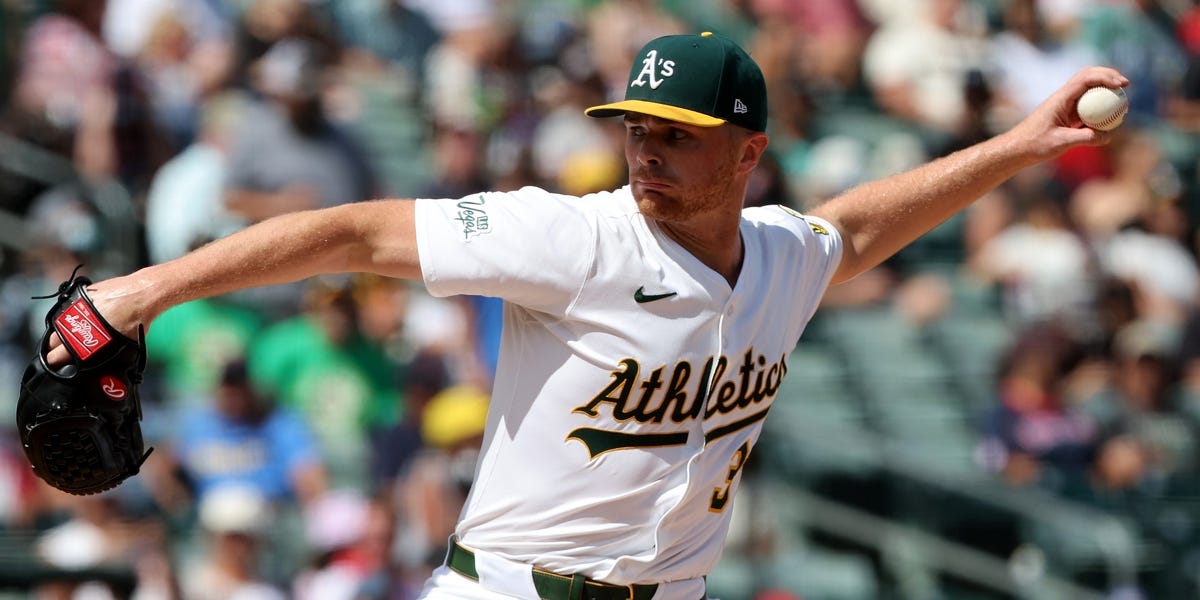
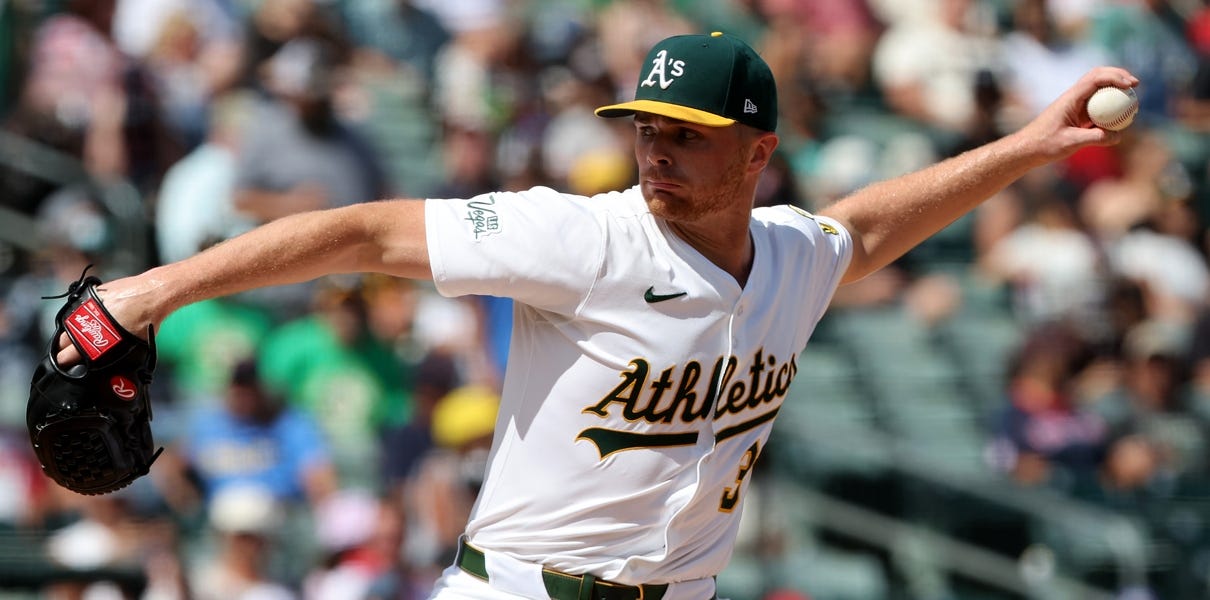
 New White Sox left-hander Sean Newcomb pitching for the Athletics last season. (Getty Images)
The Chicago White Sox added veteran depth to their pitching staff this week, signing left-handed pitcher Sean Newcomb to a one-year, $4.5 million deal.
Newcomb heads to Chicago’s South Side with a legitimate opportunity to start, something that has largely eluded him over the past several seasons. For a White Sox team in transition, the signing represents a low-risk bet on a pitcher whose underlying data finally caught up to his results late last year.
 Ed Hand’s 2025/26 MLB Free Agency Tracker
Newcomb split the 2025 season between the Red Sox and the Athletics, and his performance varied significantly by role.
He opened the season in Boston’s rotation due to injuries to Lucas Giolito and Brayan Bello, making five starts. While the surface numbers were underwhelming — a 4.43 ERA — the peripherals told a more intriguing story.
Newcomb struck out 25.7% of opposing hitters with a 10.5% walk rate, hinting that his raw stuff still played at a starter’s level.
After moving to the bullpen, he posted a stronger 3.38 ERA in seven relief outings, though his strikeout rate dipped. Boston ultimately designated him for assignment, and he was traded to the Athletics — a move that unlocked the a strong 2025 campaign.
 Inside the Willson Contreras Trade: Swing Decisions, Pull Air, and the Red Sox’s Long-Term Plan
With the Athletics, Newcomb worked exclusively out of the bullpen and delivered elite results. Over 51 1/3 innings, he posted a dazzling 1.75 ERA with a 2.69 FIP. The improvement was no fluke: he struck out 24.9% of hitters, cut his walk rate to a career-best 7.0%, and generated ground balls at a 48.9% clip.
His 3.22 SIERA during his time in West Sacramento would have ranked 44th among relievers with at least 50 innings last season. Among that same group, he would have ranked fifth in ERA and 18th in FIP — remarkable territory for a pitcher who had struggled to stay on big-league rosters just a few years earlier.
 Red Sox see bullpen value in Rule 5 pickup Ryan Watson
Newcomb now operates with a true six-pitch arsenal, anchored by two fastballs that serve distinct purposes. His four-seam fastball averaged 93.3 mph with strong ride (15.8 inches of induced vertical break) and solid spin, allowing it to play effectively at the top of the zone. Meanwhile, his sinker — thrown at 92.5 mph with heavy arm-side run (-17.2 inches of horizontal break) — became his primary ground-ball weapon, especially against left-handed hitters, where it accounted for roughly 40% of his usage.
The separation between pitches is where Newcomb’s profile truly changed.
His slurve, sitting around 82 mph with massive sweep (over 16 inches of horizontal movement), emerged as his primary chase pitch, particularly versus right-handers. He paired that with a high-spin curveball that drops nearly 15 inches vertically, giving hitters a completely different breaking look despite similar velocity bands.
To bridge the gap between fastballs and breakers, Newcomb leaned more heavily on a cutter just under 90 mph, a pitch with minimal horizontal movement that helped him avoid predictable sequencing. A sparsely used changeup rounded out the mix, mainly as a show-me pitch against right-handed hitters.
Earlier in his career, Newcomb’s pitches often blended together, contributing to deep counts and chronic command issues. With the Athletics, those movement bands became clearly defined — and the results followed. His drastically improved walk rate was one of the biggest drivers of his resurgence.
 Red Sox’ Kristian Campbell wraps up Winter Ball while refining his skill set for 2026
Now 32, Newcomb was originally a first-round pick by the Los Angeles Angels in 2012 and spent years as a consensus top-100 prospect. He debuted with the Atlanta Braves in 2017 and spent his first two seasons as a rotation regular, posting a respectable 4.06 ERA (103 ERA+) with a 4.16 FIP — the profile of a back-end starter.
Command issues soon derailed that trajectory. A 2019 demotion led to a permanent bullpen shift, and after continued struggles, Atlanta designated him for assignment. Stints with the Chicago Cubs and the Athletics followed, but between 2021 and 2023 he posted a brutal 6.61 ERA in 47 2/3 innings, largely due to a massive 15.0% walk rate.
 The Chicken Farmer: How Blake Wehunt’s Farm-Raised Grit Shaped a Red Sox Pitching Prospect
The White Sox aren’t paying Sean Newcomb to be a frontline starter. They’re betting that the pitcher who showed up with the Athletics — someone with cleaner mechanics, clearer pitch separation, and improved command — is closer to the truth than the version plagued by walks earlier in his career.
If those gains hold, Chicago could uncover either a viable back-end starter or a multi-inning left-handed weapon at a modest cost. For a team searching for upside plays with limited downside, Newcomb represents a calculated gamble — one grounded not just in results, but in data that finally supports them.