
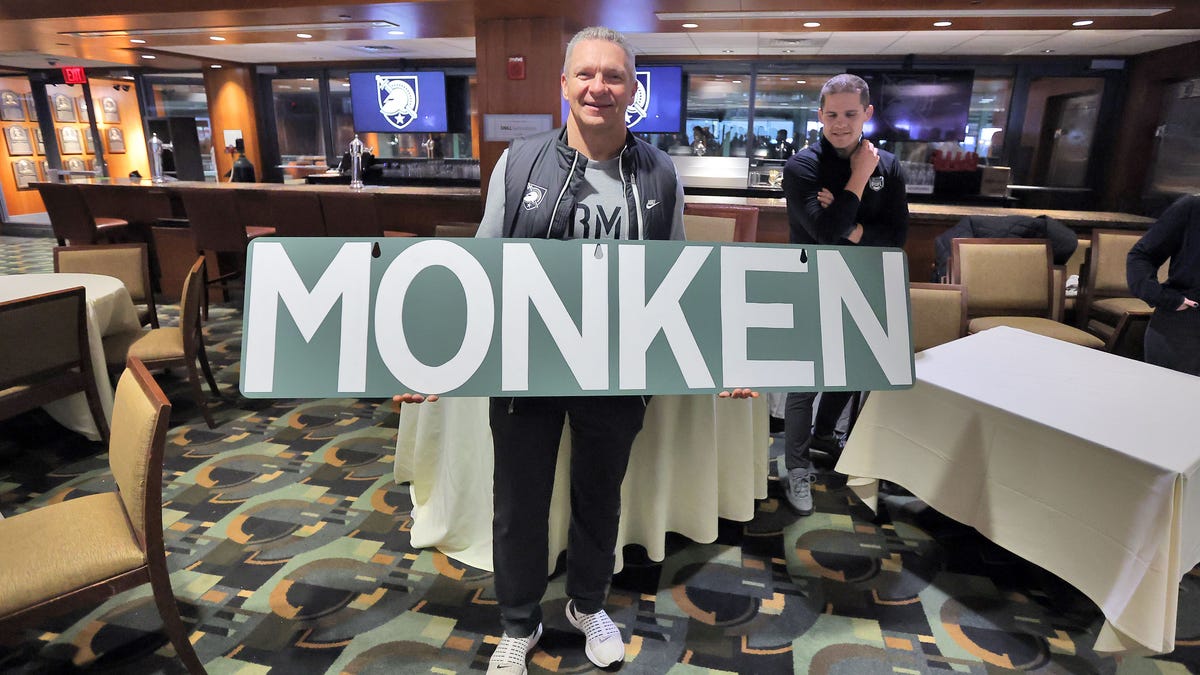
Army football head coach Jeff Monken is an avowed Chicago Cubs fan and considers Wrigley Field one of the most iconic baseball parks.
So you can imagine his excitement upon visiting another crown jewel, Boston’s Fenway Park, for the first time this week, ahead of Army’s matchup with Connecticut in the Fenway Bowl.
The Black Knights returned from a brief holiday to gather in Boston on Tuesday, and that evening the team received a special tour of Fenway Park, from the entry gates to the Red Sox clubhouse, taking cuts in batting cages, throwing the baseball in the outfield and touring inside the Green Monster scoreboard.
“What a great thrill for us,” Monken said during a special Friday edition of the This Week in Army Football radio show, ahead of the bowl game.
“Going to Fenway Park a couple days ago was crazy, especially being from Massachusetts and growing up watching the Sox, the Celtics, the Pats, all that,” said Army sophomore Grayson Baker, who grew up in Worcester. “It was a crazy experience, to go up on the Green Monster, walk around Fenway, throwing the ball with my buddies, my teammates. It’s been an unbelievable experience.”
Surely, many of the Army players may remember the recent 2013 and 2018 Red Sox World Championship teams, but the 58-year-old Monken is mindful of the great Red Sox legacy — certainly mirroring his Cubs — and all of the Boston greats.
“As I was coming into the stadium,” Monken said, “and then going up the escalator and seeing the Hall of Fame, the names of the players. And many of these were before I was a young boy and watching baseball, but so many of them, the names of guys I saw growing up. It was just awesome, just to jog my memory and to go down memory lane, looking at all those names and the pictures and the Hall of Fame plaque.”
Monken was permitted to sign the inside of the iconic Fenway Park scoreboard and in typical fashion he penned, “BEAT navy! Jeff Monken.” The coach also received a “MONKEN” placard painted in the same fashion as the city placards identifying opponents on the Red Sox scoreboard, leaving him wondering where he was going to place that in his office.
“I was thinking, ‘Gosh, this is just awesome,”’ Monken said. “The old stadiums — I have a great appreciation for, obviously, Michie Stadium, a great historic stadium — but going to Wrigley Field growing up and when I was a kid … the old Comiskey Park was still open. … I’m glad to see Fenway Park and Wrigley Field and places like that are still hanging on, and I hope they’ll always be there.”
Monken praised the City of Boston as a great sports town and thanked the bowl committee for being so welcoming to his team.
“They have embraced us coming here,” Monken said, still giddy over the baseball-like reception at Fenway. “I mean, they had hot dogs and Cracker Jack and popcorn and hot chocolate for the guys. Each guy got a baseball bat — this is maybe the most unique bowl gift that we’ve ever gotten. It’s a baseball bat engraved with their name and the Fenway Bowl, which is a really great souvenir for our players.
“But to be able to tour that iconic stadium and see the Green Monster, get out there in the outfield, guys hitting batting practice … very unique. So it’s been a lot of fun and hopefully our guys have enjoyed it and just the time together, they seem to be.”
“We talk about creating moments and special experiences,” said Army athletic director Tom Theodorakis, also on the radio show. “To take in the history, take in these types of unique experiences, we’re just so fortunate. I just can’t wait for it. That’s just exciting. We’re living the dream … I’m living the dream.”
Fenway Park opened in April 1912 and has been the home of the Boston Red Sox since then, plus the Boston Braves in 1914-15. Football has been played at Fenway for decades, including the old AFL Boston Patriots from 1963-68, plus a multitude of high school and collegiate games. This will be the fourth Fenway Bowl.
Wrigley Field in Chicago opened in April 1914, and the Cubs became tenants a year later. The original Comiskey Park was used from 1910-90, and demolished in 1991. Michie Stadium has been the home for Army football since 1924, and will debut a new east side stands, concourse, luxury suites and offices next season.
kmcmillan@th-record.com
X / Twitter: @KenMcMillanTHR