
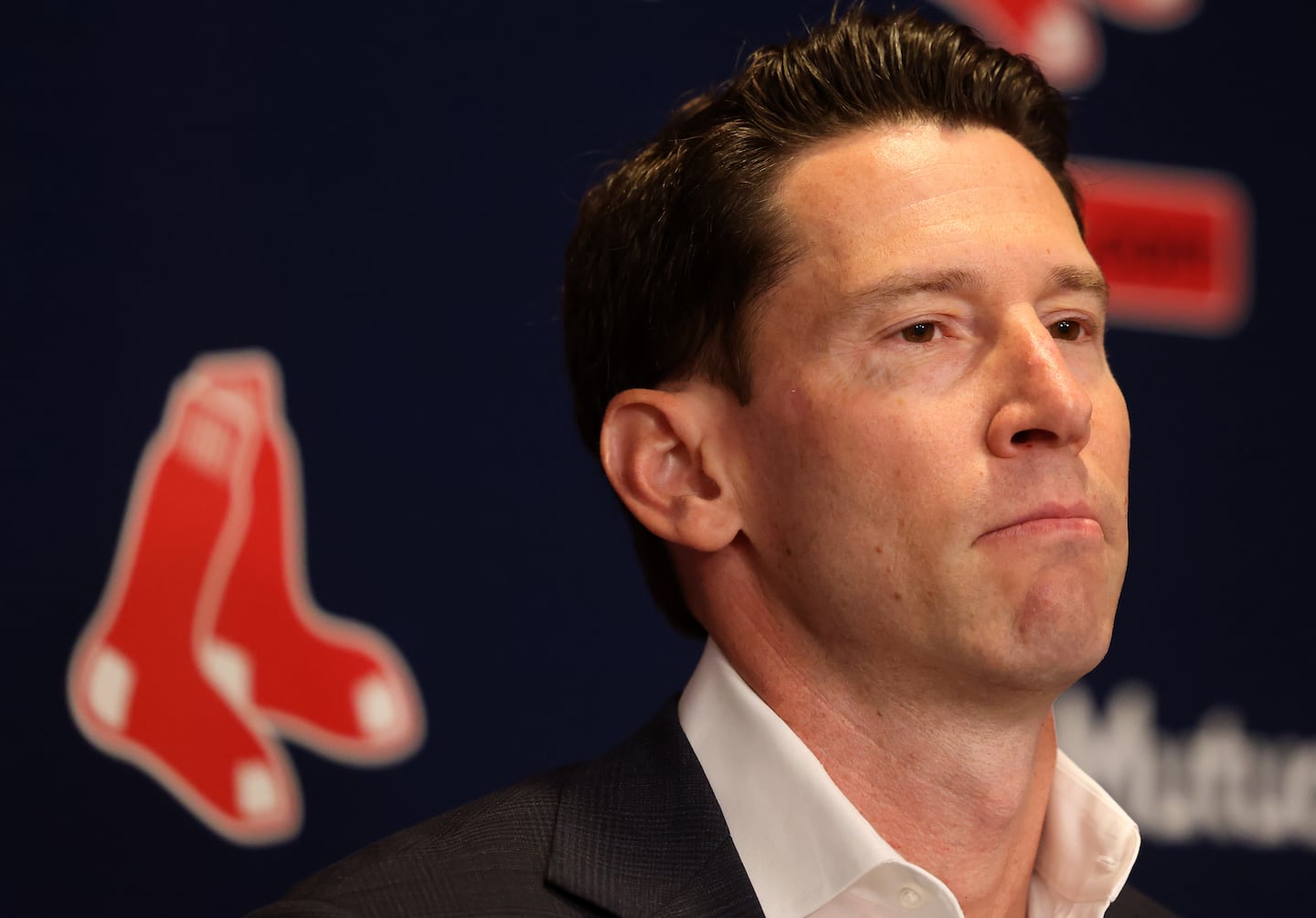
“Maybe we’re waiting for the 50th [to celebrate] — the golden trade threshold,” Breslow joked.
Since he was hired as Bloom’s successor, Breslow has authored a Seussian smorgasbord of swaps — big trades, little trades, Red Sox for White Sox trades, prospect-for-prospect trades, veteran-for-prospect trades, prospect-for-veteran trades, DFA trades. He’s traded away stars (Chris Sale, Rafael Devers), added stars (Garrett Crochet), and traded for players only to deal them again (Richard Fitts, Vaughn Grissom, Quinn Priester, James Tibbs III, and Fajardo).
Get Starting Point
A guide through the most important stories of the morning, delivered Monday through Friday.
Since November 2023, the Sox have made 44 trades involving players on the big league 40-man roster, second-most by any club in that time. The offseason started less than two months ago, yet the Red Sox already have made 10 trades — more than they made in the majority of 12-month spans from 2016-22 — without a single major league free agent signing.
Why the ongoing swap meet?
“It can be an effective [strategy] that leverages your ability to learn as much as you possibly can about your own players and different perspectives — scouting perspectives, coaching perspectives, analytical perspectives — about identifying players that, for one reason or another, may be valued more by our organization than others,” said Breslow.
“It could be that two teams value players very similarly, and they’re just at different stages … and one is trying to compete now, and one maybe has more of an eye toward the future. Or it could be positional fit and differences where a certain player, based on their profile or role, just fits a need that we have on our roster. And maybe we value a player more than another organization because we think we can continue to develop them, or we think that there’s some underlying indicator that his future performance is bound to improve. Any of those things can allow you to line up.”
Of course, it’s also worth noting that trades can serve as an alternative to the risks of free agency. Whereas top free agents usually require long-term deals with a likelihood of cratering performance at the back end of a deal, trades can allow teams to acquire players either for more of their prime seasons or limit the exposure to long-term risk.
Perhaps for that reason, trades have been a frequent avenue of team-building for teams with smaller budgets. The Rays (49) have made the most trades involving big leaguers since the start of Breslow’s tenure; the Orioles (39) rank third.
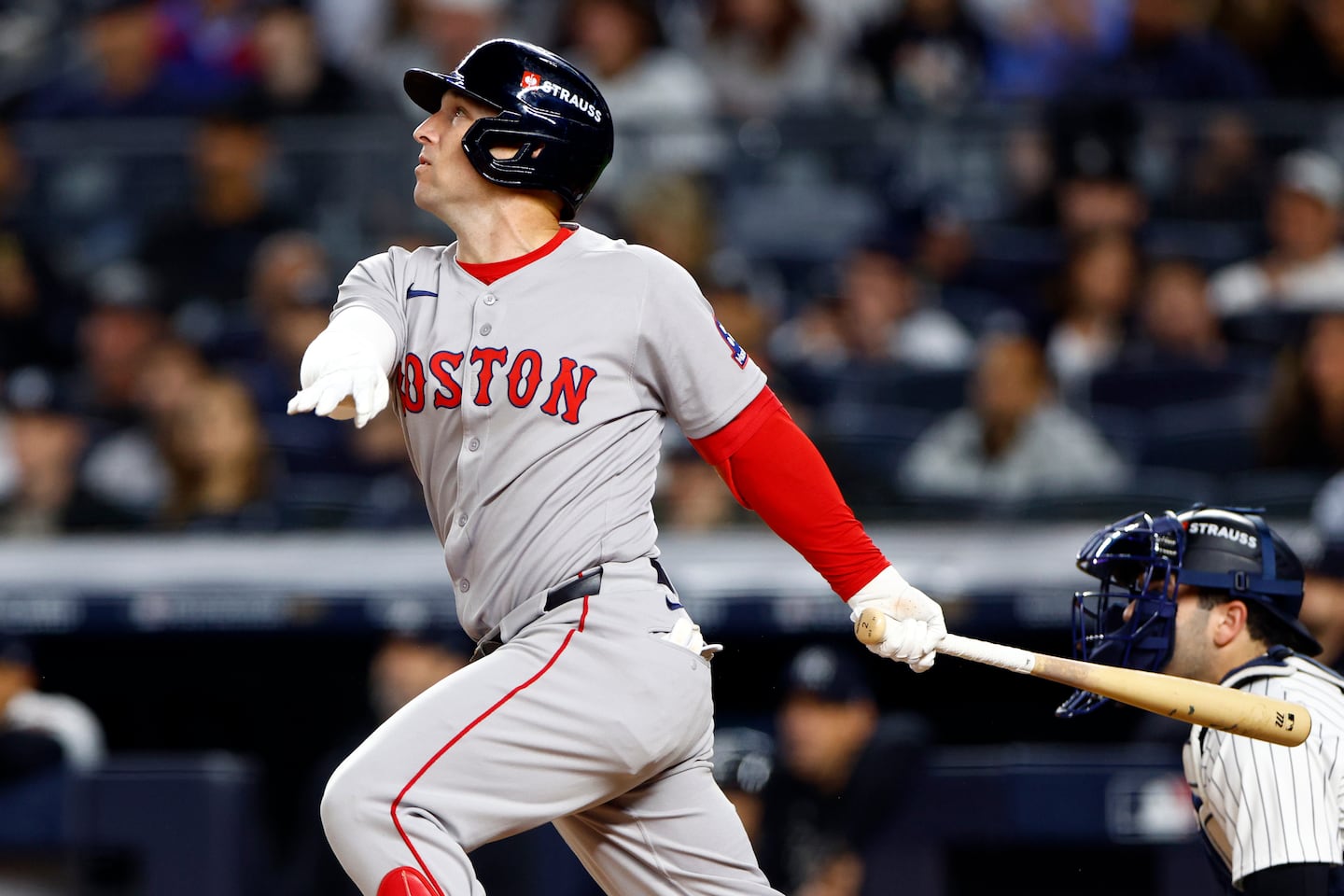 The lone major free agent signing made by Craig Breslow has been the deal for third baseman Alex Bregman, who has already decided to opt out of it and become a free agent again. Danielle Parhizkaran/Globe Staff
In that vein, any discussion of the frequency of trades by the Red Sox would be incomplete without mention of the fact that they’ve signed just one free agent — Alex Bregman — to a deal of more than two years under Breslow. And even the Bregman deal came with the caveat that he was always likely to opt out of it after one year.
That said, trades aren’t just a small-market game. Atlanta (36) and the Dodgers (35) round out the top-five rankings of the most active traders in baseball over the last 26 months. Both teams have made a habit of trading for talented players and then signing those players to long-term deals. Crochet offers an example where the Sox did the same, in franchise-altering fashion.
The deal sending Sale (and a $17 million subsidy) to Atlanta for Grissom, made when Breslow was less than two months into his job, is undoubtedly his worst deal. Does he spend time re-examining what happened?
“You have to,” he said. “You have to take stock of the information that you had at the time that you made the decision and where that may have been inaccurate or incomplete, so that you avoid making similar decisions driven by similar circumstances in the future.
“That’s not to say that Vaughn won’t go on and have a successful major league career,” he added. “Just, for the period that he was here … it didn’t work, and we have to recognize that. We have to understand what the information was that we had in front of us at the time, and we need to work through what drove that decision and where we could potentially get more information in the future and allow us to make better decisions.”
Obviously, that early swing-and-miss as a dealer did not deter Breslow from future moves.
“You have to avoid allowing a decision that didn’t work out exactly as you thought it would from becoming a deterrent to making additional trades in the future,” he said. “Otherwise, you’re narrowing the paths to improving your roster.”
That said, if the Sox want to avoid narrowing their paths, they’ll also need to play in the free agent pool — a reality of which Breslow is aware.
“Our goals are to improve our 2026 team as much as we possibly can,” said Breslow. “Both [trades and free agent signings] offer ways to do that, and we need to be willing to pursue each.”
THE OTHER SOX
Looks brighter on Chicago’s South Side
Yes, the White Sox endured a third consecutive 100-loss season in 2025, going 60-102. But the outlook for the South Siders seems considerably more promising than it has in some time.
The team’s signing of Japanese slugger Munetaka Murakami — who cleared the fences 56 times in 2022 — to a two-year, $34 million deal comes with plenty of uncertainty. Murakami is limited to first base, and there are significant concerns about his inability to handle MLB velocity. His 29 percent strikeout rate was the sixth-highest in NPB in 2025.
Still, he not only brings 30-plus homer power potential to the White Sox, but also an element of stardom — with a sizable dedicated media contingent to cover his every move — that has long been absent from the team. With Murakami turning 26 in February, the slugger adds to an emerging White Sox core that has considerable offensive potential.
Already, the 2025 season had represented a cornerstone for the team’s young players. Shortstop Colson Montgomery exploded for 21 homers in 71 games and finished fifth in AL Rookie of the Year voting. Meanwhile, while the Red Sox got everything they hoped for in acquiring Crochet from the White Sox in December 2024, the same can be said about their return, headlined by catcher Kyle Teel (.273/.375/.411 in 78 games). Infielder Chase Meidroth had a solid big league debut in 2025 (.253/.329/.320), outfielder Braden Montgomery is now the top-ranked White Sox prospect, and righthander Wikelman Gonzalez showed promise out of the bullpen.
“We got some really core pieces here in that return that are going to be part of a bright future,” said White Sox general manager Chris Getz. “We obviously felt really good about those players, and that’s why we did that deal. But about a year later, you look at it and you’re like, ‘Wow, maybe we did even a little bit better than we than we originally thought.’ ”
The White Sox, whose 3.99 runs per game in 2025 ranked 27th in MLB, are still building. They’ll enter the year with major roster holes.
But with Chicago in possession of the No. 1 pick in the 2026 draft, and Teel, Murakami, and the two Montgomerys all in the organization, there’s a path back to relevance for a team that’s gone 20 years without winning a playoff round — the longest drought by any AL team.
As for the other Far East players next in line to sign, the posting window for NPB star righthander Tatsuya Imai closes Jan. 2, while corner infielder Kozuma Okamoto must pick a team by Jan. 4.
STEEL CITY REVIVAL
Pirates suddenly full of promise
Another long-beleaguered, small-market franchise, the Pirates, has also shown a willingness to pay for power. Pittsburgh — which earlier in December picked up outfielder Jhostynxon Garcia from the Red Sox in the Johan Oviedo deal — agreed to a two-year, $29 million deal with first basemean/outfielder Ryan O’Hearn.
Assuming O’Hearn passes his physical, he’ll become the first free agent to reach a multi-year deal with the Pirates since starter Ivan Nova struck a three-year deal in Dec. 2016. Yet the bigger shift in the team’s outlook comes from a recent draftee, 19-year-old shortstop/center fielder Konnor Griffin.
In his first full pro season in 2025, Griffin — the No. 9 overall pick in the 2024 draft — raced across three levels, finishing the year in Double A, while hitting .333/.415/.527 with 21 homers and 65 steals, becoming the first drafted teenager ever to hit at least 20 homers with 40-plus steals.
“Special, special talent and even better kid,” said former Red Sox coach Andy Fox, Griffin’s Double A manager over the final month of the year. “I won’t be surprised if he’s in the big leagues next year, early.”
TIME TO ADJUST
Is Suárez’s late power drain a simple fix?
While teams crave power, the market for Eugenio Suárez, coming off a 49-homer season, is still taking shape. One reason: After he posted a .248/.320/.576 line with the Diamondbacks through July 30, the third baseman’s offense cratered (.189/.255/.428) after a trade to Seattle.
But there’s at least one potential contributor to his struggles that seems correctable: His batting stance. In the middle of the season, Suárez moved up a couple inches in the box and also started employing a more open stance.
Those changes may have cost him time that made him late on fastballs, as pitchers dominated him with heat down the stretch, particularly after he was dealt to the Mariners. Any team that signs him will be curious whether Suárez can come closer to his Diamondbacks form with a small nudge deeper in the box.
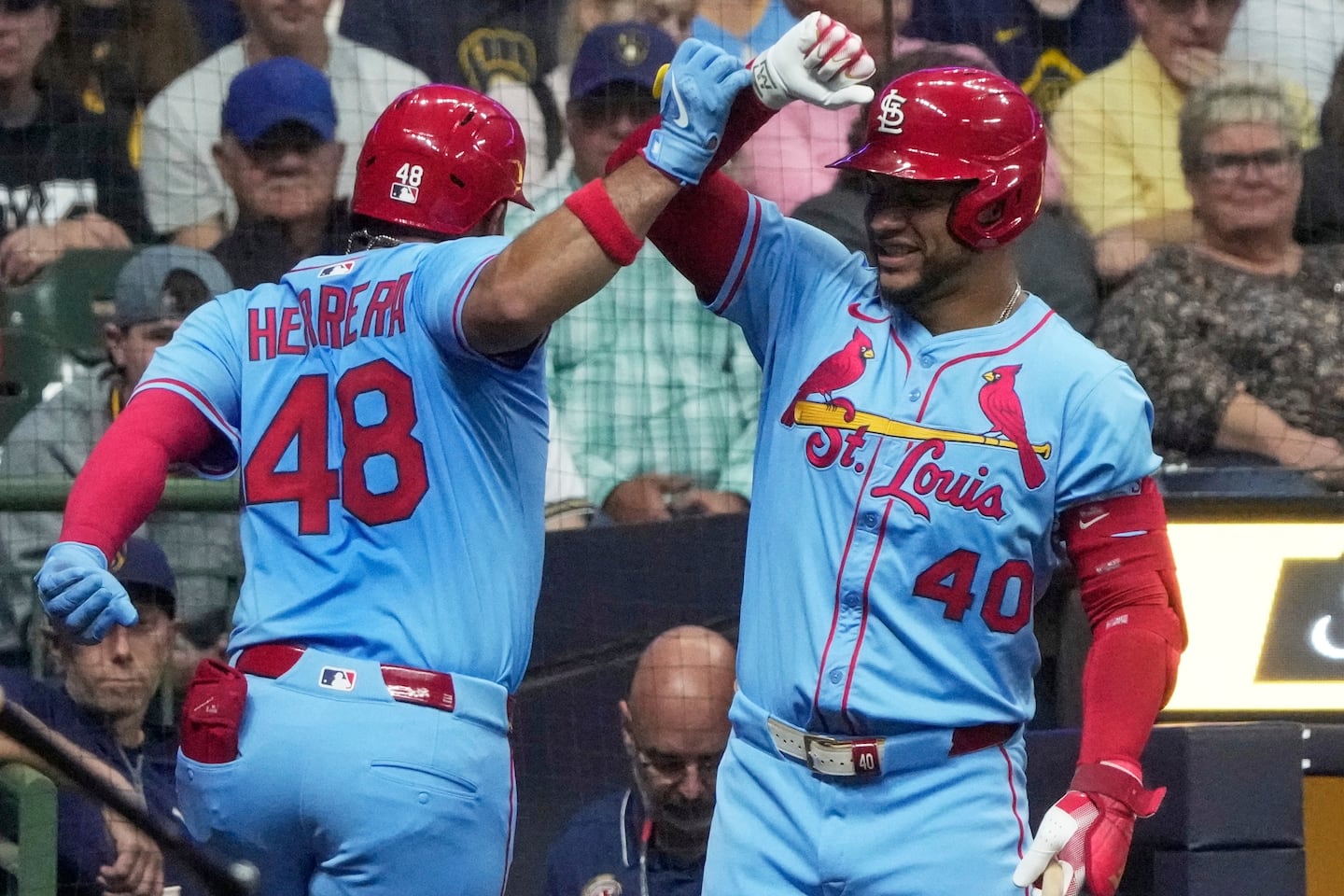 In his three seasons as a Cardinal, Willson Contreras (right) did most of his slugging on the road than at pitcher-friendly Busch Stadium. Morry Gash/Associated Press
MONSTER SIGNING
Will Fenway be friendly for Contreras?
While the 2025 statistical profile for Willson Contreras — a .257/.344/.447 slash line with 20 homers — doesn’t jump off the page, it’s not hard to wonder why the Red Sox were drawn to him as a middle-of-the-order contributor.
“Obviously, the batted-ball profile is going to be much more favorable for him in our park,” said Sox hitting coach Pete Fatse.
In three years with the Cardinals, Contreras hit .253/.355/.424 with 21 homers at Busch Stadium. On the road, he hit .268/.361/.491 with 34 homers. He put up better numbers on the road than at home in all three seasons he spent in St. Louis.
Meanwhile, recent adjustments he’s made offer promise for his fit in Boston. In 2025, Contreras started pulling the ball in the air with more frequency than at any other point in his career — a skill that is rarely rewarded in St. Louis but produces fireworks at Fenway Park.
Another righthanded hitter who went from the Cardinals to the Sox gives some indication of how a change of venue can result in a change of fortunes. Tyler O’Neill has averaged one extra-base hit for every 11.5 plate appearances in his career at Busch Stadium and one homer for every 20.2 plate appearances. At Fenway, he’s averaged one extra-base hit for every 8.6 plate appearances, while homering once every 14.2 plate appearances.
Other Red Sox notes:
▪ Rob Refsnyder, who signed a one-year, $6.25 million deal with the Mariners last week, had a remarkable mid-career emergence with the Red Sox. Signed to a minor league deal with no fanfare in 2022, the outfielder emerged as one of the most consistent Sox hitters over four seasons, hitting .276/.364/.440, including a .312/.407/.516 mark against lefties.
Yet his clubhouse impact expanded far beyond that of a traditional role player. He was part of the “Baby Bombers” Yankees youth movement (Refsnyder, Aaron Judge, Gary Sánchez, Gleyber Torres, and others) a decade ago, then a journeyman who’d assimilated plenty of player development lessons while shuttling between Triple A and the big leagues with six organizations between his time with the Yankees and Sox.
Those experiences allowed Refsnyder — who made no secret of his enjoyment of and gratitude for the Boston baseball experience — to carry clubhouse influence that far outstripped a typical role player.
▪ With Contreras in the fold, the Sox continue to pursue another infield bat. According to major league sources, the team’s primary targets remain fairly consistent: Free agent infielders Alex Bregman and Bo Bichette, as well as trade candidates Ketel Marte (Diamondbacks), Isaac Paredes (Astros), and Brandon Donovan (Cardinals). Aside from Marte, who is a switch-hitter, all are righthanded. There are additional alternatives on both the trade and free agent markets, but to date, that group of five occupies the front-burner pursuits.
▪ Breslow expressed openness to giving both outfielder Wilyer Abreu and infielder Marcelo Mayer a chance to prove they can be true everyday players, rather than platoon options who sit against lefties. If so, the Sox may become part of a trend.
There are signs that MLB as a whole is becoming less platoon-centric than it had been in recent years. In 2023, just 46 lefthanded hitters got 100 plate appearances against southpaw pitchers. In 2024, that number went up to 55, before reaching 61 in 2025 — the highest number since 2019.
▪ Ex-Sox prospect Bobby Dalbec signed with the Yomiuri Giants for the 2026 season, while Michael Chavis — who finished last year in NPB — signed a minor league deal with the Reds. Their inability to secure places in MLB underscores how thin the Red Sox system became behind the championship core of 2018.
Entering 2019, Dalbec and Chavis were ranked the top two prospects in the system. Of the team’s top 10 prospects entering that season, only two — Triston Casas and Tanner Houck — have forged more than 1.0 WAR of career value (in the calculations of FanGraphs).
▪ Baseball America’s annual Prospect Handbook has the Red Sox system ranked as the 14th best in the sport entering 2026.
The publication pegged Sox lefthander Payton Tolle as the second-best lefthanded pitching prospect in baseball, behind only the Marlins’ Thomas White, the Phillips Andover alum. The 21-year-old who reached Triple A last year led minor league lefty starters with a 39 percent strikeout rate. Tolle (37 percent) ranked second.
▪ Lefthander Jovani Morán, a 28-year-old on the Red Sox’ 40-man roster who is out of options, has impressed while pitching winter ball in Puerto Rico. Now more than two years removed from Tommy John surgery, he’s showing an uptick in velocity compared to the 2025 season, working at 93-95 m.p.h. with his four-seamer. His changeup, which produced whiff rates above 50 percent in both Triple A and the big leagues, has continued to get swings and misses. Through 10 winter appearances, he’d allowed one run in nine innings while striking out 12.
“The stuff is there,” said Sox bench coach Ramón Vázquez, who is managing Morán in Puerto Rico. “He can be a guy that can help us [in the big leagues], definitely.”
Happy birthday, Rick Porcello, who turned 37 on Saturday. Over his five-year stretch with the Sox, the righthander won a World Series, took home a Cy Young Award, and logged 964 innings — fifth most by any Sox pitcher this century, and the most since Tim Wakefield’s retirement after the 2011 season … And happy trails to Joe Kelly, who colorfully pronounced that he’s done pitching — he refused to invoke the word “retirement,” suggesting the application of the term to athletes is disrespectful to those who have real jobs — after 13 big league seasons on the “Baseball Isn’t Boring” podcast. Kelly’s five-year run in Boston included postseason brilliance. In 17 playoff games from 2016-18, he had a 0.51 ERA — the lowest ever by a Sox pitcher with at least five postseason appearances.
Alex Speier can be reached at alex.speier@globe.com. Follow him @alexspeier.