
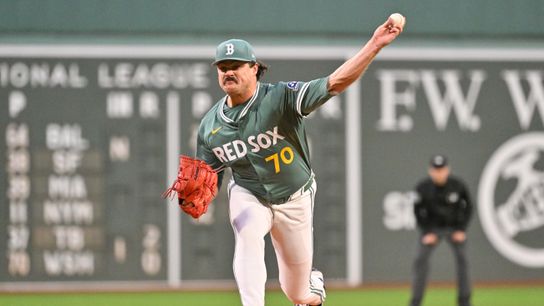
Fenway Park has a way of compressing time. One moment it’s the present, the next it’s history — then ghosts, and occasionally pennants. It’s a proving ground, too. A place where the next impact Red Sox player has a chance to earn something rarer than a stat line: the admiration of a rabid fanbase that knows exactly what this ballpark demands.
With snow on the ground and New England’s attention locked on the Patriots, it’s a good time to rewind to warmer days — when Fenway was buzzing, and the Red Sox were still playing meaningful August baseball.
On a late-August night in Boston, Payton Tolle stepped onto that stage for the first time, making his Major League debut for the Red Sox against the Pirates — opposite one of baseball’s most electric young arms in Paul Skenes.
Tolle’s arrival came just 13 months after he was drafted, a rapid ascent that made his debut must-see television for a fanbase that obsesses over prospects, timelines, and rankings. This wasn’t just another call-up. It was a debut fans cared about — one that carried weight well beyond the mound.
And Tolle didn’t shrink from it.
In fact, he dazzled, at times overshadowing Skenes’ Fenway debut, while carrying something heavier than nerves. This wasn’t just a first big-league start. It was a moment shaped by family, loss, and the enormity of the park itself.
“My goodness. Chills. A lot of chills,” Tolle said afterward. “I came off the mound after the first inning and I couldn’t feel my feet. It was the greatest experience of my life. I’ll look back on this day for a long time.”
Fenway does that. It doesn’t just test your stuff — it etches memories. Tolle created a memory he will be able to carry with him for the rest of his playing days and life.
The final score didn’t fall Boston’s way. Pittsburgh left with a 4–2 win. But the result barely told the story.
Tolle went 5 1/3 innings, faced 21 batters, allowed three hits and two earned runs, struck out eight, walked two, and generated 14 whiffs. He threw strikes at a 63.1 percent clip, challenged hitters early, and never looked overwhelmed by the moment.
Across the diamond, Skenes was everything the hype promised. But when Roman Anthony turned on a Skenes fastball and sent it flying, Fenway reminded everyone that even the hardest throwers have to answer to this ballpark. The night became a showcase of baseball’s next wave — and Tolle looked like he belonged in the same frame as a future National League Cy Young winner.
Working with a lead, Tolle continued to impress on the mound, and high above the field sat Tolle’s father, Chad, watching a moment they had both carried for years.
“Every time I know he’s there, I try to give him an ‘I love you,’” Tolle said. “I was trying to find him. He was up there somewhere.”
Fenway was holding space for someone else, too.
Two months before the Red Sox drafted him, Tolle’s mother, Jina, died after a battle with cancer. In a quiet, powerful gesture, the organization left an empty seat in her memory — roses placed where she would have sat.
The moment stayed with Tolle.
“But the other side of that was looking up and hearing my mom still saying, ‘You’re still a hack,’” Tolle said. “I was very pleased with it. I competed and had fun.”
That line — competed and had fun — captured the night better than any stat line could. On a night when one of the organization’s top pitching prospect debuted against arguably baseball’s best young arm in baseball, Tolle showed up — with his focus split between the Pirates’ lineup and his mother’s memory.
And that night in Boston wasn’t a fluke. It was the culmination of a season that moved fast — even by modern prospect standards.
How can you not be romantic about baseball?
Tolle opened his professional career at High-A Greenville and immediately looked like a pitcher playing below his level. In 11 appearances (10 starts), he posted a 3.62 ERA while striking out 38 percent of hitters. By June, the Red Sox pushed him to Double-A, where the performance only intensified. Across six games (five starts), he carved through more advanced hitters, posting a sterling 1.67 ERA with a 37 percent strikeout rate.
By early August, Tolle reached Triple-A Worcester, where he held his own against big-league depth arms. Over three starts, he logged a 3.60 ERA with a 28 percent strikeout rate, while his four-seam fastball consistently pushed into the upper 90s.
Less than a month later, he was standing on the Fenway mound.
From Greenville to Boston in one season — a 13-month sprint from draft day to the majors — Tolle didn’t skip steps. He cleared them.
Tolle leaned heavily on his four-seam fastball, throwing it 64.1 percent of the time (195 pitches). The pitch averaged 96.7 mph, paired with elite 7.5-foot extension (99th percentile), and consistently played faster than hitters expected. But the usage also left his secondary mix underexposed. In total, non-fastballs accounted for just 36 percent of his pitches — typical for a pitcher reaching the majors on raw power, but also the clearest roadmap for what comes next.
The cutter was his most-used secondary, thrown 41 times (13.5 percent usage). Results were uneven: a .500 batting average and 1.250 slugging allowed, but paired with a .212 expected batting average, a 30 percent whiff rate, and a 50 percent putaway rate. The gap between damage and expectation points to execution lapses rather than a flawed pitch. When located, it missed bats. When it leaked, it got punished.
The slider, though limited to just 29 pitches (9.5 percent usage), quietly flashed real promise. Opponents hit .125 against it with a .098 wOBA and a 33.3 percent whiff rate. The quality suggests a weapon waiting for volume. His changeup remains the biggest variable. Used only 21 times (6.9 percent usage), it generated a 50 percent whiff rate but also allowed the loudest contact in his arsenal, with a 102.5 mph average exit velocity and a .417 expected wOBA. It’s a feel pitch — volatile, but intriguing. The curveball, thrown just 18 times (5.9 percent usage), functioned mostly as a show-me offering. It didn’t get hit hard, but it didn’t finish hitters either.
Taken together, the message is clear: Tolle doesn’t need more velocity. He needs structure — sequencing, command, and confidence in at least one secondary pitch to pair with an elite fastball. If he’s not able to find an effective secondary pitch, he will have no staying power in a big league rotation. For the stuff he possesses, the Red Sox can certainly get the left-hander to the next level, if not, he could be an impact high-leverage arm out of the bullpen.