

Compared to star closers like Edwin Diaz and Devin Williams — both of whom signed long-term contracts in free agency this offseason — the Chicago Cubs’ bullpen remodeling has been about reeling in a bunch of small fishes, rather than a giant one worth posing with. Phil Maton has been the only multi-year splurge made by the front office; other additions include a reunion with Caleb Thielbar, and one-year pacts with Hoby Milner and Jacob Webb.
The team’s latest signing of Hunter Harvey fits that same model, though he brings a bit more heat (literally and figuratively) to a relief corps in desperate need of some true high-leverage horsepower.
All of the Cubs’ reliever additions this winter have one thing in common: they don’t throw fast. Thielbar, Milner and Maton ranked toward the very bottom of the league with fastballs that averaged less than 90 mph in 2025, and Webb was below average in that category as well. Daniel Palencia should be a reliable leverage arm moving forward, but as the primary (only?) source of meaningful velocity in the bullpen, Craig Counsell was going to have to get really creative with piecing together outs from the relief corps Jed Hoyer had assembled.
Luckily, Harvey can add some gas to the fire. His fastball averaged more than 96 mph this past season with the Kansas City Royals, and in 2022-23, he was pumping it in around 98.3 mph. Even if injuries have sapped some of his juice, there’s clearly a high-powered arm attached to the 31-year-old.
Of course, injuries are a big part of the equation for the right-hander, who has struggled to stay healthy since turning pro. Despite turning in a 0.00 ERA and 1.35 FIP this past season, he only made 12 appearances (10 2/3 innings) due to a teres major strain and a separate Grade 2 adductor strain. In fact, he’s only made 50 appearances in a season once (2023), and his healthiest three-season stretch (2022-24) only saw him tackle about 150 innings. He’s just not durable, hence the short-term nature of his deal.
As long as he can stay relatively put together for 2026, that’s of no great concern to the Cubs. He’s struck out 27.4% of opposing hitters since the start of the 2022 season, and his walk rate plummeted to 2.6% in 2025. That’s a wildly intriguing combination, even if hitters tend to crush the ball (40.7% hard-hit rate, 92.4 mph average exit velocity allowed) when they make contact. Those batted-ball trends can likely be chalked up to the fact that he relies so heavily on his four-seam fastball and lives so frequently in the zone; he still generates whiffs and chases at a solidly above-average rate.
Harvey makes a living off his high-rise fastball and bowling-ball splitter, featuring them about 80% of the time, give or take a few pitches each season. Peculiarly, he absolutely feasts with run on his pitches rather than any real cutting action, which is somewhat of a departure from the norm for the Cubs.
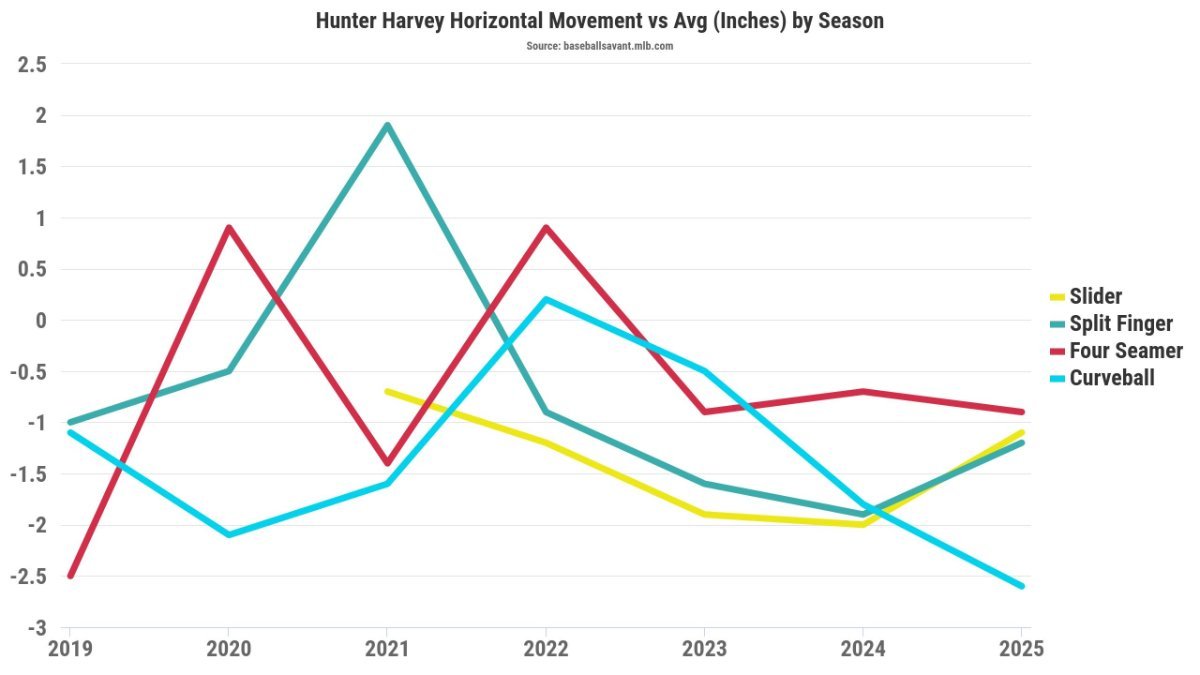
Perhaps there’s some work to be done with his slider and curveball that he continues to oscillate favor with, as both pitches represent his best chances to work away from right-handed hitters (he’s worked reverse splits quite often, including his small sample in 2025). Still, the whole point of adding Harvey was adding premium velocity to a bullpen short on it. Insofar as his fastball doesn’t fall off a proverbial cliff in 2026, that one pitch alone should make him a breath of fresh air for Craig Counsell and Cubs fans alike.