
Here, you can find the first half of this list. This is a continuation of the top 10 Cubs free agent signings of all time, inspired by the 50th anniversary of modern MLB free agency.
5.) Ryan Dempster
When the Cubs signed Dempster before the 2004 season, he was nothing more than a depth arm. He was coming off a brutal season and a half with the Reds, wherein he had an ERA over 6.00 across 37 games. He was still recovering from Tommy John surgery, which ended his 2003 season. He briefly appeared at the end of the 2004 season, but did not start making a real impact until taking the closer job from LaTroy Hawkins early in 2005. He collected 33 saves in 35 save opportunities—the best conversion rate in the league—after originally beginning the season in the rotation. He saved 52 more games over the next two seasons before moving back to the rotation in 2008, which was his best season in a Cubs uniform.
That season, he made 33 starts with a 2.96 ERA and earned his first All-Star selection since 2000. He was the ace of a staff that also featured Carlos Zambrano, who had been the Cubs’ default ace in the few seasons prior. Whether it be in the bullpen or the rotation, Dempster was one of the essential pieces of the pitching staff when the Cubs won back-to-back division titles in 2007 and 2008. After that 2008 campaign, Dempster signed a 4-year deal to stay in Chicago and filled the veteran leadership role on some Cubs teams that were quite forgettable. The other reason why he is so high on this list is that his exit from Chicago brought back one of the greatest Cubs starters of all-time, and a key piece of the 2016 rotation. At the 2012 trade deadline, Dempster was traded to the Rangers for a package involving right handed starter Kyle Hendricks. (The Cubs got lucky there.)
4.) Jason Heyward
Heyward was, by far, the hardest signing to rank here. His 8-year, $184-million contract remains the largest in Cubs history. The Cubs usually rank in the top 5 among MLB’s most valuable franchises, trailing only the Dodgers, Yankees, and Red Sox, so it remains baffling that 19 teams have handed out a larger free-agent contract or extension. There’s no question that the frugality we have seen from ownership of late is an effect of this contract. Over his 7 years as a Cub, Heyward accumulated 9.1 WAR. In comparison, he posted 23 WAR in his 5 years with Atlanta, and 7 WAR in his single season with St. Louis. He slashed .245/.323/.377 with only 62 home runs and 32 stolen bases, which were all far cries from the numbers he posted prior to 2016. He played a dependable center or right field, earning Gold Gloves in his first 2 seasons in Chicago. The Cubs even cut ties with Heyward before the 2023 season, which was supposed to be the last year of his contract.
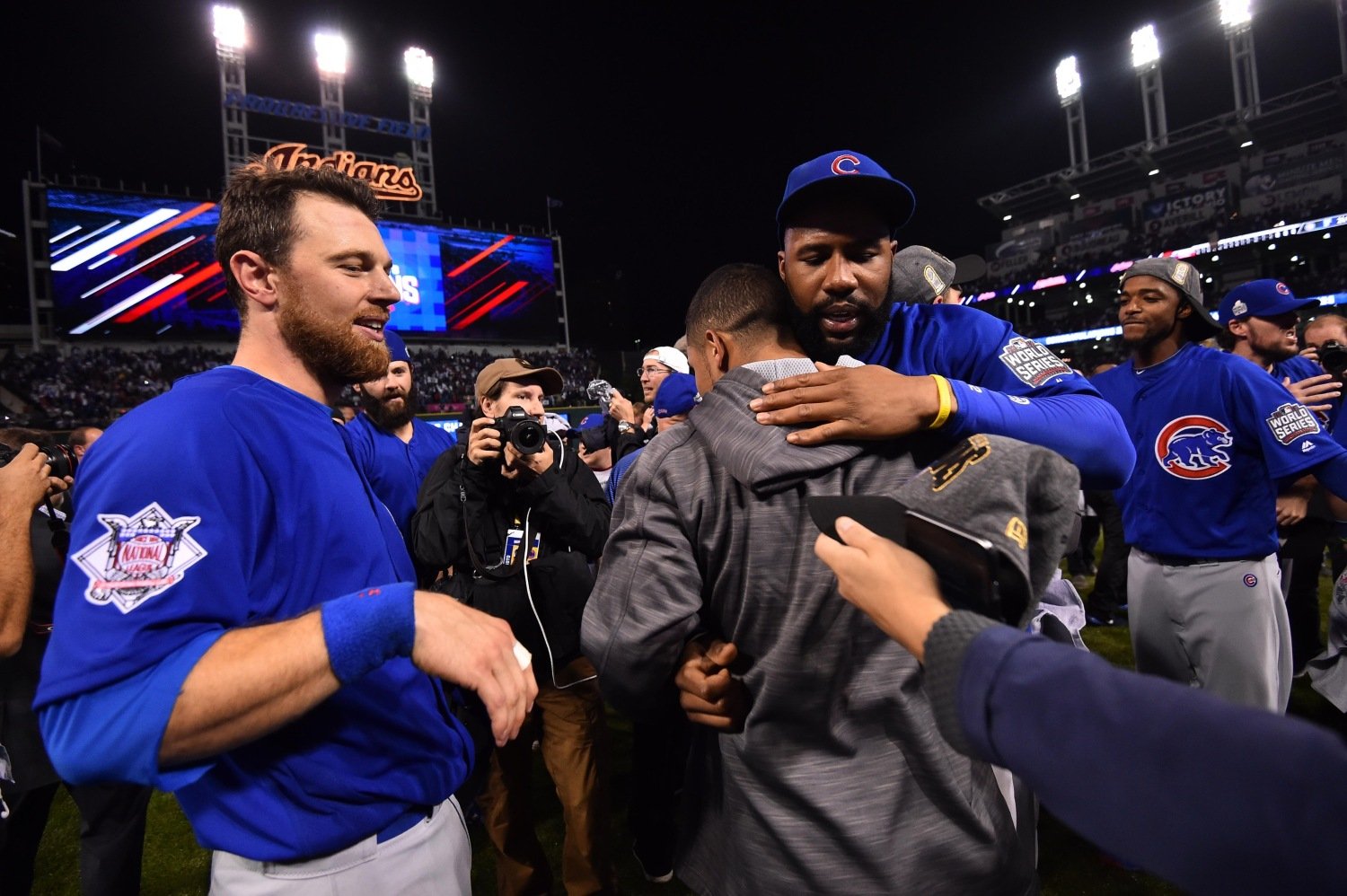
His inclusion on this list comes from one moment that took place in the visitors’ locker room at Progressive Field, during the rain delay in Game 7 of the 2016 World Series. Lockdown closer Aroldis Chapman had just given up a game-tying 3-run home run to Rajai Davis in the bottom of the eighth, and before the top of the 10th, the umpires called the teams off the field for what would be a 17-minute delay. At this point, Heyward gathered the team, and spoke from his heart, highlighting the path they took to get there and their ability to win as a team. The mood changed from disappointment to hunger. The team knew who they were, and knew they could win. Anthony Rizzo called the rain delay the “best rain delay of all time” and credited the team’s eventual victory to Heyward. There’s no real way of knowing how the team would have fared without the rain delay, but that question will forever be moot. Heyward was a major disappointment for virtually all of his time in Chicago, but the legend of his speech will live on forever.
3.) Andre Dawson
The only Hall of Famer on this list, Dawson had one of the most peculiar cases of free agency ever. After 11 seasons, 3 All-Star selections, 6 Gold Gloves, 3 Silver Sluggers, a Rookie of the Year award, and a collection of knee injuries, Dawson wanted out of Montreal and the artificial turf used at Olympic Stadium. After the 1986 season, Dawson expressed a need to play for a team who played on grass, and heavily campaigned for an offer for the Cubs. Due to collusion among MLB owners, many high-profile free agents were having trouble securing contracts during the 1986-87 offseason. Cubs GM Dallas Green originally resisted signing Dawson, due to a desire to play Brian Dayett in the outfield. Dawson’s agent, Dick Moss. hatched a plan whereby he and Dawson would approach the Cubs with a blank check and let the Cubs decide what they would pay him. The Cubs decided to pay him $500,000, with a bonus of $150,000 if he avoided the injured list, and an extra $50,000 if he made the All-Star team.
He admired Wrigley Field and the dedication of the fanbase, and was willing to bet on himself, knowing his play on the field would earn him a bigger contract next offseason. That certainly worked out for him, as he won the NL MVP in 1987, slashing .287/.328/.568 while leading the league in both home runs (49) and RBI (137). Though Dawson did his part, the Cubs finished in the cellar, but this would make the first time ever that a league MVP played for a last-place team. It was the first of 5 consecutive All-Star seasons for Dawson on the North Side, where he also earned 2 Gold Gloves and a Silver Slugger, picking up down-ballot MVP votes in 3 of the next 4 seasons. The Cubs only reached the postseason once during Dawson’s tenure, reaching the NLCS in 1989 before being quickly dismissed by the Giants. Still, his 6 seasons in Chicago were enough to cement him as one of the most loved Cubs of all time.
2.) Ben Zobrist
After losing to the Mets in the 2015 NLCS, the uber-talented but young Cubs core was ready to be taken seriously. Like Dexter Fowler, Zobrist was signed to provide veteran leadership for the clubhouse and some consistency to an offense with a lot of free swingers. Fresh off a World Series win with the Royals, Zobrist came to Chicago to reunite with Joe Maddon and fill a hole at second base after a trade of Starlin Castro, and to provide that key versatility that he displayed over his tenure with the Rays. His presence was felt almost immediately, as he made the All-Star team in his first season and finished with 3.5 WAR.
Zobrist, like Heyward, was a hero of Game 7 of the World Series. After the rain delay (and Heyward’s speech), Kyle Schwarber, playing in his first series since getting hurt in April, singled off Cleveland reliever Bryan Shaw. After pinch-runner Albert Almora Jr. advanced on a Kris Bryant fly ball, Rizzo was intentionally walked, bringing Zobrist to the plate with two runners on. This became the biggest at-bat of the game, as Zobrist doubled to left, driving in the go-ahead run. That hit earned him World Series MVP honors, and his second World Series ring in as many years. Zobrist had varying levels of success throughout his next 3 seasons as a Cub, and his power nearly evaporated after 2016, but he still helped the team with his defensive versatility and ability to get on base. Zobrist’s Cubs tenure gets more interesting when his age is considered. He was 35 when he signed the 4-year deal, and remained a productive player through his late 30s, something that only a few position players do anymore.
1.) Jon Lester
Lester is the clear and obvious pick for the greatest Cubs free agent signing of all time. The 6-year, $155-million contract he signed prior to the 2015 season is one of the best contracts that any team has given to a starting pitcher in the last 25 years. The Cubs were expected to turn a corner in 2015. Some of their top-ranked farm system got a cup of coffee in the big leagues in 2014, but 2015 would mark the debut of the best prospect in baseball: Kris Bryant. Kyle Schwarber and Addison Russell were all highly ranked among the top prospects in baseball and seemed set to make their debuts, as well. Culture guru Joe Maddon was signed to be the skipper, and all of a sudden Theo Epstein’s vision for the Cubs was coming to be.
Lester was one of the top arms on the market, and the Cubs were instantly seen as a top suitor. Lester was seen as the veteran, frontline arm who would slot perfectly above Jake Arrieta, Jason Hammel, and emerging rookie Kyle Hendricks. Lester made 2 All-Star teams as a Cub and finished second in NL Cy Young voting in 2016, when he also posted the lowest ERA of his career (2.44). Lester was a proven postseason arm, with a 2.11 ERA in 76 2/3 playoff innings with Boston, and that continued in Chicago, where he had a 2.44 ERA in the postseason. Lester finished his time in Chicago with a 77-44 record, a 3.64 ERA, and 940 strikeouts. This was a rare example of a long-term contract for a pitcher that worked throughout the majority of the term. He had some down-ish years, but even in his late 30s, he was able to eat innings and get outs. At his best, he was an ace who dominated in the playoffs and was essential in the Cubs’ pursuit of the World Series.