

Twins righthander Bailey Ober threw 418 sliders in 2025, according to Statcast, and they cost him eight runs on their own. His -1.9 Run Value per 100 sliders was eighth-worst in baseball, by that system’s accounting, and three of the seven offerings worse belonged to pitchers on the historically inept, gravity-starved Colorado Rockies. Sometimes Statcast’s Run Value is misleading, because it can be heavily influenced by a bit of batted-ball luck on a pitch type that might have been put in play just 50 or 60 times in a given season. This isn’t really one of those times.
Baseball Prospectus offers a much more robust way to evaluate pitch quality, with their StuffPro and PitchPro metrics. These are expressed somewhat similarly to Run Value, but a negative number is good, because they’re estimating the effect on run scoring exerted by that pitch, on a per-100 basis. Ober’s slider was dreadful according to StuffPro this year, too.
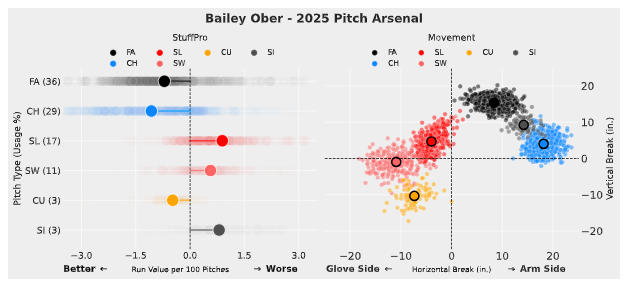
It’s rare that pitch-quality metrics of any kind (be it PitchingBot, Stuff+, StuffPro or any other) dislike a pitcher’s breaking balls this much. Sweepers are almost a hack of such models, to the extent that some teams mark down a pitcher on their wishlist if the strongest recommendation for them is a metrics-friendly sweeper. Ober, though, has both a sweeper and a slider that come in on the wrong side of average—and this metric, unlike Run Value, is trying to look past the results and assess the expected value of each pitch, based on release point, velocity, movement and location.
In short, Ober’s slider was a disaster for him this season. He never gave up on the pitch, though, throwing it just as much late in the year as at the beginning. That’s because the slider isn’t really an out pitch for him; it’s a bridge pitch. Study the movement plot above, and it’s fairly easy to see what I mean. Given his fastball shape and reliance on the changeup and sweeper, Ober used the slider to keep hitters from finding it too easy to identify his offerings out of the hand. The slider lives in between his fastballs and his curve and sweeper in terms of velocity, and it has a different spin profile than the rest of his pitches.
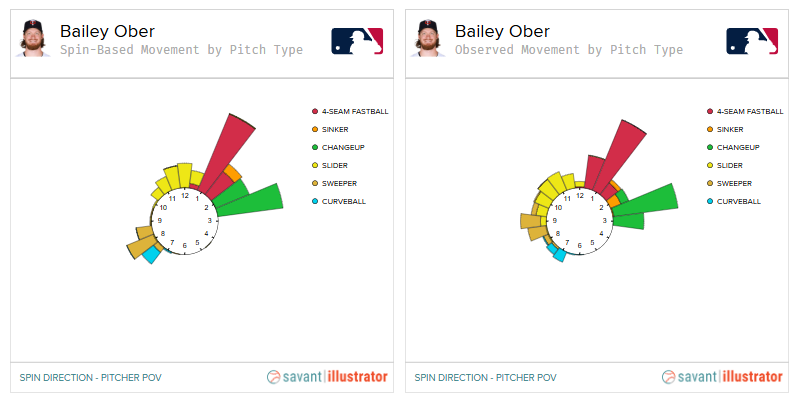
Ober is hardly alone in using a pitch that isn’t good on its own as an intermediate offering that muddies the picture for hitters trying to pick up spin and get started early on hittable pitches. He lacks the ability to spin the ball at a high rate, but he does manipulate that spin relatively well and uses grips and seam shifting to induce movement that isn’t perfectly predicted by his spin axes, creating deception. Even by the standards of a bridge pitch and in Ober’s unusually deft care, though, the slider isn’t working at all.
The solution is simple, though here, it’s important not to confuse ‘simple’ with ‘easy’. Ober needs to throw the pitch harder, and it should probably thereby transform into more of a cutter. He throws the pitch with backspin already; he just needs to modify the grip a bit and let it rip more.
A firmer slider or true cutter would be a better bridge offering for Ober’s mix, given the lift his sweeper achieves and the way he used the slider in 2025. He has other problems to address, but this one is especially urgent. It’s one thing to have a pitch that exists only to make other pitches play better. It’s another thing to have a pitch that exists only to make other pitches play better, but doesn’t succeed in doing so.