
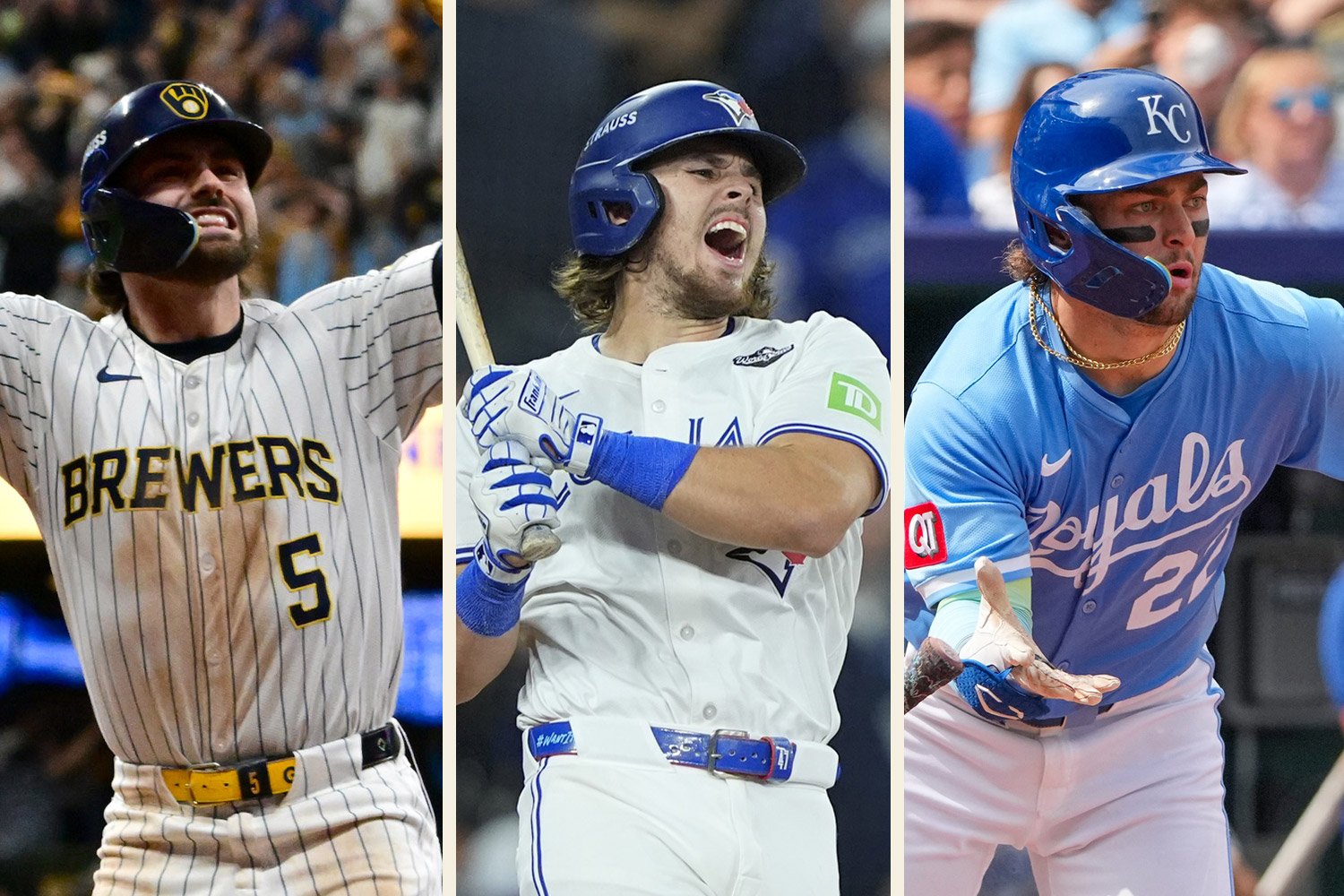
With the New Year right around the corner (as I’m starting this piece), I thought it’d be an opportune time to publish something on potential breakout candidates for the 2026 season. I initially considered reviewing OPS-xOPS differentials, but a recent find on Twitter changed my approach. Despite my attempts to limit screen time, I feel obligated to check Twitter, as most baseball pundits are active on the platform. A little over a week ago, I stumbled upon a tweet from Nathaniel Thomas that reviewed ideal fast swings. This sparked a new idea: What if I reviewed ideal fast swing rates to identify breakout candidates for 2026?
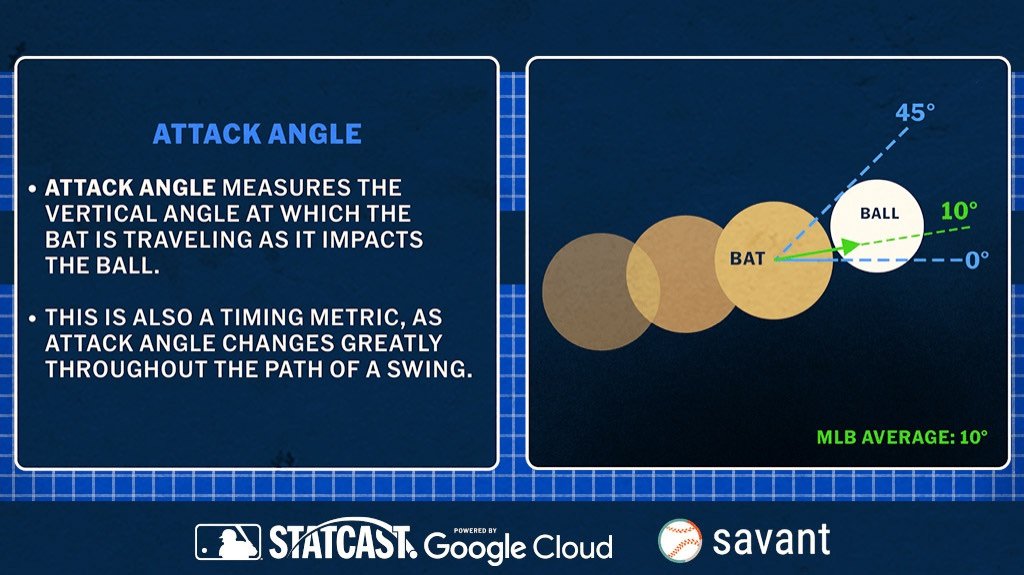
Attack angle is the vertical angle of the bat’s path as it makes contact with the baseball. It differs from swing path (tilt) and launch angle because:
Swing path (tilt) describes the bat’s trajectory approaching contact
Attack angle captures the bat’s angle at the moment of contact (or miss)
Launch angle measures the ball’s trajectory after contact
Statcast lists the ideal attack angle for a swing between 5° and 20° because swings in this range generate the most value for a hitter. Ideal attack angle rate measures how often a batter’s competitive swings fall within this range. Competitive swings are defined as “the fastest 90% of a player’s swings, plus any 60+ mph swings resulting in an exit velocity of 90+ mph.”
Ideal attack angle rate’s limitation? Competitive swings are relative to an individual player, not a universal standard. This past season, Jose Trevino posted a 70.0% ideal attack angle rate, the highest in baseball (minimum of 200 PA), but his 87.9 mph average exit velocity, .284 wOBA, and 40.6% hard-hit rate point to a weak contact profile. Ideal attack angle rate should be taken with a grain of salt, but that shouldn’t discredit its practicality. Elite hitters like William Contreras (64.5%) and Corbin Carroll (64.6%) also posted high ideal attack rates in 2024, in conjunction with higher bat speeds.
Note: Swing speed is not to be confused with bat speed. Swing speed is measured six inches from the head of the bat (aka the sweet spot), whereas bat speed averages the top 90% of a player’s swings at the sweet spot.
This is where fast swing rate comes into play. Fast-swing rate shows all the times a batter’s swing reached 75+ mph, a fixed league-wide threshold. Faster swing speeds correlate with higher exit velocities, which is why filtering for fast swings matters for ideal fast swing rate.
Since Statcast’s search function doesn’t allow filtering by swing speed, I used bat speed ≥ 75 MPH as a proxy. Both metrics track with one another, measuring speed at the sweet spot, so bat speed acts as a reliable placeholder for this exercise. By filtering for bat speeds ≥ 75 MPH and an ideal attack angle, we can identify batters making quality contact with elite bat speeds. A guy can swing 75+ mph every time he steps in the batter’s box, but if his timing is too early or too late, his power is wasted. Ideal fast swing rate filters for swings where the hitter combines timing AND power.

I created the following scatter chart comparing ideal fast swing rates and hard-hit rate, which measures the outcome of the swing. Both metrics exhibit a moderate correlation (R-squared of 0.370). As previously mentioned, having an ideal fast swing doesn’t guarantee hard contact. When evaluated with plate discipline metrics and contact quality, an ideal fast swing rate helps identify hitter breakout candidates.
Carter Jensen’s Savant page is redder than a Weasley family reunion. In his age-21 season, he played a limited sample of 20 games with strong production, posting a .300 BA, .941 OPS, .250 ISO, and 159 wRC+ across 69 plate appearances. His third home run was a 456 ft moonshot at Sutter Health Park, which was coincidentally the third farthest home run hit at the venue in 2025. With a 20.4% ideal fast swing rate, 58.3% hard-hit rate, and 14.5% barrel rate, his swing and contact quality metrics are already elite.
The cherry on top? Jensen maintains a patient approach at the plate (17.4% strikeout rate, 13.0% walk rate, 24.0% chase rate, and 24.6% whiff rate). Jensen isn’t just swinging hard and praying he’ll connect with the ball – he’s selective, and when he swings, he does damage.
Another thing to note is that his expected stats exceeded his actual stats against all pitch types. In Jensen’s case, “underperforming” is slugging at least .500 on every pitch type. His 20.4% ideal fast swing rate is on the lower end, but his 70.7% Z-swing rate shows he’s not being passive on hittable pitches in the zone, and his 24.0% chase rate shows he’s not swinging at bad ones either. His walks are earned. With more consistent at-bats and a larger sample next season, his actual production should catch up to his expected stats.
Pitch Type
BA
XBA
SLG
XSLG
Fastball
.308
.339
.577
.676
Breaking
.300
.370
.550
.575
Offspeed
.286
.312
.500
.546
Jensen possesses a rare trifecta of elite contact quality, power, and plate discipline. Due to his limited playing time in 2025, he retains rookie eligibility into the 2026 season. Just months before his major league debut, Jensen was under the legal drinking age. He still has plenty of time to develop. If Jensen becomes an everyday player and his underlying swing metrics hold, he’s a strong candidate for rookie of the year.
Garrett Mitchell’s profile is fascinating. He posted a 44.1% ideal fast swing rate, the third highest in baseball, but his whiff rate shows he’s missing hittable pitches in the zone. That said, his whiff rate has fluctuated over his career, but it hit a career low of 30.9% in 2025. He’s still not making consistent contact. Mitchell has never been a free swinger on pitches outside of the strike zone. Throughout his career, his chase rate has stayed below 24%, so he knows what pitches to swing at, but he doesn’t connect with them. Despite posting a career-high hard-hit rate and career-low chase and whiff rates in 2025, he had his worst season at the plate.
Garrett Mitchell’s Career
Season
BB%
K%
BA
ISO
OPS
wRC+
Whiff %
Chase %
Hard Hit %
2022
8.8%
41.2%
.311
.148
.832
136
31.5%
22.5%
41.2%
2023
9.6%
35.6%
.246
.200
.761
104
39.7%
23.5%
37.5%
2024
11.2%
31.7%
.255
.214
.812
127
34.8%
17.6%
37.0%
2025
9.0%
32.1%
.206
.088
.580
65
30.9%
20.9%
42.2%
Health issues have derailed Mitchell’s career, so there’s a Grand Canyon-sized gap between swing quality and production. This past season was cut short by a left-shoulder surgery, limiting him to just 25 games. For a left-handed hitter, posting the third-highest ideal fast swing rate in baseball and a career-high hard-hit rate while playing through a same-side shoulder injury is impressive. When relatively healthy in 2024, Mitchell posted an .812 OPS and 127 wRC+ across 69 games.
If Mitchell can stay healthy for a fullseason, the 44.1% ideal fast swing rate suggests he has significant upside. Between Sal Frelick, Jackson Chourio, and Blake Perkins, the Brewers have a crowded outfield. Mitchell has more upside than Perkins, but has’t proven he can stay on the field for an entire season. If his shoulder holds up (he’s aiming to be ready by the start of spring training), 2026 could finally be the year Mitchell’s production catches up to his swing.
Addison Barger’s 2025 numbers weren’t eye-catching, especially sharing a lineup with George Springer, Vladimir Guerrero Jr., and Bo Bichette. He appeared in 135 games and logged 502 plate appearances, registering a .243 BA, .756 OPS, .211 ISO, and 107 wRC+. Nonetheless, he was a valuable contributor for the Blue Jays in 2025.
Barger registered a modest 32.4% ideal fast swing rate and an absurd 51.0% hard-hit rate, but a below-average chase rate of 31.1% (30th percentile) and a 26.1% whiff rate (37th percentile). He’s chasing bad pitches and missing more than he should, but when he connects with the ball, the contact quality is there. His 116.5 mph max exit velocity ranked in the top 3% of MLB. If he tightens up the zone, he’ll make better swing decisions, the whiff rate should drop, and the production will climb.
Honorable Mentions
Player
Team
Ideal Fast Swing%
Hard-Hit%
ISO
Whiff%
Chase%
Z-Swing%
MIN
38.3%
45.7%
.262
35.5%
28.4%
70.6%
SDP
31.9%
46.8%
.177
23.0%
31.4%
59.4%
FA
30.9%
41.2%
.135
34.7%
49.0%
75.7%
The honorable mentions weren’t included in the main list because they possess pressing red flags that can’t be ignored. Matt Wallner has one of the most enigmatic profiles in baseball. One can argue that he’s the reincarnation of Joey Gallo. Wallner swung out of his shoes on almost every pitch, but still posted a respectable .776 OPS and 114 wRC+ across 392 plate appearances in 2025. Wallner has the sixth-highest overall ideal swing rate (38.3%) and the highest ISO (.262) in this group. His horrendous 35.5% whiff rate (1st percentile), 28.4% chase rate (46th percentile), means he’s missing a ton of pitches both inside and outside the strike zone. Yet, his 11.7% walk rate (84th percentile) demonstrates that he’s well-aware of the strike zone, but he’s not connecting with most pitches when he swings. Gavin Sheets has the highest hard-hit rate in the group (46.8%). However, his 59.4% Z-swing rate and 31.4% chase rate indicate that he’s swinging at pitches outside the zone and ignores hittable pitches thrown in the zone. Sheets still had a breakthrough season with this strategy (.746 OPS, 111 wRC+). Imagine what Sheets could do if he reversed his approach at the plate! Jhonkensy Noel has the highest risk and upside in the group. The raw power is obvious (41.2% hard-hit rate and 30.9% ideal fast swing rate), even if his .135 ISO doesn’t reflect it. His 49.0% chase rate and 34.7% whiff rate are brutal, and fixing a poor chase rate is easier said than done. At age 24, Noel is currently a free agent with no guaranteed playing time, so it comes down to whether a team will take a chance on him. If he learns to lay off, the power will come to fruition.
Finding a contact hitter in baseball’s age of analytics is becoming almost as rare as a Valyrian steel sword. MLB’s decline in .300 hitters illustrates this trend. Ideal fast swing undervalues contact hitters like Luis Arráez (0.2%, 3rd lowest). Then again, baseball doesn’t value contact hitters anymore. Arráez is projected to sign a 1-year, $11 million contract, while slugger Kyle Schwarber, whose 47.5% ideal fast swing rate ranks second, signed a 5-year, $150 million deal with the Phillies. Schwarber and Arráez represent opposite ends of the hitting spectrum, with most players falling in between. Balanced lineups need both profiles. In a game increasingly centered around power in the batter’s box, identifying hitters with untapped potential to drive the ball out of the park is crucial for teams.
Interested in learning more about this year’s class of free agents? Check out our comprehensive top 50 prospects list, with scouting reports, projected contracts, and more!