
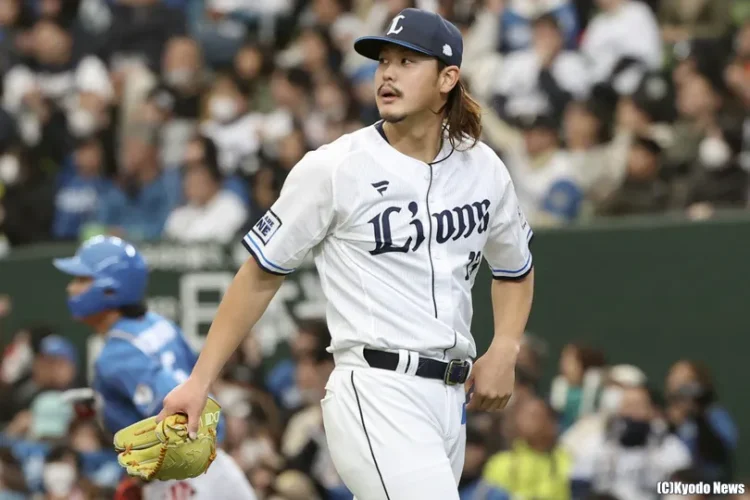
 Credit: Japan Times
With Seibu Lions starter Tatsuya Imai signing with the Houston Astros in a surprise move, could the Padres be in the market for another Lions starter on the market?
The San Diego Padres are between a rock and a hard place, as they are looking to make additions to their roster while lacking the financial flexibility to make splash moves.
Instead, the Padres have made more low-key signings outside of the return of Michael King.
Korean infielder Sung-mun Song, the additions of relievers Ty Adcock and Daison Acosta, and the re-signing of Kyle Hart all remain as additions around the margins of a mostly established roster. Nonetheless, the Padres are still looking for starting rotation depth, as even with the re-signing of King, the team’s depth is unproven or low-ceiling. A.J. Preller and his staff are one of the most active clubs in international markets, as seen with the signings of Song, Hart, Ha-Seong Kim, and Robert Suarez in recent seasons. The international avenue could once again bring them another option for the rotation.

With all the buzz surrounding international signees Cody Ponce, Munetaka Murakami, and, most recently, Tatsuya Imai, one arm has slipped under most evaluators’ radar.
The Seibu Lions made two of their arms available this offseason, and with Imai having signed, Kona Takahashi remains on the market. Takahashi is an intriguing arm for any team interested in a starter, and as of the time of this publication, he has one confirmed major league offer from an anonymous team. His ceiling has been rumored to be that of a back-end starter at the Major League level, but let’s dive in.
Takahashi is not in the same talks as fellow Japanese pitchers Yoshinobu Yamamoto, Roki Sasaki, or even Masahiro Tanaka when he came over to MLB. Takahashi falls into the sort of back-end/swingman class of starter coming over from NPB, with some comparing his free agency market to that of Kohei Arihara or Shinnosuke Ogasawara.
Despite the perceived high floor for him at the MLB level, Takahashi brings an intriguing skillset to the MLB mound. The right-hander now has eight seasons of NPB experience under his belt, though his rookie season lasted all of 20 innings. Takahashi took some time to establish himself as a regular in the Lions’ rotation, but his 2022 and 2023 seasons were his finest hours.
2022: 26 GS, 175.2 IP, 2.20 ERA, 2.95 FIP, 3.05 xFIP, 128 K, 51 BB, 10.9% K-BB
2023: 23 GS, 155 IP, 2.21 ERA, 2.83 FIP, 3.08 xFIP, 120 K, 47 BB, 11.7% K-BB
Kona Takahashi gets former teammate Hotaka Yamakawa looking to escape the jam!
7.0 IP, 6 H, 1 ER, 2 BB, 8 K, 123 Ppic.twitter.com/zktXqwXoWp
— Yakyu Cosmopolitan (@yakyucosmo) April 29, 2024
The last two campaigns have been a step backwards for the right-hander, as he pitched only half a season with the Lions, and he was sent down to their minor league team. On the season as a whole, his performance was much more optimistic than a “high” 3.87 ERA (high by NPB standards).
2024 saw an uptick in his hits allowed while most of his other percentile numbers remained around his career averages, partly due to suffering from an elevated .335 BABIP. The 2025 campaign was something of a return to form for Takahashi, as he spent the whole year on the Lions’ top team and made 24 starts spanning 148 innings. In those 148 innings, Takahashi had a 3.04 ERA, 3.34 FIP, and 3.28 xFIP. While he kept the walks low at 6.7%, his strikeout rate dropped to a career-low 14.3%. For reference, only six pitchers in all of MLB last season had a strikeout rate below 14.3%:
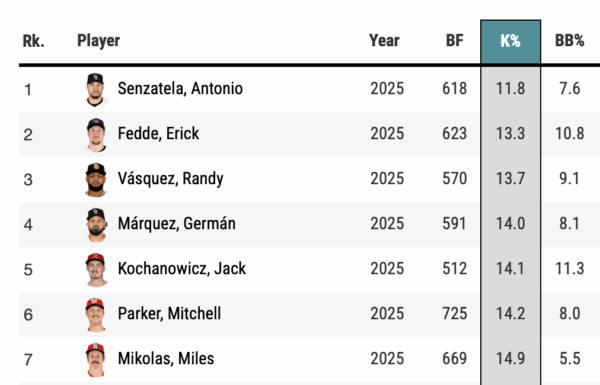 Graphic via Baseball Savant, MLB
On the upside, Takahashi continued to get ground balls, as he recorded a ground ball rate of 50.5%, which sat closer to his best seasons. His overall pitching profile is built for the contact-oriented hitting in NPB, but how would such an approach fare in MLB?
At this point, I’m convinced that Kona Takahashi is cursed.
Another no decision. pic.twitter.com/CgxoZAyT1o
— Gaijin Baseball/外国人野球 (@GaijinBaseball) June 13, 2025
For as silent as his free agency has been, there is much to like about Takahashi as a pitcher. Despite being 28 and on the older side for an arm being posted, he is an arm that is not going to be stubborn. The right-hander has continuously looked for ways to improve his game, even making the trip from Japan to Seattle’s Driveline facility, working with coaches there on improving and optimizing his mechanics. He has also continued to look for ways to increase the efficacy of his arsenal. Here are his pitch usage rates, courtesy of JapanBall’s Yuri Karasawa (Yakyu Cosmopolitan on X).
Kona Takahashi 2025 NPB Pitch Mix
Note: hard/slow variations are categorized together under vertical slider pic.twitter.com/3kWXnUMjD6
— Yakyu Cosmopolitan (@yakyucosmo) November 12, 2025
His fastball is a question mark for scouts and evaluators, as it is considered to be a dead-zone fastball. This sort of offering works best for pitchers from low vertical approach angles, or for pitchers with a diverse arsenal that lends to effective tunneling. Takahashi falls in the latter camp, as in 2025, he had seven different offerings he turned to. Staying with the heater, his fastball sits in the 92-97 mph range, and doesn’t have much movement in one direction or the other.
He made a habit of using the four-seamer up in the zone, generating pop flies and occasional whiffs. The whiffs didn’t come against his fastball, though, as against right-handers he turned to the slider. His slider is more of a sweeping slider, although it has a more significant vertical break. The offering is strong at getting whiffs against hitters from both sides, but it has something of an inconsistent shape. The pitch at times behaves like a gyro slider, while at others it has more sweeping action. His slider and cutter have very similar grips, which simply adds another wrinkle on top of the already existing ones. Takahashi’s cutter was a platoon-neutral offering, as his usage with it ranged from 10-20% depending on the batter’s handedness. The pitch averaged 88.55 miles per hour in 2025, and was mainly used to induce ground balls and weak contact, doing so 53.3% of the time against left-handed batters versus 43.3% against right-handers.
Like most pitchers coming over from Japan and NPB, Takahashi also features a splitter that is thrown with the middle finger on the edge of the internal seam; the index finger does not make contact with the seams. His splitter drew positive reviews from Fangraphs, who plot the pitch as a 55. It is a big weapon for the right-hander against same-sided batters, who whiffed on 20.9% of swings against it. It also had a 64.1% ground ball rate against left-handed batters, therefore making for a solid secondary offering.
The biggest question with Takahashi is simple: how well can his stuff translate to the MLB level if he doesn’t get many swings and misses? Other pitchers who have leaped to MLB have seen an uptick in their strikeout rates upon arriving, like the aforementioned Shinnosuke Ogasawara and Yusei Kikuchi. Takahashi doesn’t come with the concerns over command that arms like Shun Yamaguchi had, so he could at the very least serve as a back-end starter with room to grow. Takahashi could develop a sinker in MLB to complement his breaking stuff, and if there is anyone in MLB who can help a pitcher develop a mighty sinker to ride to success, it is Ruben Niebla. Just ask Corey Kluber.
Contract projections for a pitcher like Takahashi can be complicated, as comparable arms to him include the likes of Shun Yamaguchi, Naoyuki Owasawa, Shinnosuke Ogasawara, or even KBO returnees like Kyle Hart and Ryan Weiss.
Considering the Padres’ needs at starting pitcher and the somewhat quiet posting window for Takahashi, a Major League deal will likely be needed to entice him to make the leap to the majors rather than re-sign with Seibu. Adding to this, the comparable rates of the aforementioned starters, one can hypothesize that Takahashi would receive a contract in the neighborhood of one to two years at roughly $3-5 million per season, which would not break the bank for San Diego.
The Padres have been rumored to be in the mix for foreign talent making the jump to MLB, so why not skip the line and bring in an arm who can fill in this rotation for the 2026 season?

A born and raised San Diegan, Diego Garcia is a lifetime Padres fan and self-proclaimed baseball nerd. Diego wrote about baseball on his own site between 2021-22 before joining the East Village Times team in 2024. He also posts baseball content on his YouTube channel “Stat Nerd Baseball”, creating content around trades, hypotheticals, player analyses, the San Diego Padres, and MLB as a whole.
A 2024 graduate of San Diego State, Diego aims to grow as a writer and content creator in the baseball community.
Continue Reading