
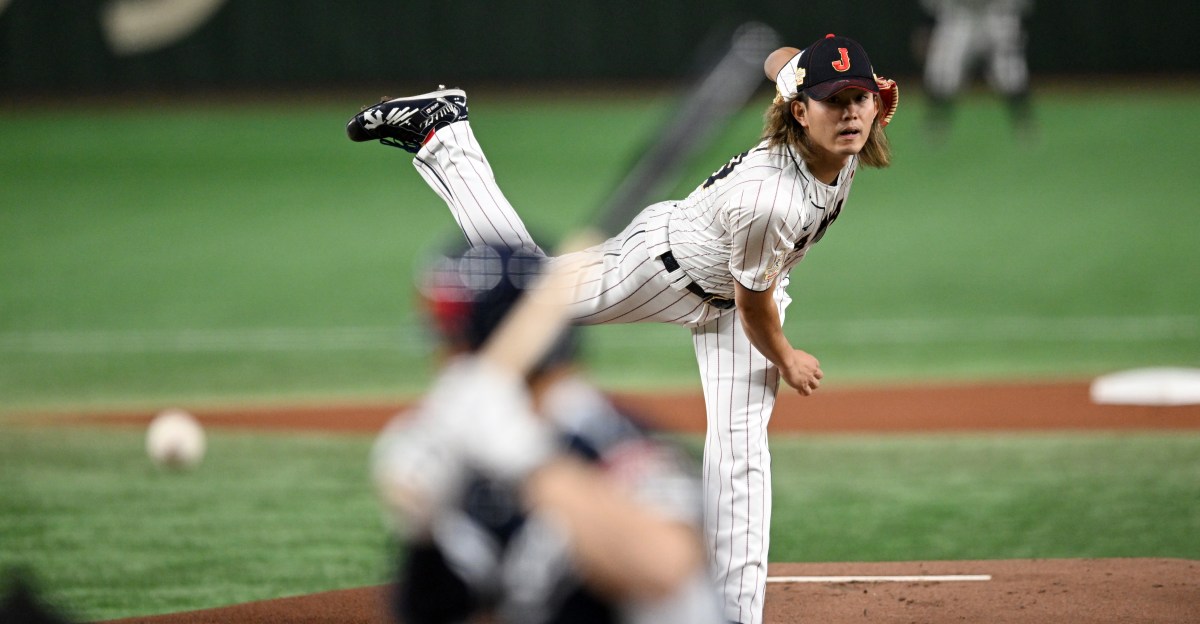
I’ll admit I was still asleep when the word came down, that NPB ace Tatsuya Imai was signing with the Houston Astros for three years and $54 million guaranteed. Escalators exist on the deal that can give Imai another $3 million per, for a total possible AAV of $21 million — or some six million less than the average annual value the Yankees divvied out to Max Fried and Carlos Rodón on their repective contracts.
I think in recent weeks we had all accepted the Yankees were going to make one, maybe two big splashes this offseason and sit out the rest of the frenzy. Kyle Tucker didn’t seem a proper fit positionally or at the money he’ll likely make, Imai’s countryman Munetaka Murakami carries question marks about his ability to make contact, and while the Yankees are a team with needs, none of those needs were readily answered by a free agent. Except for, in my belief, Imai.
The escalators on the deal the reigning Sawamura Award winner inked with Houston kick in at 80, 90, and 100 innings, meaning the Astros have built themselves a tremendous amount of flexibility. Imai won’t be a “real” rookie, but there are always questions about a player making the transition to MLB and the increased workload that carries. Imai’s never had more than 25 starts in a season, and while MLB starting pitchers are working less than ever, his potential and tools would have you looking at him as a number-two type, making closer to 30-32 starts.
But as I said, the Astros have quite a bit of leeway in how best to deploy Imai. Hunter Brown, the club’s ace, is about as good as it gets in the AL, and while Cristian Javier threw just 37 innings last year returning from injury, a 3.65 FIP across those innings paced him for a four-win season had he been a qualified starter. To get to slot Japan’s nominal best pitcher in between or behind those two gives Houston a potentially-devastating playoff rotation, but those escalators also mean the Astros may want to shuffle Imai between the bullpen and rotation, or perhaps finally show the world the multi-inning “piggyback” reliever that’s been bandied about as a concept for a number of years.
The short end of it all is the Astros just bought a significant amount of potential with its own warranty, and will pay just $18 million guaranteed each year — roughly what Marcus Stroman made while doing a whole bunch of nothing in the rotation from 2024-25. Of note: despite that net negative, the Yankees made the World Series in Stroman’s first year (ignoring him entirely in October) and then tied for the best record in the American League in the second, so it’s not like the $18 mil was a true anchor. Also, the Yankees will give $15 million to DJ LeMahieu, who sharp-eyed readers will know no longer plays for this team.
So where does this all leave the Yankees anyway? The only player left on the market that makes any real sense is Cody Bellinger, who I do expect to return to the Bronx. That return is just that though, with the club more or less starting 2026 with the same team it ended 2025 with, minus some bullpen parts and with Anthony Volpe likely to be on the IL for Opening Day. The club has currently cut about $33 million in payroll, but of course the lion’s share of that gap may be taken up by whatever Bellinger agrees to. After that, there’s just not much you can buy in 2026 with $8-ish million, and the club will likely pocket the difference.
This was never going to be a great winter for the Yankees, as there just isn’t one big piece that could boost the club by five or six wins available. Still, to more or less return the same roster, while everyone’s gotten a year older, just to save a couple million dollars doesn’t exactly leave me salivating for Opening Day.