
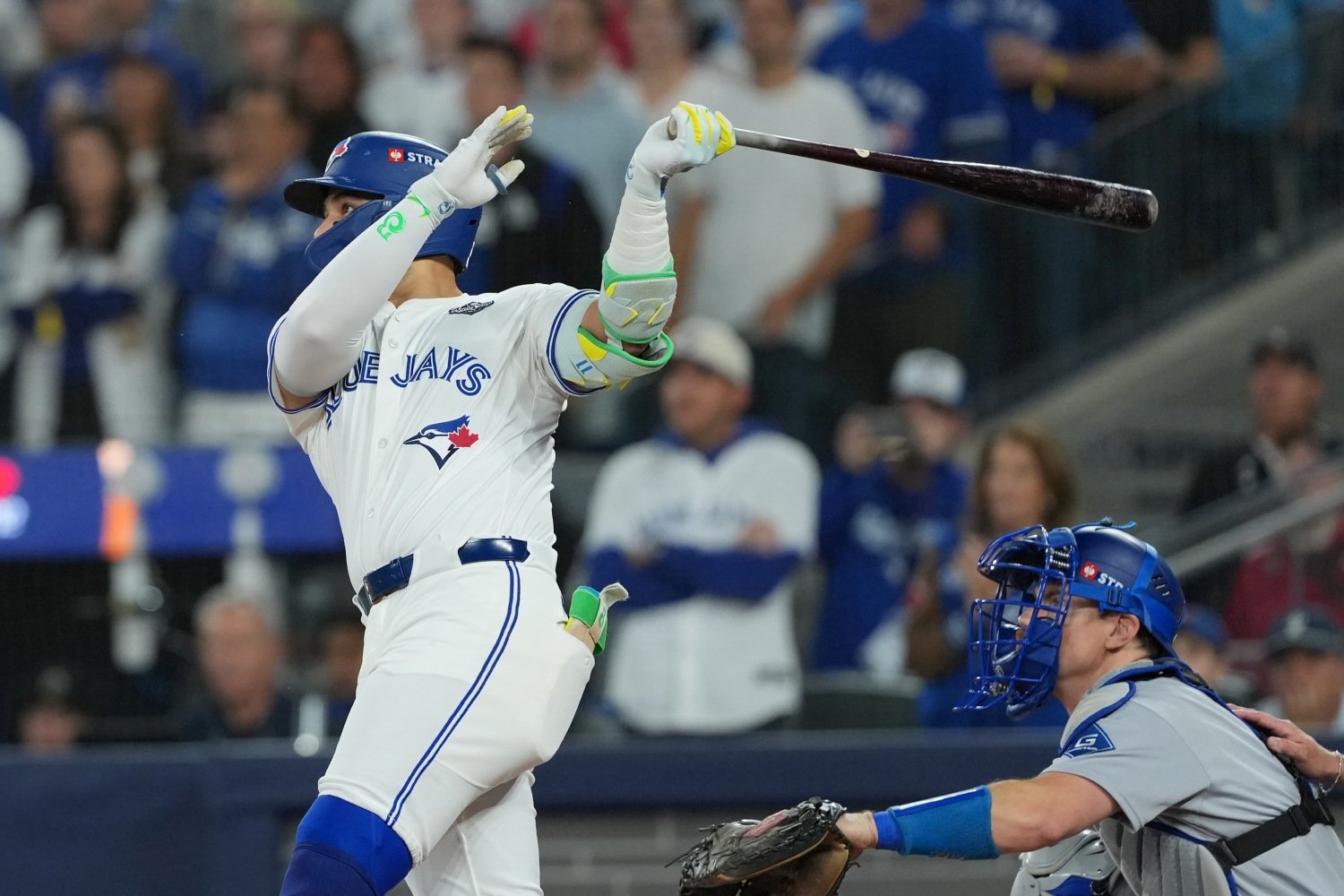
If you’re feeling open-minded, Bo Bichette is the perfect fit for a Chicago Cubs team struggling to find the right one this winter. They made only passive overtures to infielder Kazuma Okamoto before he signed with the Blue Jays, but they met with Pete Alonso in December, and have had multiple discussions with and about Alex Bregman this offseason. Upgrading their offense—and, specifically, bringing in a solidly above-average right-handed batter to balance and deepen the lineup—is part of Jed Hoyer’s offseason plan.
Bichette is a unicorn, with a swing unlike that of any other right-handed batter in the league. His steep stroke (37.5° of swing tilt this season) is unusual for righty hitters, but the fact that he also lets the ball travel very deep into the hitting zone before making contact (meeting it 24.5 inches in front of his center of mass) sets him apart even from those otherwise roughly similar. Here are all the other hitters with a swing plane of at least 36° and a contact point no more than 28 inches in front of their frame in 2025:
That’s a highly varied set of hitters, but they almost all share one trait: left-handedness. Only Dingler is a righty batter. Here’s a composite animation of Bichette’s swing from last season. It’s highly unusual.
His extreme counterrotation with the shoulder makes him a lashing line-drive hitter, and his exceptional feel for contact makes him dangerous despite his lack of high-end raw swing speed. This is the kind of player the Cubs like to bring in, when they make a major investment, because he lacks some of the measurables (especially swing speed and power potential) that invite larger-market teams to make bids so high that Chicago loses interest.
With Nico Hoerner set to hit free agency after 2026, Bichette also fits the positional and timeline sweet spots for the Cubs. He could play third base this season and second base thereafter; he could stay at third and play alongside Hoerner and Dansby Swanson for another half-decade. He’ll only turn 28 years old in March; he has plenty of prime years left. He’d be a plus defender at second and at least an average one at third, even though he was markedly worse than average at shortstop over the last few seasons of his tenure in Toronto.
Signing Bichette would get the Cubs out of a tense chess match with Scott Boras. With him in the fold, the team wouldn’t need to sweat the rising likelihood that Alex Bregman returns to the Red Sox, and they could trade either Hoerner or Matt Shaw in their pursuit of help in the starting rotation. Bichette would become the team’s big financial outlay, and the displacement he would create on their roster would bring them pitching help on a more cost-controlled basis.
The rub, of course, is that Bichette is still likely to cost more than the Cubs are willing to pay. He’s remained on the market this long and drawn the Cubs’ attention at all because the $250-million deal once imagined isn’t out there, but he will still get to choose between a deal that would be the richest in Cubs history (likely eclipsing $200 million) or one that would come with massive flexibility and expected value, with a shorter term but multiple opt-outs and an annual average value over $30 million. Hoyer is trying to avoid that grand an outlay, and a source familiar with the team’s thinking indicated that they do not view Bichette as the same kind of special case (a confluence of ability and personal trustworthiness) that Swanson was when they signed him to a seven-year deal two winters ago.
That doesn’t mean they won’t sign Bichette to a similar, even larger deal. He’s been more consistently productive at the plate than Swanson, and is a year younger than Swanson was when he signed with the team. The Cubs are in a stronger financial and competitive position now than when they signed Swanson. Still, with several other big spenders in on him, Bichette has a robust market. The fit here is perfect. He would unlock some of their most desirable paths forward, not just for 2026 but through the end of the decade. To make it happen, though, Hoyer and company would have to do something uncharacteristic. Their disciplined valuations would have to tell them that the market was a bit too low on the slowish-swinging not-quite-shortstop, and they would have to feel confident that they could execute the other half of a large and complicated double-move, trading young talent for a pitcher whose arrival would dovetail with Bichette’s to form the next set of pillars for this ever-evolving roster.