
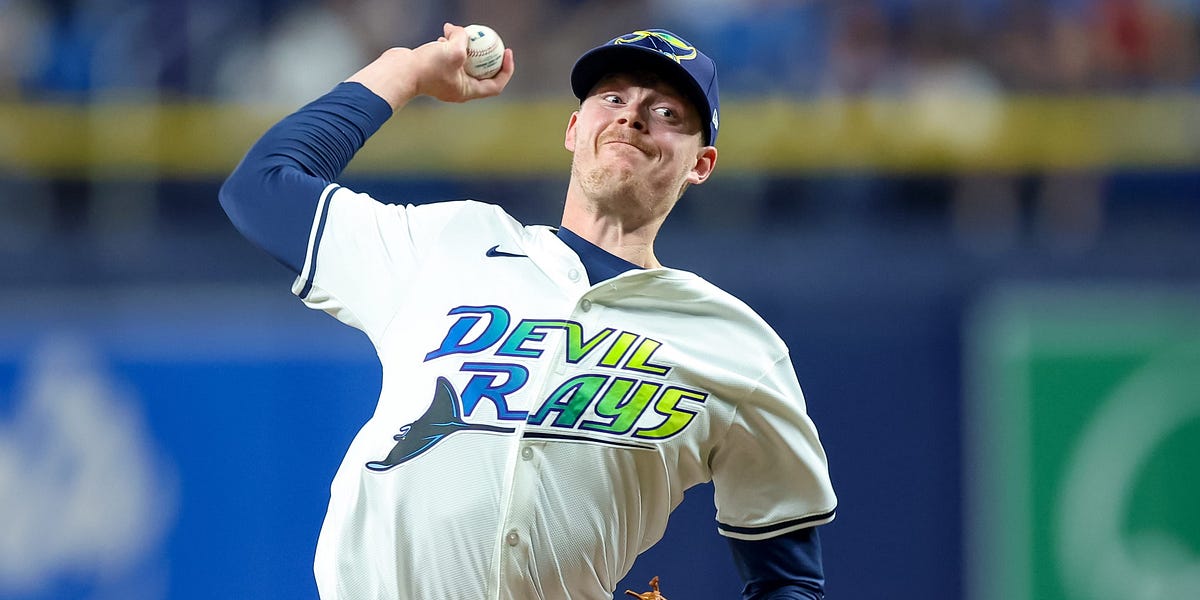
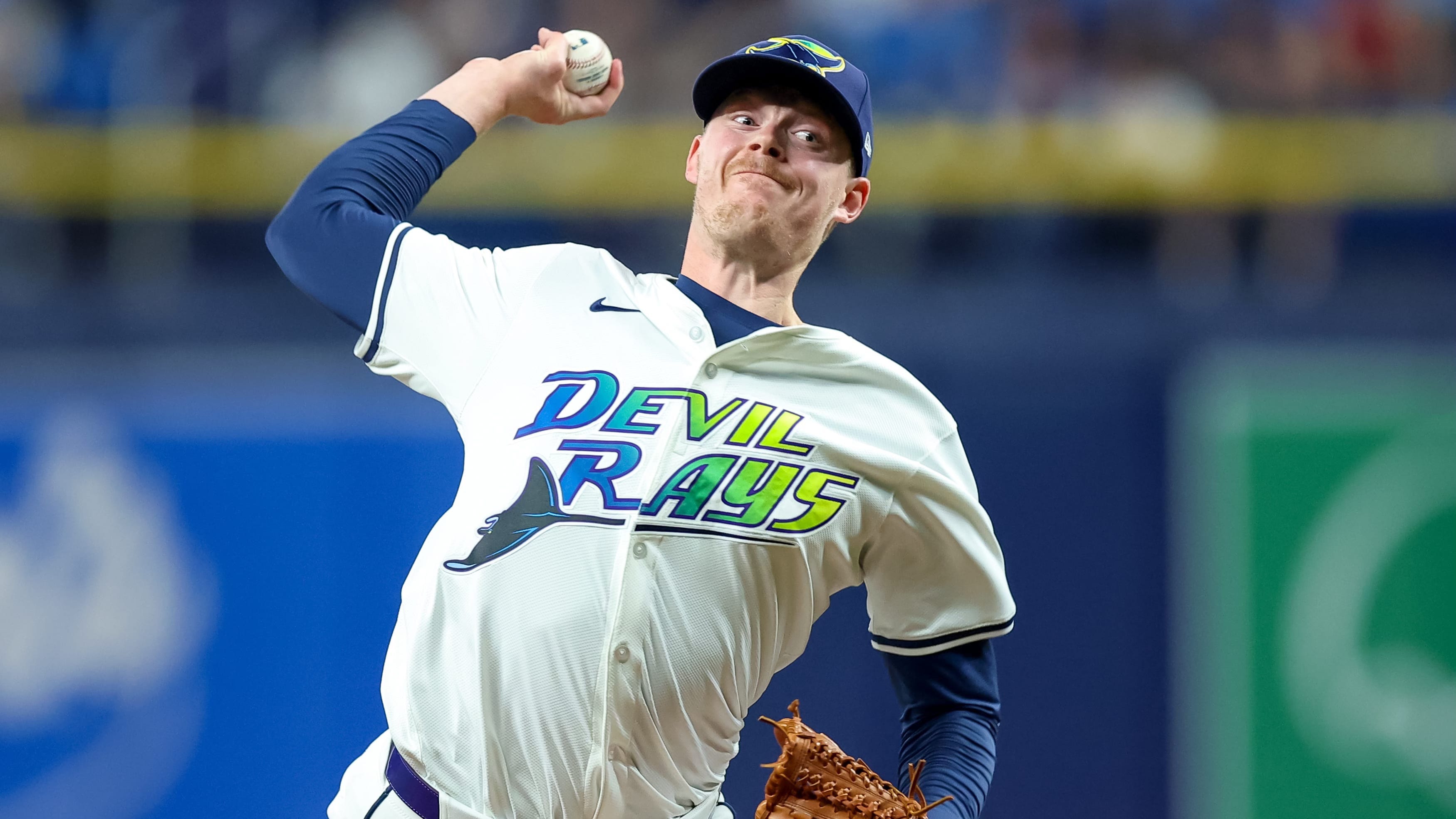
 New Marlins reliever Pete Fairbanks pitching for the Rays in the back-end of their bullpen. (Mike Carlson / Getty Images)
This winter, right-handed reliever Pete Fairbanks departed the Tampa Bay Rays and signed a one-year deal with the Miami Marlins, officially ending his run in the American League East.
Now removed from regular trips to Fenway Park, Fairbanks admitted he’ll miss pitching at America’s Most Beloved ballpark.
Appearing on Foul Territory on January 2, Fairbanks was asked about facing the Boston Red Sox and what it was like to play at Fenway.
“I mean, it’s a great atmosphere, fun place to play, but the bullpen sucks,” said Fairbanks jokingly on the podcast.
Fairbanks’s comment offered a blunt but honest assessment of Fenway’s tight and inconvenient bullpen setup — even as he praised the overall experience of playing in Boston. The former Rays reliever made it clear that the atmosphere, history, and energy of the ballpark are aspects he’ll miss now that his AL East days are behind him.
 Eugenio Suárez isn’t the answer for the Red Sox if Alex Bregman walks
One Fenway Park moment that Fairbanks would like to forget was from last season when Ceddanne Rafaela crushed a walk-off homer that extended the Sox’ winning streak to eight games in July. With one out in the ninth inning and facing the lights-out closer in Fairbanks, Rafaela launched 406-foot homer that easily cleared the Green Monster in left field.
It was a moment that Rafaela will cherish for the rest of his professional career.
“I’ve been waiting for this moment since I was watching games with my mom in 2004, 2005, 2006, 2007,” Rafaela said following the game back in July. “To play in this atmosphere. When I hit that homer, I was thinking about my mom and my wife back home. For this team, it was a special moment.”
Fairbanks will head to Miami on a young Marlins team and is set to earn $13 million this season. The deal includes a $1 million signing bonus, $1 million in appearance-based incentives, and an additional $500,000 bonus if he is traded at any point during the year.
His one-year pact represents the largest single-season AAV ever given by the Marlins to a relief pitcher, surpassing the three-year, $27 million deal the club gave to Heath Bell in 2012.
Miami utilized a closer-by-committee approach last season, but with Fairbanks now anchoring the back end of the bullpen, he should factor prominently into the mix to close games in 2026. Other late-inning options for the Marlins include right-handers Anthony Bender, Calvin Faucher, and Tyler Phillips.
The need to add Fairbanks became more pressing after the Marlins learned that Ronny Henriquez will miss the entire season following UCL reconstruction surgery on his right elbow.
 This Week in Free Agency: 12/28 – 1/4
“I know that I’ll be throwing leverage,” Fairbanks said when discussing his role after being introduced by the club. “Whether that’s the ninth — I’m sure it will be the ninth at times — I’m sure it might end up being the eighth at times. Or if you’ve got to get an out in the seventh against the heart of the order, I’m sure that it’ll be something like that. Whether it’s accruing the counting stats in the ninth or facing the heart of the eighth, whatever is asked of me is going to be what I do.”
Fairbanks was effective for Tampa Bay last season, posting a 2.83 ERA while converting 27 of 32 save opportunities. The primary obstacle throughout his career has been health, as he spent time on the injured list each season from 2021–24 before avoiding it altogether in 2025.
He had 90 saves (and 18 blown saves) and a 2.98 ERA in seven seasons for Tampa.
That healthy campaign allowed Fairbanks to set career highs in both appearances (61) and innings pitched (61 1/3), reinforcing why Miami made him a priority addition to its bullpen this winter.
 New Years resolutions for the Red Sox entering the 2026 season
While Fairbanks doesn’t generate elite swing-and-miss numbers last season, ranking in the 57th percentile in both chase percentage and whiff percentage last season. He posted above-average marks in strikeout rate (61st percentile) and walk rate (63rd percentile). Importantly, when hitters did make contact, it was often on the ground, as Fairbanks ranked in the 68th percentile in ground-ball rate.
He leaned heavily on his fastball, which helped him limit damage, ranking in the 93rd percentile in barrel rate allowed. In addition to his power four-seamer, Fairbanks relies heavily on a slider that serves as his top strikeout pitch, while also mixing in occasional changeups and cutters.
 Mets add infield depth, sign former Red Sox’ Christian Arroyo to minor league deal
“I would say probably because I was throwing the fewest pitches per inning in my career,” Fairbanks said. “There are certainly execution things that go into it, but if you can get a one-pitch groundout to short, I’ll take that almost more than fighting through a seven-pitch battle to get a strikeout. I think there are plenty of ways to skin the cat, and efficiency is something I really pride myself on — getting in and out as quickly as possible. If that comes via strikeout or a first-pitch popup to first, I’m not going to complain either way.”
Fairbanks cited staying close to family and his familiarity with Marlins president Peter Bendix as key reasons for remaining in Florida, according to Craig Mish of the Miami Herald.