
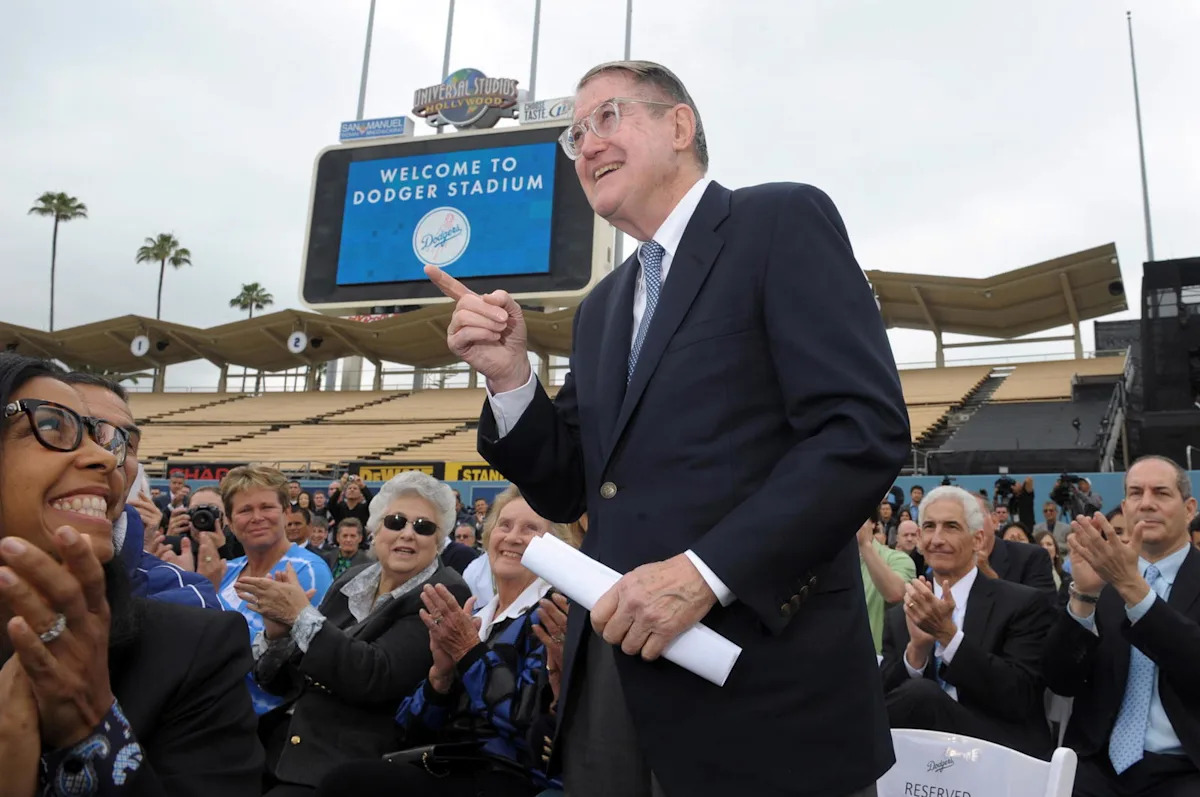
On this day in 1997, Peter O’Malley revealed his intention to sell the Los Angeles Dodgers, signaling the end of one of the most influential ownership tenures in Major League Baseball history. The announcement marked a turning point not only for the franchise, but for the sport itself, as the Dodgers prepared to transition away from nearly 50 years of continuous family ownership under the O’Malley name.
The O’Malley era began in 1950, when Walter O’Malley purchased the Brooklyn Dodgers. Seven years later, he made the franchise-altering decision to relocate the team to Los Angeles, a move that forever reshaped the geography of Major League Baseball. Under Walter and later Peter O’Malley, the Dodgers became a model organization, blending innovation, player development, and community engagement in ways few teams could match.
Advertisement
Peter O’Malley officially took control of the franchise in 1979 and continued many of the principles his father established. During his stewardship, the Dodgers captured World Series championships in 1981 and 1988, while consistently fielding competitive teams built on a strong farm system. The organization was widely respected for its stability, long-term vision, and emphasis on homegrown talent. Dodger Stadium, already iconic, remained one of the sport’s crown jewels during his tenure.
Despite that success, financial realities were shifting rapidly in the 1990s. Player salaries were rising, ownership models were changing, and the economics of baseball were becoming increasingly corporate. O’Malley, known for his traditional approach and reluctance to operate the team at a loss, determined that it was time to step aside rather than fundamentally alter how the franchise was run.
In 1998, O’Malley completed the sale of the Dodgers for $311 million, a figure that reflected the franchise’s immense value and stature within the sport. At the time, it was one of the largest transactions in baseball history. The sale officially closed the O’Malley chapter, ending an era defined by stability, championships, and profound influence on the game’s expansion and popularity on the West Coast.
While the Dodgers would go on to experience varying degrees of success and turbulence under subsequent ownership groups, the legacy of the O’Malley family remains deeply ingrained in the franchise’s identity. From the move west to the establishment of Dodger Stadium and decades of sustained competitiveness, their impact is still felt today.
Advertisement
The 1997 announcement was more than a business decision—it was the conclusion of a foundational era in Dodgers history, one that helped shape the modern MLB landscape and cemented Los Angeles as one of baseball’s most important markets.