
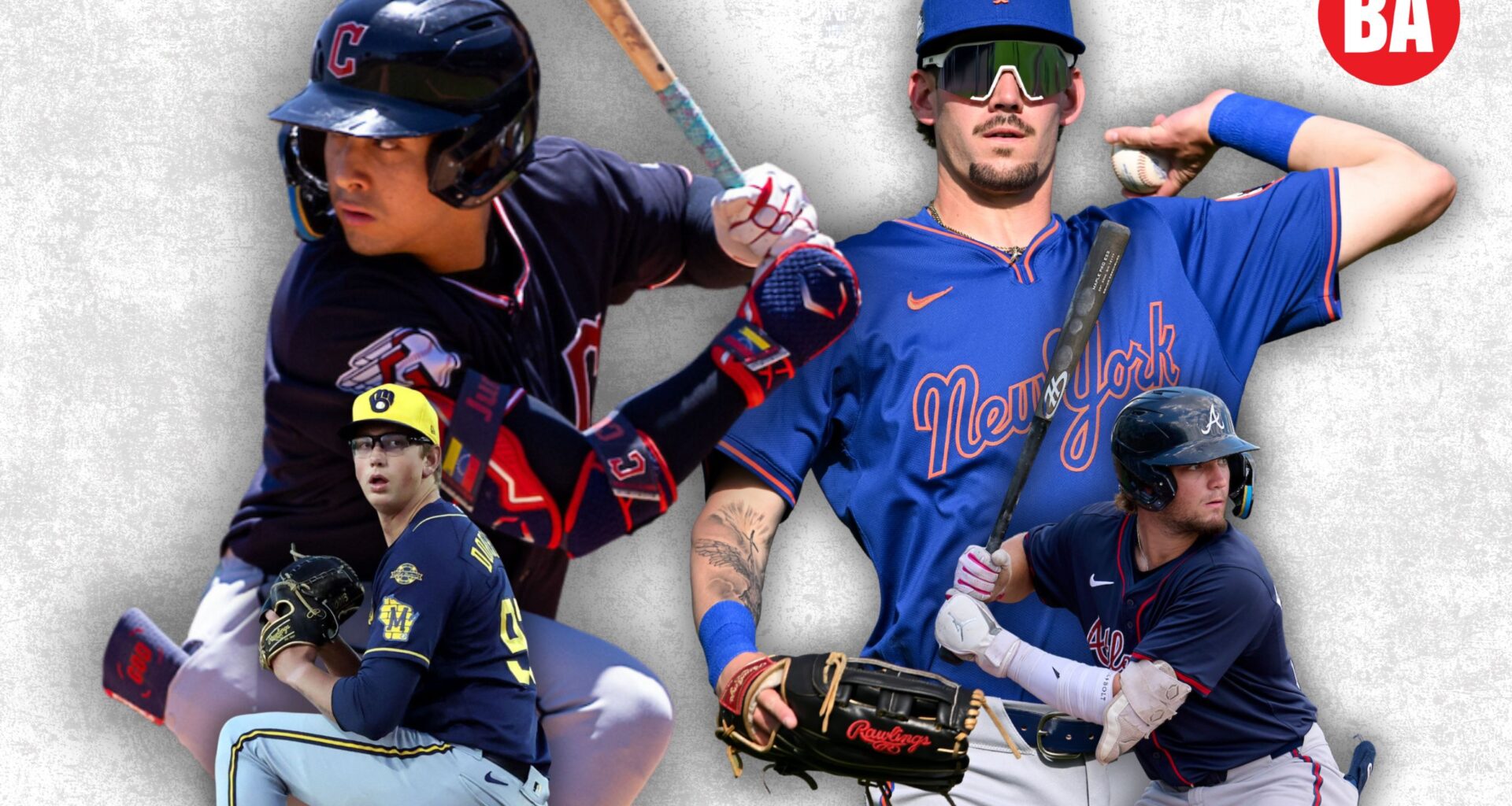
Prospect season rolls on at Baseball America with the release of our preseason 2026 Top 30 Prospects for every system, the earliest we’ve ever rolled out all 30 updated rankings. Now, it’s time to find some picks to click for every organization.
Below, find one sleeper prospect in each MLB system who could take a significant step forward in 2026. For the purposes of the exercise, a sleeper is defined as any prospect-eligible player who does not rank within his organization’s Top 10 prospects. You can also purchase our 2026 Prospect Handbook here.
Arizona Diamondbacks
Ashton Izzi, RHP
A projection righthander out of high school in 2022, Arizona acquired Izzi at the 2025 trade deadline in the Josh Naylor trade. He works with two mid-90s fastballs: a riding four-seamer with more than seven feet of extension and a sinker. Izzi introduced a low-80s sweeper at the end of 2024 and it was his best swing-and-miss offering in 2025, and his mid-80s gyro slider is his go-to pitch when he needs a strike. While his changeup took a step back, and command and sequencing have been longstanding hurdles, Izzi made tangible strides in the second half of the season, boosting his strike rate to 66.6%. If those gains hold, keep an eye on the 22-year-old in 2026. — Mark Chiarelli
Athletics
Zane Taylor, RHP
Taylor was one of college baseball’s most consistent strike-throwers and his velocity surged in 2025. The A’s drafted him in the fifth round and showed enough confidence for him to make an emergency Triple-A spot start in September, where he struck out four batters over two innings. Taylor’s four-seamer averaged 93.6 mph last spring and was up to 98 mph in instructs. It doesn’t have great shape, but gets results because of its angle, lower release height and precise command. Taylor has a medley of average secondaries and began learning a sweeper in pro ball. He could move very quickly if one of those offerings takes a step forward in 2026 to induce more whiffs. — Mark Chiarelli
Atlanta Braves
Conor Essenburg, OF
Essenburg was a two-way player out of a Lenox, Ill., high school and signed with the Braves for $1.2 million as a fifth-round pick in 2025. He hasn’t officially debuted, but he already raised eyebrows—and expectations—after a handful of highlight plays in bridge league action. Essenburg has excellent bat speed and raw power, though his hit tool against professional pitching is largely unknown. If he can tap into his raw power in games, he could become one of the most fascinating hitting prospects in this system. — Carlos Collazo
Baltimore Orioles
Anthony Nunez, RHP
Nunez has one of the weirder paths to the 40-man roster. The Padres drafted him in 2019 as an infielder, but he returned to college to play at Division II Tampa after the Padres released him. He remade himself as a pitcher during the school’s 2024 national championship run. The Mets signed him as an undrafted free agent, and then traded him to the Orioles for Cedric Mullins. Nunez challenges all four quadrants of the zone with a 95-97 mph four-seam fastball at the top of the zone, a hard two-seamer at the bottom of the zone and an 88-92 mph cutter, sweeper and kick changeup that allows him to work in and out. He could fit eventually as a high-leverage reliever, and he could be part of the O’s 2026 pen. — J.J. Cooper
Boston Red Sox
Henry Godbout, 2B
Boston has two hitters just outside its Top 10 with breakout potential. One is teenager Enddy Azocar, who is already familiar to Baseball America subscribers after showing significant exit velocity gains in 2025. Godbout is the other, with closer proximity. A three-year bat-to-ball maven at Virginia, the righthanded hitter makes excellent swing decisions. He has also shown solid feel for pulling the ball in the air. The Red Sox have successfully helped hitters unlock additional bat speed in pro ball and believe Godbout could be next. If that happens, his fringe-average power could play up and allow him to move quickly through the upper minors as an offensive-minded infielder capable of posting high averages and, perhaps one day, peppering the Green Monster. — Mark Chiarelli
Chicago Cubs
Josiah Hartshorn, OF
A switch-hitter, Hartshorn dealt with a variety of injuries as a high schooler including elbow, back and oblique woes that limited him to exclusively swinging lefthanded or righthanded for long stretches of his senior year. The Cubs made him their sixth-round pick in 2025 and signed him for a well above-slot $2 million bonus. Hartshorn combines an average hit tool with above-average power, and a chance for even more power if he can remain healthy and add more strength to his frame while refining his switch-hitting. He can play all three outfield positions but is destined for a corner. Hartshorn’s injury history and the Cubs’ recent struggles developing high school picks creates significant risk. — Geoff Pontes
Chicago White Sox
Matthew Boughton, SS
Boughton entered the 2025 draft with some signability questions and wasn’t highly ranked, but the White Sox pried him from a Texas A&M commitment in the 11th round for $197,500. His age also worked against him—he turned 20 in September—and he has yet to make his pro debut, so there’s clear risk. Still, Boughton is an uncommonly athletic high school infielder. He’s a three-time track and field state champion as a jumper and also a plus runner. Offensively, he will need to tighten his bat path and sharpen his hit tool, but his speed and defensive potential create multiple avenues to add value. Boughton ranks 30th in a White Sox system light on position players beyond its top 10, making him an intriguing lower-level name in 2026. — Mark Chiarelli
Cincinnati Reds
Jose Franco, RHP
Between the coronavirus pandemic and an elbow injury, it took Franco six years to get out of Class A, but he sped up his timetable in 2025, riding increased velocity to impress at Double-A Chattanooga and Triple-A Louisville. The Reds added him to the 40-man roster this offseason, and he should serve as a useful swingman for the big league club in 2026. He now can reach back for 97 mph when needed and generally sits 94-96. That fastball and his average slider, combined with his competitiveness, gives him a shot to be a solid big league contributor. — J.J. Cooper
Cleveland Guardians
Juneiker Caceres, OF
Caceres could get overlooked in a Cleveland system that is deep with upper-level hitters who have done more in their careers and are more famous. But Caceres has an enviable hit/power combination and doesn’t turn 19 until August. He was one of the best prospects in the 2024 Dominican Summer League, then had a successful stateside debut in 2025 when he hit .270/.379/.410 in 70 games between the Arizona Complex League and Low-A Lynchburg. He’s a modest defender and runner who should be fine in a corner, but his raw power, contact ability and plate skills give him a rock-solid offensive foundation to build on. — Carlos Collazo
Colorado Rockies
Derek Bernard, OF
Bernard has hit nearly .300 at every level since turning pro in 2022. He took it up a notch in 2025 by slashing .302/.385/.448 with six home runs in 72 games with Low-A Fresno. Bernard showed plus raw power and above-average in-game exit velocities, but still needs to prove he can handle spin and high-octane offerings. He has a very athletic frame, but struggles defensively. If he can add any more value in the outfield, his profile could surge. — Jesús Cano
Detroit Tigers
John Peck, SS
From 2023-2025, the Tigers produced a number of infielders with solid bats and iffy defensive resumes like Jace Jung and Colt Keith. Peck is the counterbalance as a true shortstop who could provide above-average defense at any infield spot. He’s a plus runner who is a very smooth, reliable defender with an above-average arm. He has hit so far, but his bat will likely be challenged against better pitching. With defense like this, that shouldn’t matter too much, especially for a team that could use additional glove-first infield options in upcoming years. — J.J. Cooper
Houston Astros
Lucas Spence, OF
Spence went undrafted out of Southern Illinois-Edwardsville in 2024. A little over 18 months later, he looks like the Astros’ latest scouting find. The lefthanded hitter showed advanced hitting ability as he climbed three levels in 2025, making in-season adjustments to his swing to create more loft and slash his groundball rate. Spence is a plus athlete who can stick in center field as a plus runner and thrower. His well-rounded profile has a chance for five average or better tools. Spence does a majority of his damage against righthanded pitching and will need to improve against lefties to project as an everyday player. — Geoff Pontes
Kansas City Royals
Warren Calcaño, SS
A Cuban shortstop, Calcaño had his bonus reduced when a physical revealed a shoulder issue, and then missed almost the entire 2025 Dominican Summer League season because of surgery to repair that shoulder. So, there’s plenty of risk until Calcaño shows he’s fully recovered. But if he can bounce back to his pre-injury form, Calcaño could be an everyday MLB shortstop with plus defense, an above-average arm and solid bat control to go with above-average athleticism. There’s all kinds of risk in his profile, but there’s also rare upside. — J.J. Cooper
Los Angeles Angels
Hayden Alvarez, OF
Alvarez was a big part of the Angels’ 2024 international class. He has proven to be a very productive player so far, and was a key part of the Angels’ 2025 Arizona Complex League champs. He has everyday upside with a smooth swing and solid plate discipline, although he’ll need to add bat speed and power to be a future MLB regular. The biggest questions revolve around his defense. He is a plus runner, and he’ll flash the ability to play center field, but on other nights he looks lost in the outfield. — J.J. Cooper
Los Angeles Dodgers
Christian Zazueta, RHP
Acquired from the Yankees in February 2024, Zazueta was coveted for his athleticism and projection. Over the last two seasons, he’s begun to emerge as one of Los Angeles’ best pitching prospects. He’s added strength to his large 6-foot-3 frame, and his pitches have gotten stronger as well. He posted a solid 2025 season at Low-A Rancho Cucamonga and will advance to High-A in 2026. There, his goal will be to improve his breaking ball enough to match the quality of his fastball and changeup. If he can, he should be in the top 10 of this system in short order. — Josh Norris
Miami Marlins
Fenwick Trimble, OF
There’s no shortage of confidence inside the Marlins organization that Trimble is poised for a sizable jump in 2026. The 2024 fourth-round pick showed a clear feel for quality contact in 2025, producing above-average exit velocities. He also showed advanced strike-zone discipline with limited chase and added value on the bases with his plus run tool. Trimble’s primary obstacle remains batted-ball shape. He posted below-average launch angles and lifted pulled contact just 16.7% of the time, factors that capped his power output at seven home runs. Swing adjustments aimed at elevating his best contact could unlock another gear. If that progress comes, a breakout season could follow. — Jacob Rudner
Milwaukee Brewers
Ethan Dorchies, RHP
Dorchies has a lot of projection indicators pointing in the right direction. He just turned 19 in October, so he was young for a 2024 high school draft pick, and he spent the 2025 season pitching well between the Rookie-level Arizona Complex League and Low-A Carolina. He’s 6-foot-6, 227 pounds and pitches off a fastball that sits in the low 90s, touches 96 mph and should climb higher as he continues gaining strength. He moves well on the mound with good extension and comes at hitters from a lower release height for his size, mixing two- and four-seam fastballs with a slider that flashes above-average, a solid cutter and a splitter that can get empty swings against hitters from both sides of the plate. If he comes out throwing everything with a touch more power in 2026, he could vault up the rankings. — Ben Badler
Minnesota Twins
Adrian Bohorquez, RHP
Despite steadily improving stuff, Bohorquez’s strike-throwing has always held him back. But his control improved throughout 2025 and by the end of the season he was throwing the most strikes of his career. Bohorquez cut his walk rate to 6.1% over his final six High-A starts of 2025. Prior to that, his lowest at any affiliate was 11.3%. Bohorquez can run his fastball up to 98 mph and pairs that with two high-spin breaking balls that can miss bats. If his improved strike-throwing carries over to 2026 and his changeup progresses, he has a chance to become an intriguing starting pitching prospect. — Ian Cundall
New York Mets
Eli Serrano III, OF
Drafted in the fourth round out of NC State in 2024, Serrano served as a sparkplug for a dynamic High-A Brooklyn lineup in 2025. He got out of the gates hot with an .813 OPS in the first half, but that figure dipped by more than 250 points in the second. Serrano is a 6-foot-6 lefthanded hitter who does a little bit of everything well, including limiting his miss rate despite having such long levers. He produced the 14th-best isolated slugging among qualified South Atlantic League hitters, a product of strong exit velocity data and a low groundball rate. — Matt Eddy
New York Yankees
Mac Heuer, RHP
He hasn’t thrown a professional pitch, but Heuer already is knocking on the door of the top tier of New York’s system. The righty is one of three Texas Tech alums among the Yankees’ top 30—fellow righties Chase Hampton and Jack Cebert are the others— and has the physicality and frame to overpower hitters, and he sports three potentially average or better pitches as well. If he can add a bit more velocity to his curveball, it could also reach that level of quality. Heuer’s college pedigree should allow him to begin his career at least at High-A Hudson Valley, putting an upper-level debut in the cards for the second half of 2026. — Josh Norris
Philadelphia Phillies
Ramon Marquez, RHP
Marquez was a low-dollar signing out of Mexico in 2025 and quickly made the Phillies’ investment look wise. The Phoenix-born righthander was one of the best pitchers in the Florida Complex League, and he upped the ante by season’s end with a strong turn in the Florida State League that included five no-hit innings in his season finale. Marquez bamboozles hitters with a strong fastball-changeup combination and a willingness to relentlessly pound the strike zone. He rounds out his mix with a slider that currently projects as a 40-grade offering and will need time and repetitions to become a viable third pitch. If he can achieve that goal while maintaining the quality of the rest of that mix, he has a chance to one day fit in a big league rotation. — Josh Norris
Pittsburgh Pirates
Duce Gourson, INF
The Pirates’ farm system is teeming with high-risk, high-reward types in the lower levels. Gourson represents a different profile. A 2024 ninth-rounder, he was viewed as a sum-of-his-parts type with polished skills, a slashing swing and no obvious carrying tool. But Gourson was far more of a complete hitter in 2025. He added 3-4 mph of bat speed and unlocked better impact to pair with his already solid foundation of strong strike-zone control and pitch recognition. He also did a better job elevating and pulling offspeed pitches. An instinctual player with defensive versatility, Gourson logged time at third, second and first base and has already reached the upper minors. While others carry more pedigree in Pittsburgh’s infield depth chart, Gourson firmly put himself on the radar entering 2026. — Mark Chiarelli
St. Louis Cardinals
Ryan Mitchell, SS/OF
The Cardinals historically have found success in the draft when targeting higher upside high school players. Mitchell, their second-round pick in 2025, falls squarely into that category. The lefthanded hitter had plenty of high-level showcase experience and built a reputation as one of the best hitters in the 2025 high school class. Mitchell’s approach at the plate and bat path is geared for line-drive contact, though he does show at least average underlying power and will likely make some adjustments to add loft. He’s a versatile defender who will see time at shortstop and in center field this season. Mitchell has lots of upside with a good balance of twitchiness and developed baseball skills. — Geoff Pontes
San Diego Padres
Tucker Musgrove, RHP
Musgrove is shaping up to be a scouting success story for San Diego. A seventh-round selection out of NAIA Mobile, Musgrove missed all of 2024 recovering from Tommy John surgery. Following a solid pro debut with Lake Elsinore in 2025, Musgrove made waves in the Arizona Fall League. He’s an athletic righthander whose profile is anchored by an exciting fastball-sweeper combination. His fastball sits in the mid-to-upper 90s and has been up to 100, but it plays above its velocity band because it’s a high-spin offering with a flat vertical approach angle. It generated a 39% miss rate in 2025, while Musgrove’s sweeper flashes sharp, lateral life and also is a viable swing-and-miss pitch. Musgrove’s athleticism and high-end stuff both serve as exciting building blocks for his development and he is one of the more intriguing arms in San Diego’s system. — Peter Flaherty
San Francisco Giants
Carlos Gutierrez, OF
Gutierrez’s 2026 New Year’s resolution undoubtedly is to stay healthy and on the field. When he’s been available, the lefty-swinging outfielder has been a menace to opposing pitchers. He makes oodles of contact, rarely strays from the strike zone and has a dash of power as well. He handled fastballs and offspeed with aplomb, and showed enough speed to swipe 26 bases as well. Gutierrez also can provide value with his glove. He has the chops to handle center field and potentially be above-average, but he could be even better in a corner. That’s especially true for the Giants, whose home park has plenty of turf to chew up in the corners. — Josh Norris
Seattle Mariners
Leandro Romero, SS
The Mariners had a strong contingent in the 2025 Dominican Summer League, but no one stood out more than Romero in his second year at the level. He slashed .304/.367/.557 with a .924 OPS and tied for the third-most homers (nine) on the circuit. He’s a very polished defender for his age with a plus arm and snappy release who should stick up the middle. He made far more contact in his second attempt at the DSL, but his uppercut swing can leave him susceptible within the strike zone. He’s one to watch if he can sustain those offensive gains in his stateside Arizona Complex League debut in 2026. — Jesús Cano
Tampa Bay Rays
Ty Johnson, RHP
Johnson’s exceptional 2025 Double-A season is a bit of a misdirection. He pitched to a 2.61 ERA with 149 strikeouts over 110.1 innings and 20 starts. However, anyone expecting a solid big league starter will likely be disappointed. Instead, Johnson’s results are a great sign for the funky low-slot righthander’s chances of becoming a quality big league reliever. He is a true two-pitch pitcher who almost exclusively relies on his fastball and slider. Hitters don’t pick the ball up well out of his hand, and he has shown he can turn over a lineup with lefties as well as righties. That could get him to the big leagues in 2026 as a quality reliever. — J.J. Cooper
Texas Rangers
Izack Tiger, RHP
The 2025 season was supposed to be Tiger’s coming out party, but Tommy John surgery got in the way and he missed the year. He was back into the upper 90s in bullpens by season’s end, and there was talk that he might get some action in winter ball as well. When healthy, the righthander throws a hot, lively fastball and backs it with a slider and splitter that each project as above-average or plus pitches. His control is only fringy, but his mix should be enough to overpower hitters in the early stages of his career before having to fine-tune his strikes at the upper levels. If his entire repertoire comes back unscathed, he has the stuff to quickly rise through the ranks. — Josh Norris
Toronto Blue Jays
Silvano Hechavarria, RHP
In many ways, Hechavarria got lost in the shuffle among the many Blue Jays pitching breakouts in 2025. He signed out of Cuba in 2024 and began 2025 in the Florida Complex League before quickly earning a promotion to Low-A Dunedin. Over 11 games with Dunedin, Hechavarria pitched to a 1.90 ERA with 53 strikeouts to 11 walks over 47.1 innings. He then went 3-0, 3.22 over four late-season starts with High-A Vancouver. Hechavarria mixes three pitches in a fastball, slider and changeup. His average fastball sits in the low-to-mid 90s with average shape. His slider is his best pitch and an above-average swing-and-miss pitch. — Geoff Pontes
Washington Nationals
Marconi German, SS/2B
German signed for a modest $400,000 out of the Dominican Republic in 2025 and turned in one of the most productive seasons in the Dominican Summer League. Among players age 17 and younger, his .992 OPS ranked fourth-best among DSL qualifiers. German popped eight homers, stole 33 bases and drew 43 walks in 53 games. He’s a 5-foot-10 switch-hitter with well-rounded tools and the potential to stick in the middle infield, possibly at shortstop. German should make exit velocity gains as his body matures, but his passive batting approach may be challenged by more experienced pitchers. — Matt Eddy