
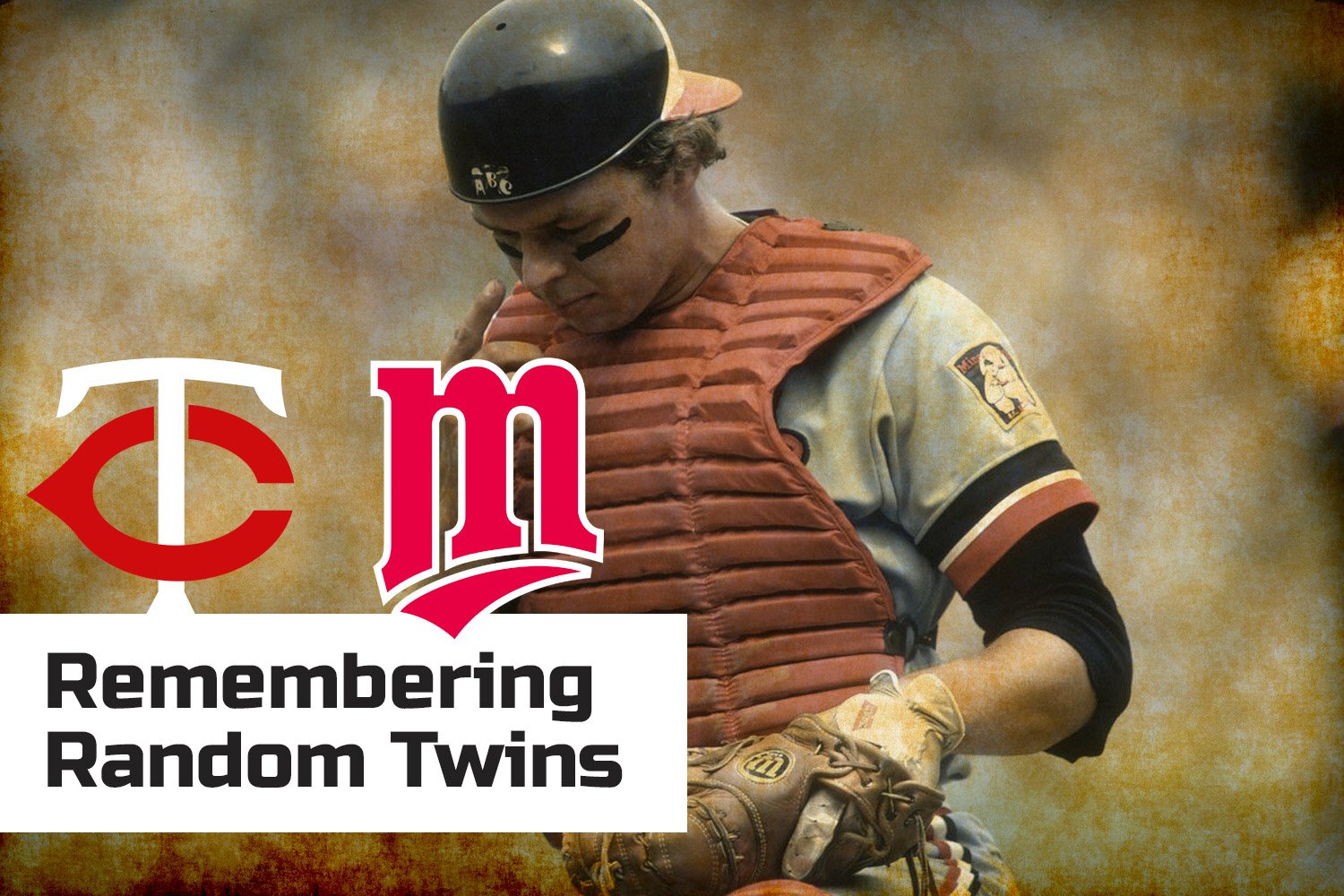
Butch Wynegar was a bright spot on some middling Twins teams in the late 1970s. He remained in Minnesota as one of the team’s more recognizable players when other successful players such as Rod Carew, Larry Hisle, and Lyman Bostock moved on to greener pastures. Once his success turned into a higher salary, he too moved on in a trade to the New York Yankees.
Harold Delano “Butch” Wynegar was born on March 14, 1956, in York, Pennsylvania, a city of approximately 50,000 people located in the south-central part of the state. He grew up and attended high school in the nearby town of Red Lion. Wynegar played catcher in high school, attracting the attention of local baseball scouts. He was always a switch-hitter, imitating his idol, Mickey Mantle. The Minnesota Twins decided to select the promising six-foot-one, 190-pound Wynegar in the second round of the 1974 June Amateur Draft.
Shortly after the draft, Wynegar signed and went to Elizabethton for rookie league ball. He immediately fared well, hitting .346/.464/.524 with eight home runs and 51 runs batted in. His .346 batting average led the Appalachian League, and he was named to the All-Star team. An impressive debut. He followed that with an equally remarkable .314/.473/.500 for Class-A Reno in 1975. He led the California League with 142 walks and 112 runs batted in. He was certainly showing he had an innate hitting ability.
By 1976, he had caught the attention of the Twins’ front office and manager Gene Mauch, as catching was an area where the team sought improvement. Wynegar was invited to spring training, where he impressed enough to make the Opening Day roster as the starting catcher. Wikipedia reports Wynegar is the only catcher to have jumped directly from Class A to MLB. Wynegar made an immediate impact, starting 18 of the first 20 games of the season. His first career home run was a game winner against future Hall of Famer Catfish Hunter in Wynegar’s eighth career game. Starting on May 8 of that season, Butch had multiple hits in eight of his next nine games, quickly increasing his batting average from .190 to .315. The 20-year-old rookie was showing he belonged. He continued to hit throughout the season’s first half and was selected for the All-Star Game. Wynegar entered the midsummer classic in the 7th inning when he walked in his lone plate appearance. Unfortunately for Wynegar and the American League, they were beaten soundly by the senior circuit, 7-1.
Wynegar cooled in the second half of his rookie season but still hit .260/.356/.363 for the complete season. While he was the fourth youngest player in the American League, he proved he was not overwhelmed, exhibited a discerning eye at the plate (79 walks versus 63 strikeouts), showed a little pop in the bat with ten home runs amongst 33 extra base hits, and started a whopping 145 games as a 20-year-old catcher. He finished second in Rookie of the Year voting behind the flamboyant Mark “the Bird” Fidrych, who had a historic 19-win, 9.6 WAR season, and practically became a cultural icon.
Wynegar’s second season, 1977, was statistically remarkably similar to his first. Good hitting, a little power, a ridiculous amount of starts behind the plate, and a second All-Star selection. Once again, the National League scored seven runs and won the game, this time 7-5. Wynegar’s involvement started in the 7th inning with a leadoff single off Tom Seaver. He would score four batters later on a single by Willie Randolph. He would get another at-bat in the 8th inning, but grounded into a double play.
For the next four seasons, Wynegar continued to shoulder the defensive load, playing at least 135 games per season (excluding the 1981 strike-shortened season). However, his batting numbers were slipping ever so slightly each season. He was by no means a bad-hitting catcher, but he wasn’t playing at an All-Star level anymore. His fielding abilities remained solid. His caught stealing percentage in 1979 (52.9%) was the best in the AL, and his Total Zone Runs Above Average was the best in the league in both 1979 and 1980. He was an asset on both sides of the plate.
In 1981, Butch Wynegar and the Minnesota Twins agreed on a five-year, $2 million contract. While I’m sure he was initially ecstatic, that probably put a target on his back, indicating to the owner that the player should be traded. In the early 1980s, most Twins players of any ability, i.e., those with a salary, were traded. Not long thereafter, in early 1982, Wynegar was shipped to the Yankees with Roger Erickson for Pete Filson, Larry Milbourne, and John Pacella. Filson provided 3.5 WAR in five seasons with the team. Milbourne and Pacella each played for the Twins for less than one full season. Each registered a negative WAR in their time with the club—an underwhelming return to say the least.
Wynegar spent five seasons in New York. He put up similar numbers and value as he did for the Twins. His offense was better compared to his Twins seasons, but there were no more All-Star games. His defensive fielding abilities seemed adequate, but he was no longer leading the league with any of his defensive numbers. He seemed to be a perfectly capable starting major league catcher. However, the stress of playing in New York took a toll on Wynegar. In 1986, he asked for time off to cope with depression. His request was granted – for one day. Eventually, the stress and unhappiness became too much, and he walked away from the Yankees and $1.4 million in salary. After the season, he requested a trade.
In December of 1986, the Yankees dealt Wynegar to the Angels for Ron Romanick and Alan Mills. The trade proved to be uneventful as Wynegar, now in his early 30s and battling an arthritic big toe, was winding down. He played only 31 games in 1987 and 27 in 1988. Romanick never played for the Yankees, and Mills offered only 0.1 WAR in two seasons in the Bronx.
Wynegar’s 13-year career was over after 1988. He finished with those two All-Star appearances in those first two glorious seasons. His final batting line was .255/.348/.347. His OPS+ was 93. He had 65 home runs and 506 runs batted in. He struck out only 428 times in 5,067 plate appearances while drawing 626 walks. He was behind the plate for the Yankees in 1983 when Dave Righetti pitched a no-hitter, and in 1985, for two Phil Niekro milestones: his 300th win and 3,000th strikeout. Butch’s 1,247 games caught are 66th most in MLB history – higher than I would have expected for a guy whose career was over by the age of 32.
Starting in 1991, Wynegar served as a coach or manager all over baseball from the college level to the big leagues. He served as the hitting coach of the Milwaukee Brewers from 2003 to 2006. The last coaching assignment I uncovered was in minor league baseball during the 2018 season.
While he had a nice, long 13-year career, Wynegar seems like a bit of a flash in the pan to me, or maybe a what-if? He started so young and with such immediate success, it seems his career could have or should have led to something more.
What do you remember of Butch Wynegar? Please share your thoughts below. If you like looking back at the Twins’ past, check out my previous articles at Twins Daily History.
Sources include Baseball Reference and Wikipedia.
Are you interested in Twins history? Then check out the Minnesota Twins Players Project, a community-driven project to discover and collect great information on every player to wear a Twins uniform!