
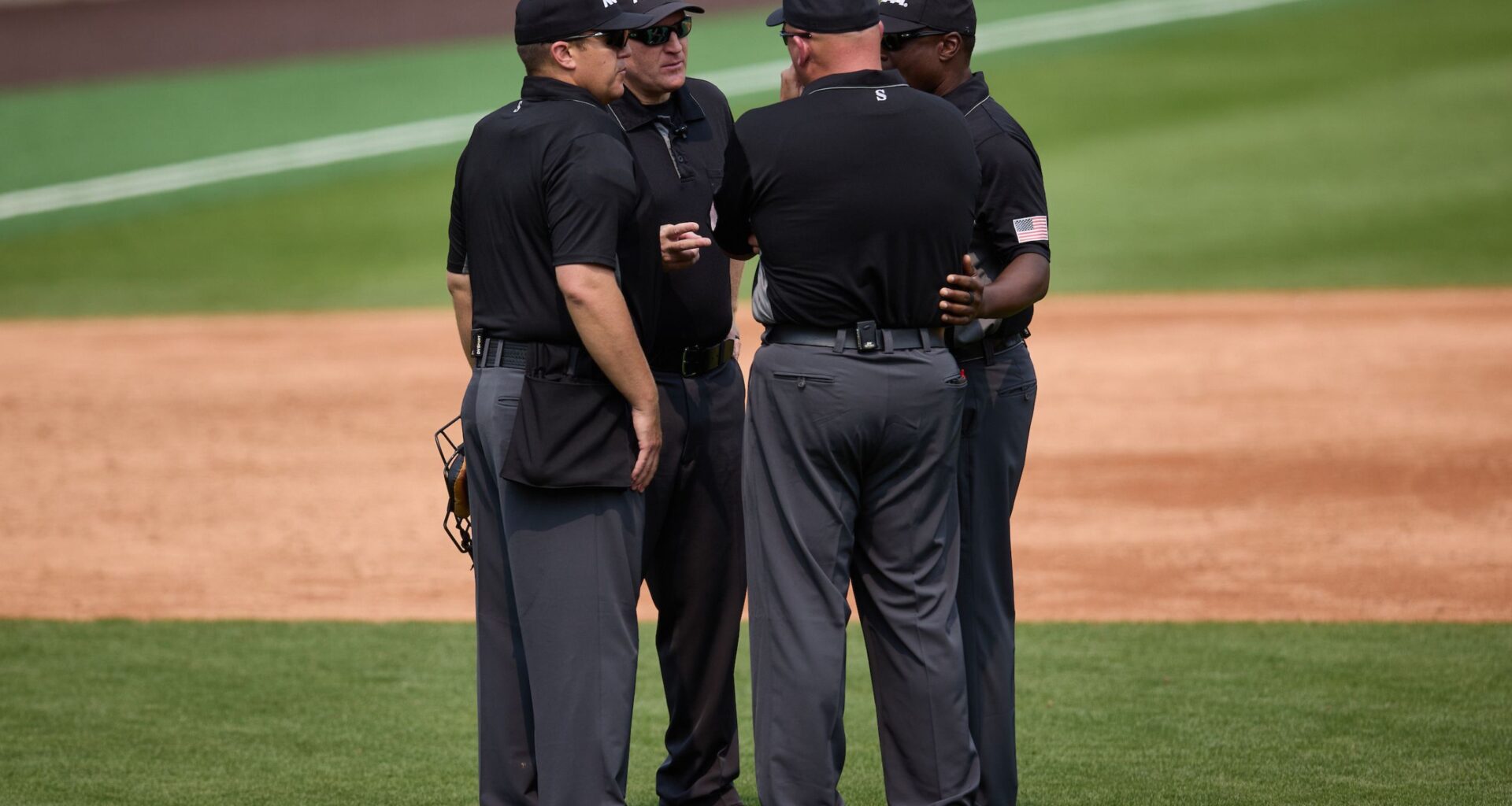
For years, college baseball coaches have complained quietly—and sometimes not so quietly—that the sport’s biggest games are too often shaped by inconsistent strike zones rather than players on the field.
When the stakes rise, the margins disappear. Every pitch matters. Every call lingers. And in a sport where postseason outcomes can hinge on a handful of borderline decisions, frustration with umpiring has followed college baseball deep into June.
That reality is now driving change.
Beginning in 2026, umpiring assignments for the super regional round will no longer be determined before the start of the NCAA Tournament. Instead, crews will be selected largely based on an umpire’s regular season body of work and performance during the regional round. The College World Series umpiring crew will be chosen through a similar process, with selections informed by a full season of evaluation rather than preset assignments.
The postseason shift represents the most visible outcome of a broader effort to overhaul how college baseball evaluates, develops and deploys its umpires. It’s an initiative shaped jointly by newly appointed national coordinator of umpires Jeff Gosney and Florida State athletic director Michael Alford in his role as chair of the NCAA Division I Baseball Committee.
Alford, who was appointed in September, identified umpiring as one of the areas he hoped to impact most after years of limited progress despite the growing availability of evaluation tools.
“I want to make a difference in how we approach that, and I think there are going to be a lot of great people around me who are motivated to do the same,” Alford told Baseball America in September.
With Gosney newly installed as national coordinator, Alford saw an opportunity to address long-standing concerns about how officiating performance was assessed and corrected across the sport. Missed balls and strikes calls often lingered without adjustment. In-game situations were mishandled without consistent follow-up. The problem, leaders emphasized, was not the existence of human error, but the absence of a system capable of learning from it quickly and uniformly.
For coaches, those gaps could shape postseason careers. For players, they could redefine an at-bat, a season or a draft evaluation, often without recourse.
Assessing that disconnect became a shared priority.
Working in tandem, Alford and Gosney focused on building a more consistent evaluation framework, emphasizing objective information as a developmental tool rather than a punitive one. The aim was not to eliminate error, but to create accountability that extended beyond individual games and into long-term improvement.
“I’m going to be working closely with (Gosney) on making sure we utilize data and evaluation that we haven’t done before,” Alford said. “What can we use? What can we do to make umpires better as a teaching tool? I think it’s awesome that we have this capability, so let’s utilize it to the max.”
That collaboration has already produced tangible change.
This offseason, the NCAA signed an agreement with Trackman that will allow umpires to receive detailed reports on their performance behind the plate, providing a data backbone for both instruction and assignment decisions. The reports will give evaluators a clearer picture of accuracy and consistency across the season, aligning performance review with the demands of postseason baseball.
Together, the new evaluation tools and revised postseason selection process represent a coordinated attempt to bring accountability and consistency to college baseball’s officiating pipeline. For the first time, postseason assignments will reflect a full season of evaluation rather than a predetermined calendar—an acknowledgment that the sport’s biggest moments demand its best, not just its most available.
The goal, officials say, is simple: When college baseball reaches its most consequential stages, the outcomes should be decided by the players on the field, not by uncertainty behind the plate.
“We want our best ball-strike umpires at the game’s highest level,” Gosney said Thursday while addressing hundreds of Division I, II and III coaches at the American Baseball Coaches Association convention in Columbus, Ohio.
Gosney is hopeful the changes will help narrow a gap between college baseball umpires and officials in college football and basketball, who he said have long benefited from detailed evaluation systems designed to identify mistakes, track trends and accelerate improvement over time.
In those sports, consistent feedback loops and data-backed grading have become central to both development and assignment, creating clearer pathways for advancement and accountability at the highest levels. College baseball, Gosney acknowledged, has historically lagged behind in that regard, even as the stakes of its postseason have continued to rise.
Ultimately, the goal of the new framework is to create a system in which performance is measured consistently, improvement is tracked deliberately and postseason assignments reflect sustained excellence rather than preset rotation. For the first time, college baseball’s officiating structure is being built to mirror the significance of the moments it is tasked with overseeing.
NCAA Officials Express Concern Over College Exit Velocities
As exit velocities at the college level continue to climb, NCAA officials acknowledged growing concern about the implications for player safety, particularly for pitchers and infielders positioned closest to the ball.
Between 2022 and 2025, average exit velocities at the Division I level increased from 82.5 mph to 86.1 mph. The escalation at the top end has been even more pronounced. Average 90th percentile exit velocity—a benchmark for a hitter’s peak batted-ball output—surged from 96.5 mph to just under 102 mph over that same span, marking the first time since batted-ball tracking was introduced to the college level that college baseball’s 90th percentile average has cracked triple digits.
The rise in batted-ball speed has coincided with an offensive environment approaching levels not seen since before the introduction of BBCOR bats in 2011. Teams averaged 6.8 runs per game at the Division I level in 2025, nearly matching the 7.0 runs per game recorded in 2010 at the end of the pre-BBCOR era. Home runs per game climbed to 1.07, the first time that figure has crossed the 1.0 mark in at least the last 20 years.
Those trends were central to conversations during the American Baseball Coaches Association rules meeting, where officials leaned on research from Baseball America to underscore the urgency of the issue. Rules committee chair and Cincinnati head coach Jordan Bischel said the sport may be nearing a point where proactive examination is necessary.
“If something tragic happens,” Bischel said, “people who don’t eat, sleep and breathe baseball will have to make a decision for us.”
Officials emphasized that the concern is not isolated to any single factor, but rather the convergence of harder contact, shrinking reaction time and uneven safety standards across college baseball. Unlike professional baseball, where equipment regulations and injury-tracking systems are tightly controlled, the college game operates with greater variability across divisions and conferences.
One source told Baseball America on Thursday night that officials have initiated conversations about the baseballs themselves to better understand how they could be contributing to the trend.
For now, discussions remain exploratory. But as exit velocities continue to rise and offensive output trends closer to professional benchmarks, batted-ball speed has emerged as one of the most consequential safety issues facing college baseball as it enters the next rules cycle in 2027.
More Notes From The ABCA Division I & Rules Meetings
The NCAA has approved experimental use of technology in the dugout, most notably iPads with strictly regulated functionality. Pending individual conference approval, players could have access to a modified Trackman interface lacking strike zone feedback, along with a note-taking application. Beginning in 2026, teams would also be permitted to use preloaded or recorded scouting video for in-game study. Multiple ABCA speakers emphasized that conference approval is required for participation, though several noted the change is trending toward permanent adoption if the experiment proceeds smoothly under current guardrails.
Division I coaches will receive a survey regarding two potential rule changes: a mandatory mercy rule and the placement of a runner on second base in extra-inning games, mirroring MLB. Currently, teams may agree before a game to use a mercy rule that ends the contest if there is a 10-run deficit after seven innings. The proposal would establish a mandatory 12-run mercy rule for all games, a consideration driven by shrinking rosters and a desire to avoid unnecessarily lengthy contests. The extra-inning proposal would explore placing a runner on second in the 10th or 12th inning with similar intent. Bischel said the rules committee was in favor of both measures.