
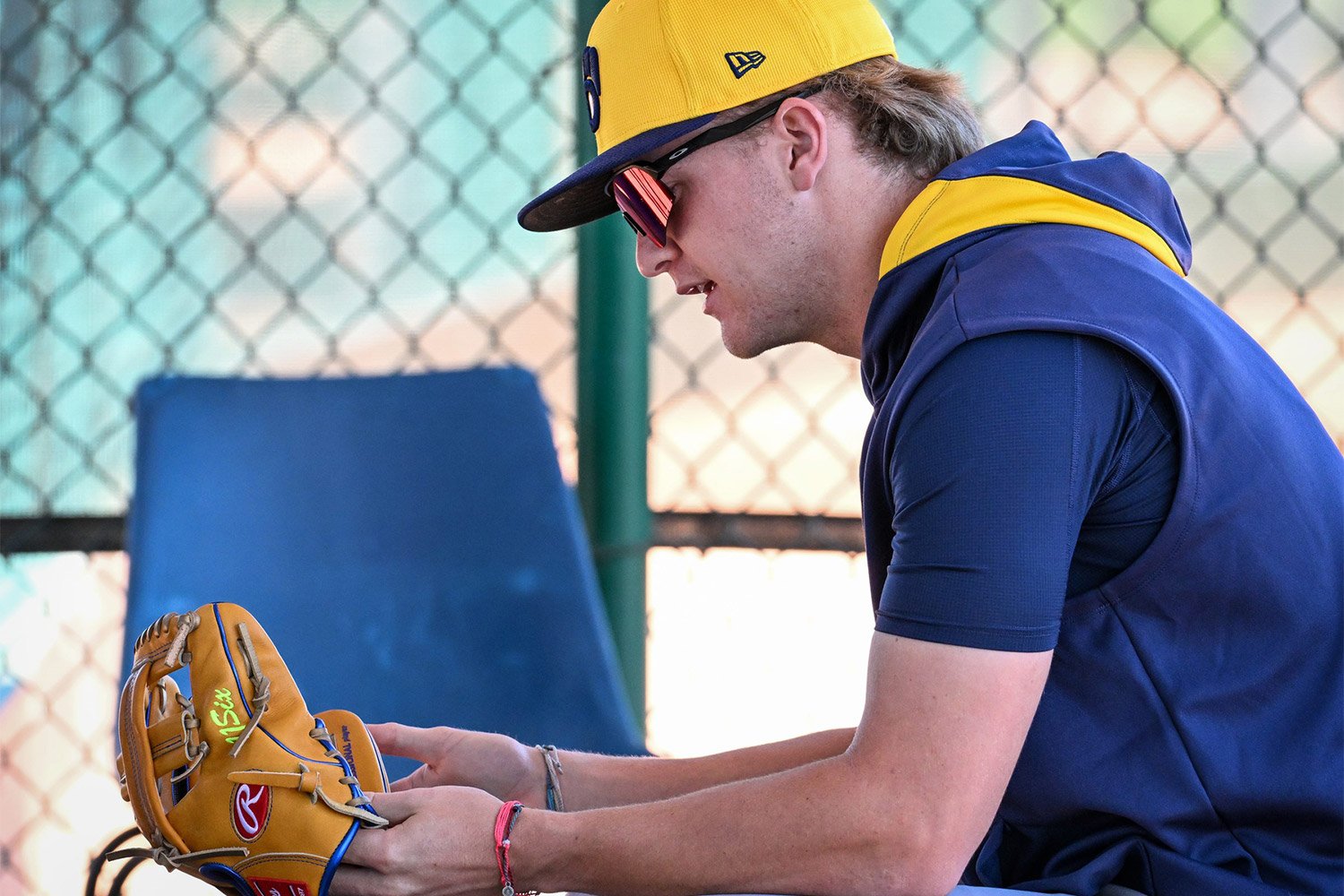
The Milwaukee Brewers have a bit of a conundrum at shortstop. The incumbent, Joey Ortiz, is the epitome of good-field, no-hit, to the point where Milwaukee may be better off moving him. Over the long term, talent like Jesus Made, Luis Pena, Juan Baez, Brady Ebel, and Filippo di Turi could also stake a claim to the position. A short-term solution could be to move Brice Turang there, but that would necessitate filling the resulting hole at second base by sliding Caleb Durbin to the keystone.
So where does that leave Cooper Pratt, who is slated for a Milwaukee debut of his own sometime in 2026? The answer may be a move a little further to the left side of the infield, a move that could benefit both him and the Brewers over the long haul.
Third base might seem to be already in good shape, with Durbin proving to be a solid starter at the hot corner, while the Brewers have multiple options (Brock Wilken, Luke Adams, Andrew Fischer, and Mike Boeve) in High-A or higher. However, Pratt may be a better long-term solution than Durbin.
Pratt’s offensive profile fits the approach used by manager Pat Murphy almost perfectly. As the number three prospect in the Brewer Fanatic Top 20, he’s the type of player who should be a franchise cornerstone. In Biloxi, he walked 67 times in 437 at-bats, striking out only 80 times, which should alleviate some concerns about his bat-to-ball and plate discipline from his brief stint in Advanced-A Wisconsin in 2024. His defense has drawn raves, and he has a minor-league Gold Glove.
Pratt’s current offensive profile in some aspects is similar to that of Wade Boggs in the 1990s, a solid performer who hit for a .300 average and got on base to the tune of a 112+ OPS. In addition, the 1990s version of Boggs delivered very good defense (Boggs won a pair of Gold Gloves during that timeframe). Pratt, though, has shown he is a very capable threat on the basepaths, notching 58 steals in 66 attempts.
So, why the hot corner for Pratt, and why 2026? The fact is, Jesus Made is on a Jackson Chourio-esque rocket up the minor-league ladder. Assuming he splits between Double-A Biloxi and Triple-A Nashville in 2026, he’s likely to be Milwaukee’s Opening Day 2027 shortstop. So, moving Pratt to third would help him get accustomed to what could be a long-term home.
As for bringing Pratt up in 2026, much of that can be laid at the feet of Joey Ortiz, whose offensive production plummeted in 2025. The 2024 version of Ortiz would be pretty good for most teams, but Pratt’s offensive floor is higher than what Ortiz provided in 2025, and his ceiling – especially if he taps into his power potential – could propel him to be among the franchise’s best at that position.
Turang could handle shortstop for 2026 and shift back to second base when Made makes his Milwaukee debut, allowing the Brewers to flank the switch-hitting with two Gold Glove-caliber defenders in the infield – proving some outstanding run-prevention over the next few years, especially if they can work out an extension with Turang.
This also allows the Brewers to use 2023 first-round pick Brock Wilken as a potential trade asset to help nail down a position of need in 2026 – or beyond.
The Brewers have been seeking some hot corner stability since trading Aramis Ramirez. Cooper Pratt may well be the solution to that hot problem.
Do you think Cooper Pratt should handle the hot corner in Milwaukee? Let us know in the comments below!