
Sport: MLB
BABIP is an important statistic that every fantasy baseball manager should be familiar with. It is imperfect, meaning it is not a one-size-fits-all stat that you can measure for every batter. However, BABIP connects to so many other important factors and statistics in a player’s profile that it is essential to understand for anyone looking to become a successful fantasy baseball manager. BABIP is both a hitting and pitching stat, so here we will cover just BABIP for batters.
What?! Your fantasy baseball league wasn’t hosted on Fantrax last season? Preposterous! Check out what the Fantrax MLB Commissioner has to offer and we think you’ll be singing a different tune for the 2026 MLB season.
What is BABIP?
Okay, so let’s start with the easy stuff. BABIP stands for Batting Average on Balls In Play. Basically, what this means is that it measures how often a ball put into play with a bat goes for a hit, excluding homers and sacrifice bunts. It loosely connects with batting average. Generally, a high BABIP means a high AVG, and a low BABIP means a low AVG. Of course, there are exceptions.
Many people consider BABIP to measure luck because factors outside of a batter’s control can impact their BABIP, like the defense they face, a shift, or baserunning speed. Typically, speedy runners tend to have higher BABIPs because they can make it to first on infield hits more often than other players. BABIPs may go up as players face porous, error-filled defenses as they make it on base when they may not against average defenses. This is the same for batters that face teams with Gold Glove defenders, where BABIPs may drop as those defenders make near-impossible grabs.
High line drive hitters also tend to have higher BABIPs because line drives go for hits more often than grounders or fly balls. So if a player hits a ton of grounders, they may end up with a lower BABIP.
These are generalizations, though, and so there are always exceptions. This is why it is important to look at BABIP in context.
What is the Context?
There is no standard or average BABIP, so you have to measure BABIP player by player. Generally, you should measure a player’s season BABIP against their career BABIP, while also analyzing the other factors that may lead it to go higher or lower.
Take a look at Aaron Judge, who had a .376 BABIP last season and a .345 BABIP for his career. He is considered one of the best hitters in baseball. Jose Ramirez, also considered to be one of the best in the game, had a .279 BABIP last season, with a .280 career BABIP. Just because Ramirez has a lower BABIP does not make him any worse of a player. Fantasy managers consistently draft both as early first-rounders because both are elite hitters.
This is why you cannot measure one BABIP against another – you have to go one player at a time. Identifying why a player’s BABIP is higher or lower than their career norm can help you determine if a batter is overperforming, underperforming, or doing exactly what they should be.
A factor that can impact BABIP is how hard a player hits a ball. A hard-hitting player may have a higher BABIP because they can put the ball deep into the outfield in places that defenders may have trouble reaching. This is especially true for batters who hit line drives hard. Hard-hit line drives may whiz past all but the most elite defenders. The same may happen with a hard-hit groundball that skips past a diving shortstop. All of those scenarios could lead to an increase in BABIP, making barrel%, HardHit%, Hard Contact%, Line Drive%, and Pull% important to consider in context with BABIP.
Take Brice Turang, for example. In his first two seasons in the majors, he owned a .287 BABIP and a .239 AVG. Then in 2025, he exploded for a .288 AVG and a .356 BABIP. Was this Turang getting lucky, or did he make improvements to legitimize the increases in BABIP and AVG?
Well, he tripled his barrel% and nearly doubled his HH% from 2024 – good signs for a BABIP increase. On the other hand, his LD% and GB% only marginally improved. If he had more significant improvements in those areas, it could have further legitimized a higher BABIP.
Turang also went from a career 5% HR/FB rate to 13% last season. This means that more of his fly balls turned into home runs than in previous seasons. BABIP does not factor in homers, and he hit fly balls at the same rate in 2025 as in his career. The higher rate of home runs could have to do with the improved hard contact, and it balances out the fact that he did not pull the ball very much.
If Turang had not improved his hard contact, it is likely many of those homers would have turned into outs, which would have lowered his BABIP and AVG to be more in line with his career performance. The key for Turang is whether or not he can build on the changes from last year, or if he will revert to his previous self. Either way, his 2025 BABIP looks legit, even though to the naked eye it seems like he was just lucky. You have to look at the data in context.
Another Layer
The most productive hits in baseball are pulled line drives, especially hard hit ones. Yes, flies can turn into home runs, but they also turn into outs more often than line drives do. The same goes for groundballs and bunts, which can even result in double plays.
So, one rule of thumb when trying to figure out if a batter has an inflated BABIP and an inflated ERA is to look at their LD% and Pull%. A high LD% and Pull%, along with high barrel and HardHit rates, should correspond to a high BABIP and AVG.
2025 BABIP Breakouts
Upon first glance, a few players seem to have had outlier seasons in 2025, with higher BABIPs and AVGs than ever before. Spencer Torkelson, Zach Neto, Corbin Carroll, and Gavin Sheets all had majorly improved seasons. They were all also better than league average in LD%, GB%, Pull%, barrel%, and HH%. This helps to explain why they improved so much in BABIP and AVG. For those players in particular, it is clear their 2025 performances were not flukes.
Other players that were better than league average in those five categories include
Michael Busch
Dansby Swanson
Wyatt Langford
Willy Adames
Brent Rooker
Francisco Lindor
Freddie Freeman
Ian Happ
Seiya Suzuki
Riley Greene
Busch, Langford, Rooker, Lindor, Freeman, and Greene may not have had career bests in BABIP or AVG, but their peripheral stats reflect their performance. Looking at their batted ball and hard contact data shows that they performed basically exactly how they should have in BABIP and AVG.
Swanson and Suzuki appear to have underperformed, simply getting unlucky. Both ended 2025 with BABIPs and AVGs lower than their career norms, despite the background data showing above average performances. Swanson’s .269 xBA and Suzuki’s .252 xBA reflect this when compared to their .244 and .245 AVGs, respectively.
Adames and Happ also seem to have hit into a little bit of bad luck, but for a different reason. Their HR/FB% were lower than usual, meaning that they had more fly balls turn into outs than normal. This could have affected their BABIPs and AVGs negatively, despite performing well otherwise.
2025 BABIP Overperformers?
On the opposite end, here is a list of batters who had BABIPs above league average in 2025, but were worse than league average in LD%, GB%, and Pull%
Trea Turner
Elly De La Cruz
Trevor Story
Christian Yelich
Yandy Diaz
Heliot Ramos
Maikel Garcia
Jackson Chourio
Rafael Devers
Fernando Tatis
Julio Rodriguez
Brandon Nimmo
Randy Arozarena
Trevor Larnach
Alejandro Kirk
Bryce Harper
Chase Meidroth
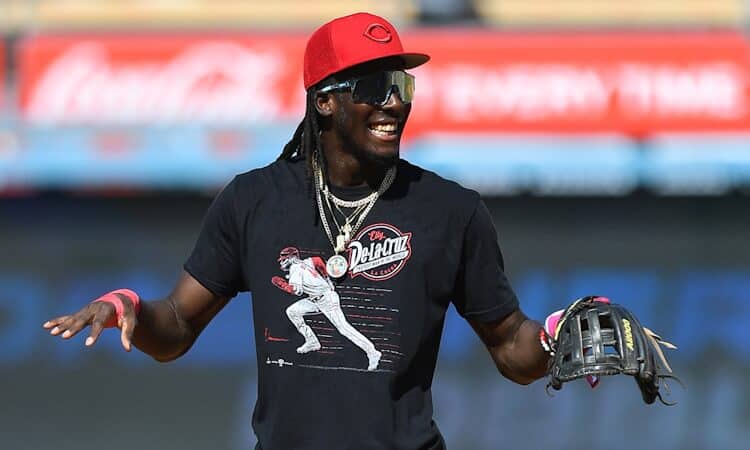
Elly De La Cruz seems to have completely outperformed his metrics when it comes to BABIP and AVG. His .264 AVG was a career best, largely due to significant plate discipline improvements. His BABIP was below his career norm, though, while his AVG shot up 10 points higher than his career norm. That is despite his barrel%, HH%, LD%, GB%, and Pull% al worsening from 2024. His .253 xBA reflect his overperformance.
Yelich is another player who likely should have done worse last season. Even with the added hard contact, he still clearly outperformed his data. His 56% GB rate was worse than it was in 2024 and his career, and his infield hit rate was higher than his career average. He also had a 29% HR/FB rate last season, 10% higher than in 2024 and 7% higher than his career. Yelich did this while also hitting fly balls at a lower rate than last season and just 1% more than for his career, while producing the lowest pull rate of his career.
Those two players appear to have overperformed in 2025, and will likely see regression to their BABIPs and AVGs in 2026. Tatis, Nimmo, and Kirk are also players that may regress some.
Where Do I Go From Here
BABIP is a complicated statistic…clearly. I mostly look at BABIP in-season, which helps me judge player performance. It is not the greatest pre-draft evaluation tool, because so many factors are involved, and you have to go one player at a time.
My best suggestion is to incorporate BABIP into your in-season player evaluation. It is great for helping to determine players to target and to make decisions on player acquisitions or drops.
Understanding how BABIP works, and how it works with other data points, can help fantasy managers see a breakout before it happens. It can also help you better predict regression before it happens.
The risk is that sometimes players will just do better than they are supposed to – Jose Altuve has been doing that his whole career. You just have to trust the data, and most importantly, trust your gut.
Fantrax is one of the fastest-growing fantasy sites in the fantasy sports industry, and we’re not stopping anytime soon. We are the most customizable, easy-to-use, and feature-rich platform in the industry, offering the greatest fantasy experience for your dynasty, keeper, redraft, and best ball leagues. Fantasy sports doesn’t sleep, and neither does Fantrax, with seasons running 365 days a year. Take your fantasy leagues to the next level now at Fantrax.com!