
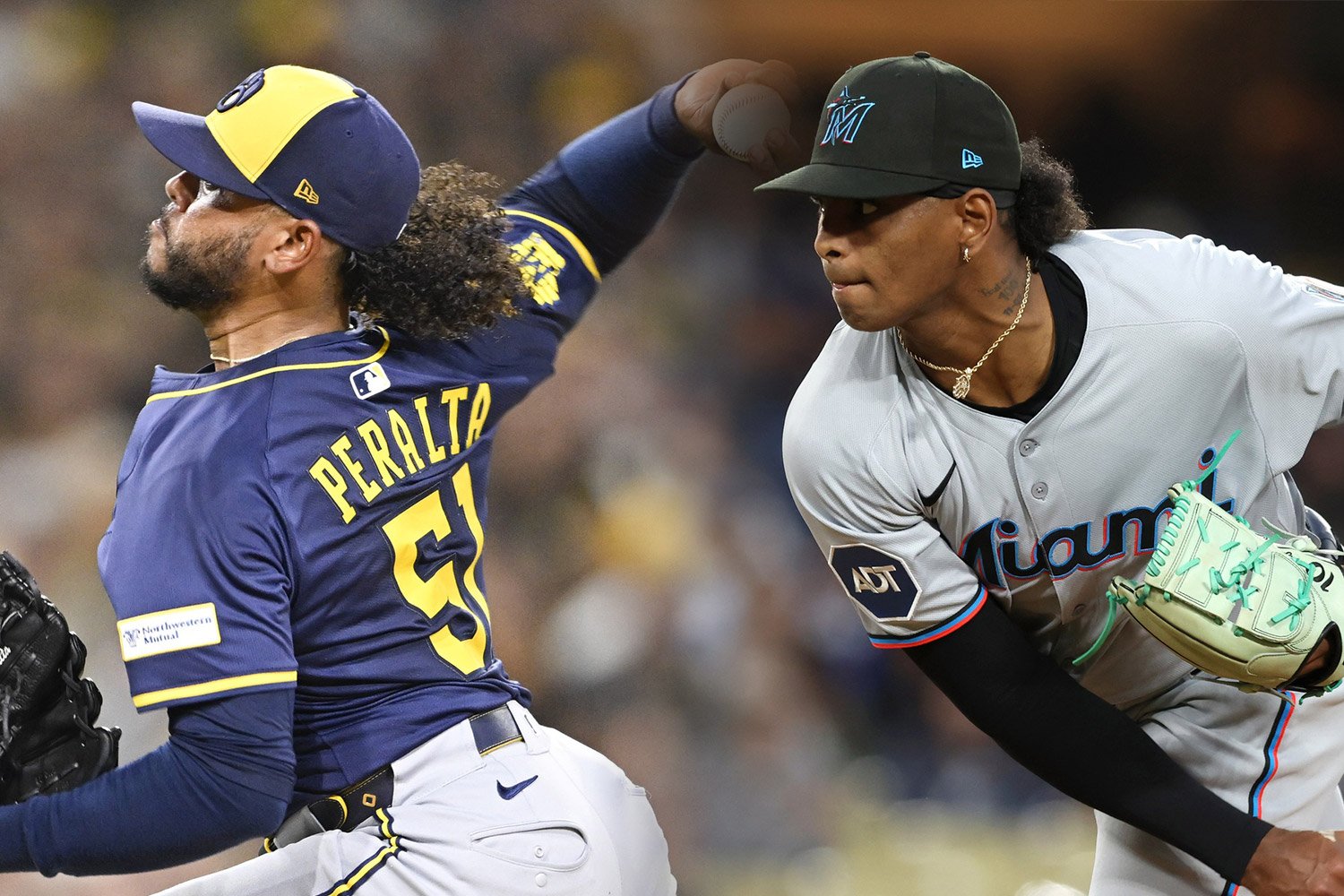
In case you missed it, the Cubs made a move to acquire right-handed starter Edward Cabrera from the Marlins. In exchange, they sent over three prospects: Owen Caissie (No. 47 prospect overall), middle infielder Cristian Hernandez (No.11 CHC prospect), and corner infielder Edgardo De Leon.
It’s a big move for the Cubs’ rotation for several reasons, but here at Brewer Fanatic, we only care about how it affects us on the north side of I-94. We’ve already established that Milwaukee’s front office doesn’t let the moves of even its closest rivals drive the pace at which they operate their offseason, but that doesn’t mean they haven’t been paying attention. They weren’t looking to acquire Cabrera, nor did they care about any of Chicago’s prospects sent to Miami,but his price could dictate what other teams may be willing to pay for Freddy Peralta.
Let’s start by getting a high-level overview of how these two starting pitchers stack up against each other in 2025:
Freddy Peralta
Edward Cabrera
IP
176.2
137.2
ERA
2.70
3.53
ERA-
65
83
FIP
3.64
3.83
FIP-
88
93
fWAR
3.6
2.0
K%
28.2%
25.8%
BB%
9.1%
8.3%
On paper, it seems like Freddy was clearly the better pitcher. He had better results in every major statistical category other than walk rate over a larger sample size. If you want to get into the weeds about what Cabrera did better, you can point out his slightly higher chase rate or his greater run value efficiency with breaking pitches, but ultimately, he didn’t do as much for the Marlins as Peralta did for the Brewers.
However, performance over a single season or even over several past seasons is far from the only thing that front offices look at when assessing trades. Another important factor is the player’s future value. Team control and future upside are both key decision-making components as well.
2026 will be Peralta’s final season under team control, which is exactly the reason Milwaukee is tempted to trade him. Making a competitive offer to retain him in free agency simply doesn’t fit with their organization’s modus operandi, and like Devin Williams, Corbin Burnes, and Josh Hader, selling high on pitching talent is more their speed.
For the acquiring team, the incentive to acquire him would be to serve as a one-year boon to a rotation that’s ambitious about making the playoffs but may not have the pieces to do so right now. This could be because of waiting on younger talent to debut and/or develop, injuries, or a mix of several factors. The Cubs’ acquisition of Kyle Tucker last offseason fell into this camp, giving them a much-needed boost to make the postseason for the first time since 2020. Of course, this comes under the assumption that the player will be as productive as usual in that one year and not face injuries or steep regression over a short-lived tenure.
On the other hand, Cabrera is much more of a long-term investment. He won’t hit free agency until 2029, and up to that point, he’ll come at an affordable price. He made just $1.95 million in 2025 and agreed to a $4.45 million contract with the Cubs shortly after being traded. Cabrera is also younger by almost two years and, according to our good friends at North Side Baseball, has a lot of potential just waiting to be unlocked by Chicago’s pitching development staff.
Before we assess how Peralta’s market value compares to that of Cabrera’s, it’s also important to touch on the state of other starting pitching offerings, specifically free agents. It’s a fairly skewed set of offerings this winter with Framber Valdez and Ranger Suarez likely exceeding the financial restrictions of most MLB organizations while also being significantly more enticing than the rest of the offerings.
This makes someone like Peralta, who is great but not quite elite, an appealing middle-of-the-road option, especially given his team-friendly $8 million salary for this upcoming season. In turn, this gives the Brewers’ negotiating leverage as they have no obligation to let him go but would be more than willing to move him for the right price.
In exchange for a player with two more years of team control, respectable promise, and recent numbers that are a step below what Peralta posted in 2025, the Marlins were able to get three prospects, including one that was in the MLB Top 100. Should Peralta expect to get something similar?
To me, the answer is complex. Because of his cheap contract, it’s not the end of the world if Milwaukee doesn’t get anything out of him by way of prospects this year. In fact, earlier in the offseason, Matt Arnold said it wasn’t something he was thinking about, but that could be yet another front office psyop. But if it is true, it leads to a situation where he’d only be traded if the return was significant.
A recent move that serves as an apt comparison is the deal that sent Burnes to Baltimore. Similarly, he had a single year of team control remaining, and Milwaukee turned him into Joey Ortiz (No. 99 overall prospect in 2023), DL Hall (No. 97 overall prospect in 2023), and a compensatory draft pick. A fairly good haul, especially considering that draft pick was used to select Blake Burke in 2024. There was more urgency to trade Burnes, but he was also considered more of an ace that could be slotted at the top of nearly any rotation in MLB at the time, which leads me to believe Peralta could absolutely net a similar prospect package.
With all of this in mind, it wouldn’t be out of the ordinary to see Peralta bring Milwaukee a compelling set of prospects. He has a more established body of work and, along with his contributions on the mound, can also bring leadership and other veteran qualities to any clubhouse. The Brewers won’t let him go for just anyone, but the Edward Cabrera trade established a baseline of what teams should expect to pay if they want him for 2026.