
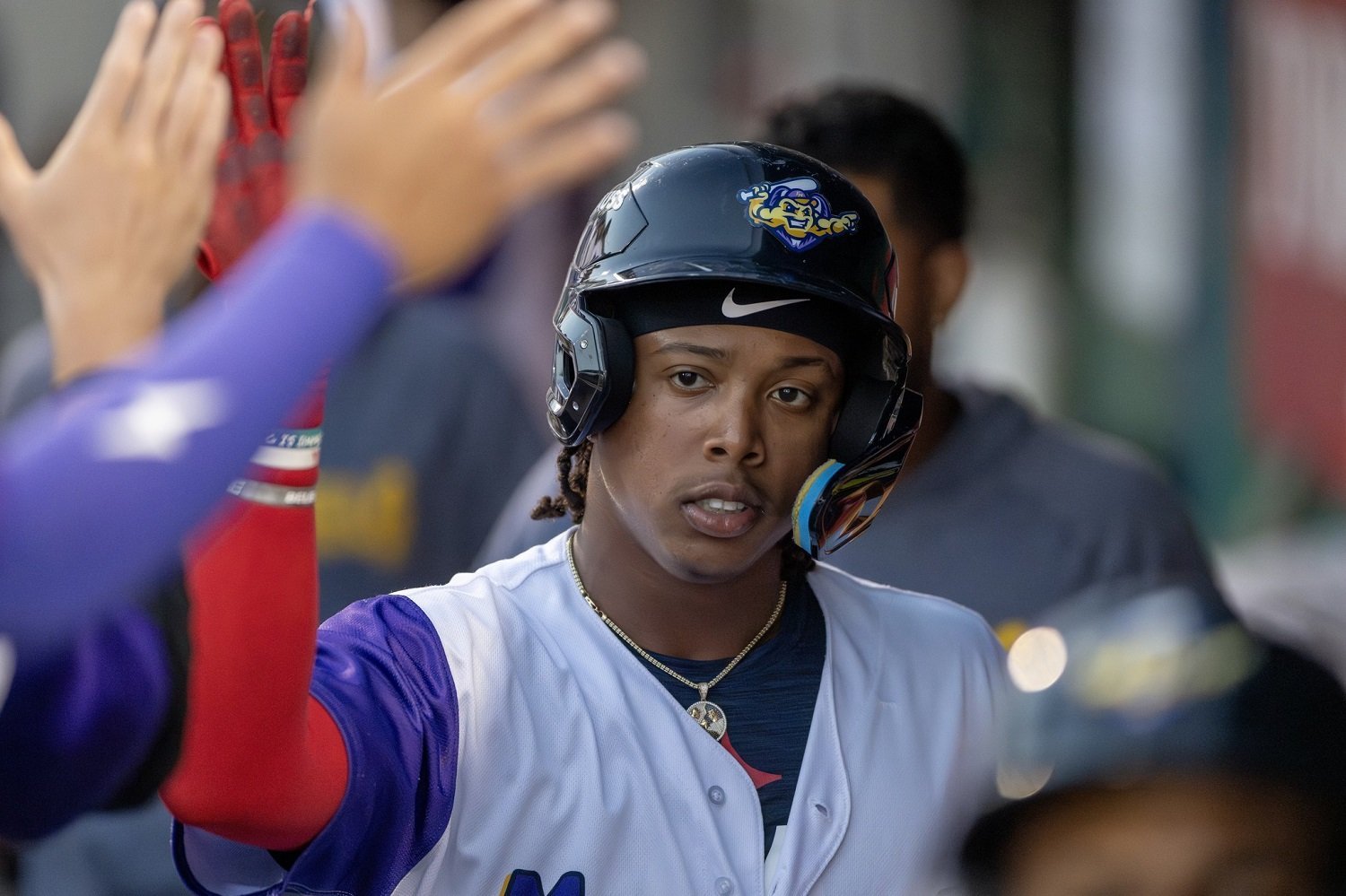
The international market has always been a necessary avenue for the Minnesota Twins. They operate without the financial muscle of some of their American League rivals, so they need to excel in areas like Latin America, a segment of the talent market wherein costs are much lower. It is also one where the returns have been frustratingly limited. Looking back at the international classes from 2019 through 2022 provides both promise and persistent questions about development, patience, and ceiling.
2019 International Class
The clear success story from this group is Emmanuel Rodriguez, currently ranked as a consensus top-100 prospect. At the time, he was MLB Pipeline’s 12th overall prospect in his international class.
At the time of his signing, MLB Pipeline wrote, “Athletic with a strong body and medium frame, Rodriguez has shown a solid hitting approach and advanced knowledge of the strike zone for a player his age. He has an efficient swing that creates lots of backspin and generates power to all fields.”
Rodriguez has become one of the most intriguing players in the system, with most prospect rankings slotting him just behind Walker Jenkins. Injuries have slowed his rise, but the underlying profile remains rare. A walk rate north of 20% paired with a strikeout rate above 30% is unusual, but Rodriguez still produced a 135 wRC+ in 2025 thanks to his power and elite strike zone awareness. He played the entire season at Triple-A St. Paul, putting him on track for a 2026 debut.
Rodriguez represents the best version of what the Twins hope to find internationally. Advanced plate discipline, projection, and a carrying tool that can survive modern pitching environments make him a potential star, even if approach adjustments will be required.
2021 International Class
There was no 2020 signing period, as MLB combined two international classes because of the pandemic. Danny De Andrade has quietly built one of the more stable offensive resumes in the system. At the time of his signing, MLB Pipeline ranked him the 14th-best prospect in his class.
“De Andrade has the ingredients to develop into an impact hitter,” Pipeline’s report read. “He shows off excellent bat speed from the right side of the plate and can drive the ball to all fields.”
Last season, De Andrade repeated High A and posted a wRC+ above 100 for the fourth straight season. His .317 OBP and .387 slugging percentage do not jump off the page, but a career-best .158 ISO hints at gradual strength gains. Defensively, De Andrade has moved off shortstop, splitting time between second and third base, which puts more pressure on the bat.
Fredy Michel shows the other side of the international equation. Once ranked 27th in his signing class, Michel never found consistency at the plate. Across parts of three seasons, he hit no higher than .163 and averaged a 77 wRC+. Despite early speed and double-digit steal totals, his bat stalled, and he has not appeared in affiliated ball since 2023.
2022 International Class
Yasser Mercedes entered 2025 looking like a potential breakout. After a strong 2024, he struggled in Fort Myers, slashing .199/.309/.331 with an 87 wRC+. The speed remains loud, with 36 steals, and he continues to log most of his innings in center field. The offensive inconsistency underscores how thin the margin can be for toolsy international prospects.
“The 17-year-old Mercedes had some of the best raw tools in this international class,” MLB Pipeline wrote at the time of his signing. “He has the chance to drive the ball from the right side of the plate and could end up having better than average power as he fills out that frame and physically matures.”
Yilber Herrera might be the most extreme example of modern plate discipline without contact. In 49 games between the Complex League and Low-A, he posted a .361 wOBA and a 114 wRC+ despite hitting below .160. A 25.9% walk rate carried the profile, but the lack of contact will be tested quickly as he climbs. Defensively, he has begun to see less time at shortstop.
“The teen has a good feel for hitting and can spray the ball across the outfield,” his scouting report said when he first signed. “He’s a smart baserunner when he gets on base. Herrera has a chance to stay at shortstop because of his above-average defensive actions and plus arm potential.”
Bryan Acuna brings pedigree and projection, as both his brothers played in the big leagues last season (Ronald Acuna Jr. and Luisangel Acuna). Ranked just inside MLB Pipeline’s top 40 in his class, he reached Low-A Fort Myers in 2025 and posted a 96 wRC+ in 78 games. Strikeouts remain an issue, and power production has been minimal so far. The feel for the game is evident, but the bat needs to translate that feel into results.
At the time, MLB Pipeline said, “Bryan grew up around the game, and it shows. He’s been praised for his plus makeup and feel for hitting. He’s aggressive and a playmaker. What he lacks in now tools, he makes up for with his baseball IQ, feel for the game and overall awareness.”
Across these four classes, a pattern emerges. The Twins have found players with strong plate discipline, athleticism, and makeup, but turning those traits into consistent impact has been difficult. Rodriguez stands as the exception, not the rule. For a mid-market team, falling behind internationally is not an option. These signings show flashes of a coherent philosophy, but the next step is to translate that promise into big-league production.
Which of these international prospects do you believe still has the best chance to break through, and what changes would you like to see from the Twins in their approach to the international market? Leave a comment and start the discussion.
Interested in learning more about the Minnesota Twins’ top prospects? Check out our comprehensive top prospects list that includes up-to-date stats, articles and videos about every prospect, scouting reports, and more!