
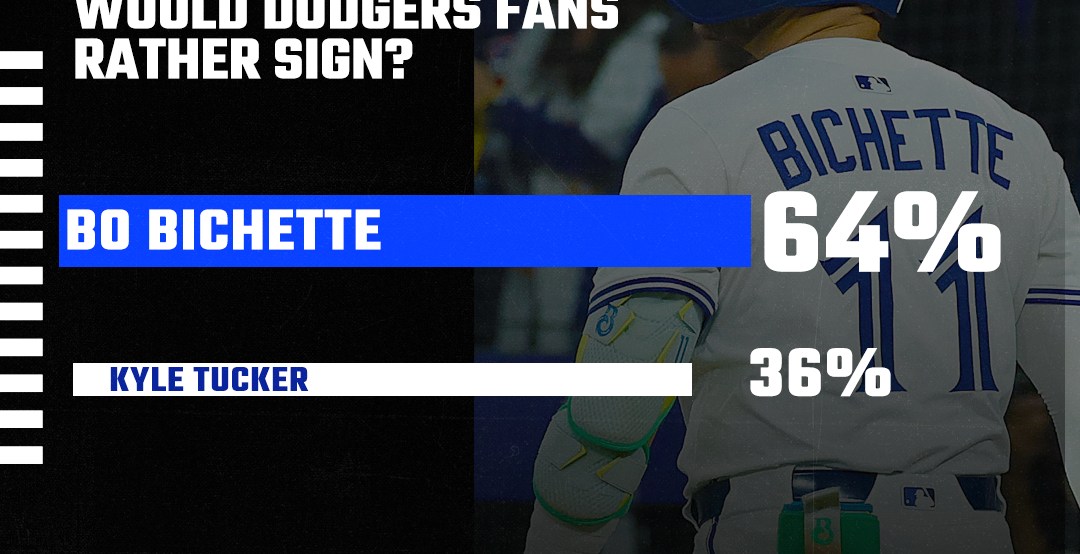
Moving like a shark, the Dodgers know only one way: to keep moving forward. The reigning back-to-back champs once again show themselves completely willing to keep improving by adding star-level talent to what’s already the greatest collection of talent in the big leagues. Two of the most notable free-agent hitters remain unsigned at the start of the new year, begging the question: Who would you rather see wearing a Dodger uniform in 2026—Kyle Tucker or Bo Bichette?
The fascinating part about this question is that one’s opinion is formed keeping in mind every aspect of signing either of these players. Tucker is widely considered to be the superior player, and the projected contract for each of them showcases that. Still, it was Bichette who won this poll by a significant margin.

After a down and injury-riddled 2024 campaign, last season could not have gone any better for Bichette, who was able to reestablish his value as the rare bat capable of hitting .300 consistently, with power, at shortstop. They don’t make them like him anymore.
Up until one year ago, the idea of adding a big-time shortstop made all the sense in the world. The original plan of having Gavin Lux as the heir-apparent to Trea Turner, who left via free agency, didn’t quite work out the way this team had hoped, and the initial results of Mookie Betts’ transition to shortstop weren’t that encouraging. Now, looking ahead to 2026, Mookie’s glovework was stupendous in his first full season at short (far superior to that of Bo Bichette), which begs the question as to how the Dodgers would proceed if they signed Bichette.
There is a reasonable argument for either Betts or Bichette to move elsewhere, and perhaps the more important question is: would a move out of short put off Bichette from signing with any particular team?
What we do know is that Betts is one of the leaders of this team, and after all the work he put in to perfect his capabilities back at shortstop, it’d seem like a waste and maybe even an affront to now ask him to move back to right. If you want to be more practical, Betts’ output in the 92nd percentile of Outs Above Average in 2025 is superior to anything Bichette has ever put up, and moving him to second, a position he played in extreme circumstances during the World Series, would be the right move. Then again, if you have a shot at getting Bichette as a shortstop and could improve your outfield by moving Betts back to right field, that’s hardly a scenario to lament in any way.
When it comes to Bichette the hitter, his 2025 numbers (.311/.357/.483) highlight exactly the type of hitter he is capable of being, and has been for the better part of seven seasons—someone who puts the bat on the ball with the quality to hover around a .300 average consistently, both striking out and walking at below league-average clips and providing enough power to be a real threat. It’s no coincidence he led the AL in hits in back-to-back seasons in 2021 and 2022.
One aspect of Bichette’s game that favors him over Kyle Tucker is that his addition would bring a bit more balance, with Tucker potentially making the Dodgers a very lefty-heavy offense. Now, when your southpaws are Shohei Ohtani, Freddie Freeman, and Tucker, calling that a problem is extremely pretentious, but nevertheless it’s something to point in Bichette’s favor. Few left-handed hitters hold such remarkable splits as Tucker, with a .848 OPS against lefties across over one thousand plate appearances since he first came up.
Tucker was on pace for the best year of his career until a hand fracture derailed his second half. Nevertheless, he still only missed 26 games and managed to put up his fifth straight 4.2+ fWAR campaign, also stealing 25+ bases for the third time in the last four seasons.