
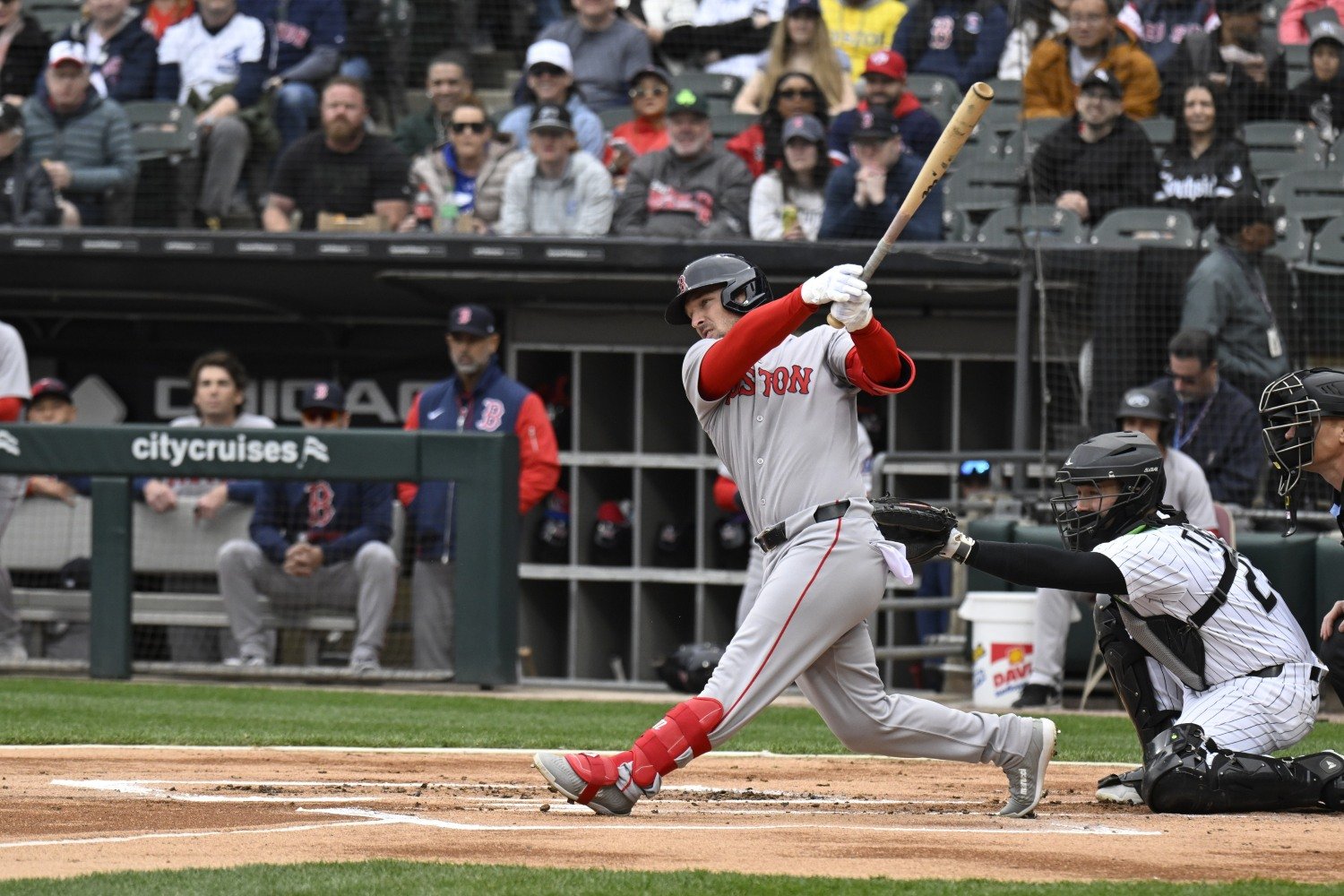
In the modern game, teams work hard to build not only strong offenses, but ones with a wide array of strengths and weaknesses. Just as it’s become popular to assemble a bullpen featuring pitchers with different arm slots and pitch shapes, as well as handedness, teams are trying to build lineups with varied skill sets—including swing paths. Platoon balance is a familiar need, and clubs have always craved a mix of power and speed, but the new hotness is loading up with players who can neutralize the constellation of looks pitching staffs will throw at you within a given game or series.
The Cubs have had a good mix of left- and right-handed offense over the last three seasons. They’ve employed sluggers and speedsters. They’ve had guys who specialize in drawing walks and those who emphasize avoiding strikeouts. Last season, though, they had one glaring deficiency in lineup diversity: swing path.
There are three key variables in a player’s swing, just as there are with a pitcher’s throw. For pitches, those vsriables are velocity, horizontal movement and vertical movement, though as we now know, there are other key characteristics, too: spin rate, arm angle and extension toward the plate at release. For hitters, the main variables are bat speed, swing tilt, and contact point. Again, there are secondary traits that also matter (attack angle and direction, depth in the batter’s box, and swing decisions), but those are controlled by the primary traits.
To visualize the way Cubs hitters map on this basis, I’ve charted swing tilt and contact point (relative to the batter’s center of mass) for 2025. The points in this scatter plot are colored by the player’s average exit velocity, as a proxy (admittedly, an imperfect one) for swing speed.
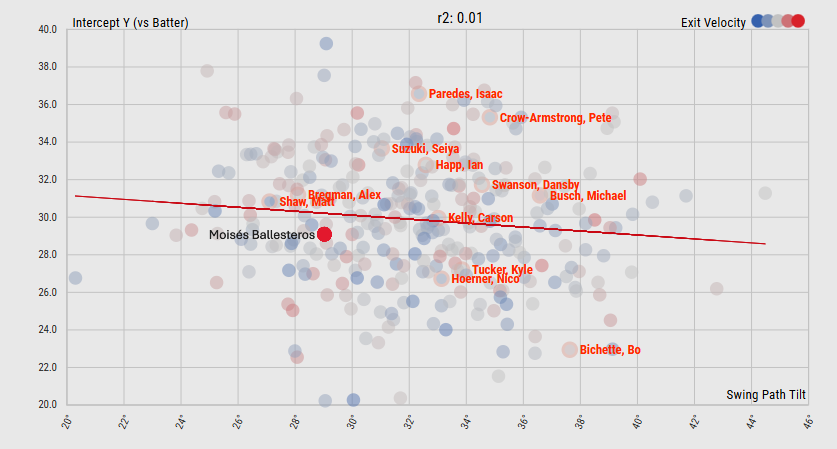
This includes all the team’s regulars last season, plus a few selected players for comparison. As you can see, the Cubs strongly favor steeper swings. The average swing tilt for big-league hitters is around 32°. Last year, the only frequent contributors to the team who were on the flatter side of that midpoint were Matt Shaw and Seiya Suzuki, and for Suzuki, it wasn’t by much. They also leaned toward catching the ball farther out in front of themselves than most hitters do.
The two exceptions to the latter rule were Kyle Tucker and Nico Hoerner, but Tucker then hit free agency. Earlier this month, we discussed the possibility that the team would pursue Bo Bichette, who catches the ball as deep as just about any hitter in baseball—but as you can see, he also would have been another of the team’s steep swingers. This move goes the other way.
The team traded Christopher Morel (an exceptionally flat swinger) for Isaac Paredes in 2024, but then shipped Paredes to the Astros as part of the deal for Tucker in December of that year. Paredes’s extreme go-get-the-ball contact point contributes to his reliance on pulling the ball right down the line. The fact that Bregman lets the ball travel much longer explains his ability to hit for power to left-center field, where Wrigley Field will be much friendlier to him. Indeed, Bregman hit 13 balls over the last two seasons that were not home runs at the parks where he was playing, but which would leave Wrigley by clearing the wall at the shallow part of the left-center power alley.
Shaw was the different swing the team needed to balance out the rest of their crew, but only when he was going well. For most of the season, he was a mess at the plate, with a disorganized approach and little feel for barreling the ball. Bregman doesn’t swing as fast as Shaw, but he makes hard contact more often, because he has what Shaw is missing: an extremely polished plan at the plate and plus-plus feel for contact. Bregman and Moisés Ballesteros now give the Cubs the flat swings their lineup lacked last season.
Mixing Bregman, Ballesteros, Busch, Happ, Suzuki, Crow-Armstrong and Hoerner into the top seven spots in the batting order each day will give the Cubs two true speed threats; as many as four 25-homer hitters; three lefties, three righties and a switch-hitter. Now, they also have a greater diversity of swing shapes, which leaves fewer pitchers able to pick their way through the lineup without hitting a buzzsaw. Bregman is a risky signing, entering his mid-30s and a bit light on power, but he boosts both the depth and the versatility of what the team hopes is a championship-caliber offense.
Consider this glimpse at the swings of four Cubs hitters: Bregman, Busch, Hoerner and Suzuki.
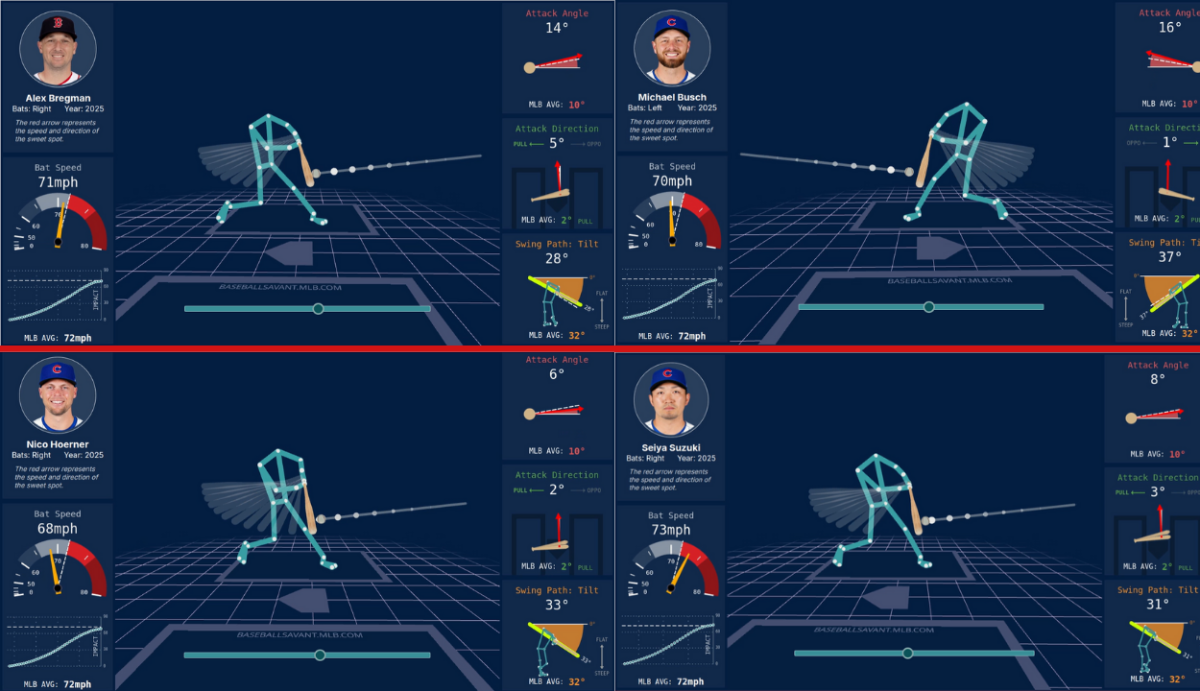
The difference in swing plane between Bregman and both Hoerner and Busch is visible to the naked eye, as well as in the measurement at the bottom right corner. Harder to pick up at a glance (but just as important) is the fact that Bregman hits by getting his hips and shoulders more open by the contact point than the others. That ensures that, despite his flatter swing, he’s working uphill at contact more than Hoerner or Suzuki are. Finally, look at his hands; that’s where his offensive genius lies. Whereas any of the other three would be on the point of breaking their wrists and rolling over by the time they get to the same point in the arc of the swing, Bregman is capable of cutting smoothly through the ball throughout a wide timing window.
Compare his right wrist to Suzuki’s, at the same point. In Suzuki’s swing, his wrist is already at full extension by then, and there’s no way to resist rolling them if he’s a hair early. For Bregman, there’s still flexion in the wrist of that top hand, and the bottom hand operates brilliantly, too. Because of the flatness of his swing, Bregman doesn’t have to turn his left wrist over until very late, either. That’s where the signature finish on his swing comes from, and it’s why he makes contact at an elite rate even while averaging such a high attack angle and a high launch angle on his batted balls.
All of that makes it hard to manipulate Bregman, and explains why he’s a perennially tough out. He’s struggled against sinkers (a little) and sweepers (sometimes a lot), but he consistently has positive run values against four-seam fastballs, changeups, curveballs, sliders and cutters, because his swing is so adaptable. Given his superb plate discipline, he’s a terrific fit for Chicago’s lineup, on multiple levels. In a vacuum, Bichette would have been a more desirable signing, because he’s younger, more athletic and more likely to have peak seasons in front of him. However, the team needed a swing just like Bregman’s to mix into their everyday lineup.