
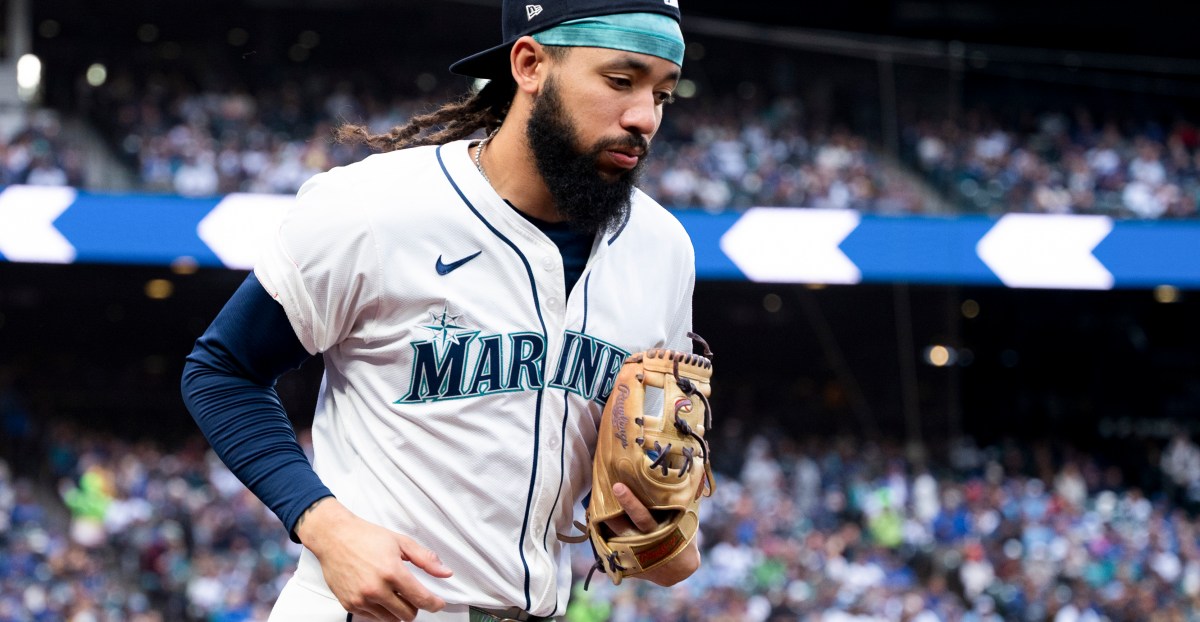
This is J.P. Crawford’s last 40 in 40.
Crawford is the longest tenured Mariner. He came to Seattle at the start of the retool way back in December 2018. Félix was still a Mariner. Seager was still a Mariner. Colt Emerson was 14.
Crawford was a “glove first” shortstop in his first few seasons. That was enough for the front office to commit long term, even as more snazzy options became available. But Crawford wasn’t satisfied being “glove first.” He spent the offseason before 2023 at Driveline, adding speed and loft to his swing and learning how to pull the ball in the air. After 10 professional seasons and nearly 5,000 at bats, he’d finally developed a skosh of power, the final touch to an otherwise well-rounded profile. The result was a 5-win season — the best ever by a Mariners’ shortstop not named Alex Rodriguez.
The career high in 2023 was followed by a career low in 2024. He posted a 90 wRC+ and less than 2 fWAR. The fundamental changes he made at Driveline were still there, but they weren’t enough to overcome poor luck and poor health.
He entered 2025 as something of a bounce back candidate, and he delivered something of a bounce back season. He posted a 113 wRC+ — 10th among shortstops — although his performance at the plate was prone to wild swings:

Crawford’s slump in August put the spotlight on his glove. It was clear that defense was no longer a carrying trait but a limiting one. He posted -11 OAA in 2025, making him the worst defensive shortstop in MLB (or tied for the distinction with Bo Bichette). He specifically struggled going to his right and making the long throw across the infield. Crawford turned 31 today. It’s unlikely his range will ever return.
The directive for 2026 is quite different since Crawford’s first 40 in 40 seven years ago. He’s no longer a young player on a bad team with a good enough glove to justify unlimited at bats. He’s now an old player on a good team with a bad enough glove to require results at the plate. He’ll be a free agent at the end of the year, and the team seems eager to gauge his replacements. The starting shortstop job is not his in the outlook, as it’s been for most of the decade, but his for just this moment. Somebody else will be our shortstop soon.
The Mariners are celebrating their 50th season in 2026. They’re asking you to remember some guys. I’ve been thinking about what Crawford’s legacy with org will be, if this is truly the beginning of his final chapter. He’s 10th all time in plate appearances in Seattle, needing 610 to pass Raul Ibanez for ninth. He’s 13th in fWAR, needing 3 1/2 to climb into the top 10 over Bret Boone, Mike Cameron and Robinson Canó. In other words, Crawford is not an inner circle Mariners’ legend, but he’s firmly established himself as one of the Next Best.
Perhaps the strongest case for Crawford’s legacy in Seattle is his performance in big moments. It’s been historic. His 146 wRC+ in high leverage situations is tied for ninth all time (or at least ninth since Fangraphs began tracking in 2002):
Joe Votto – 168Shoehei Ohtani – 168Chipper Jones Jr. – 163Albert Pujols – 155Ryan Howard – 154Vladimir Guerrero – 151Lance Berkman – 148Miguel Cabrera – 147Gary Sheffield – 146Mike Trout – 146J.P. Crawford – 146
Fangraphs splits leverage into three categories: low, medium and high. “Leverage” is determined by a rather complicated formula that captures what’s at stake in at bat, given the inning, score, situation, etc. Basically, it’s a measure of how “crucial” the at bat is to the outcome of the game.
We can see Crawford is generally at his best when the leverage index is at its highest.

The literature on “clutch” performance is mixed and goes back further than even Fangraphs’ leaderboards. It’s a subject controversial enough that my hands are sweating as I type this graf. Some analysts are certain “clutch” is a myth. It’s not something most players repeat from year-to-year, and any outsized (or undersized) performance in high-leverage situations is simply a feature of small samples and “luck.” Some analysts counter by pointing to a subset of players whose performance does seem to change with leverage, arguing we could observe the trait if only the samples were larger. After all, a lack of evidence is evidence of nothing. Some analysts scoff at the premise entirely, as the stakes of a moment are subjective to the inner machinations of the batter. How can we measure performance under pressure if we can’t objectively define it? I’m not going to solve this today, but just know I hold the correct opinion, whatever that may be.
While I’m not willing to take a stance on “clutch,” I do think Crawford’s skillset is well suited to leverage. Crawford, no matter the situation, has been one of MLB’s most selective batters since he entered the league, ranking among the top 10% by a variety of pitch-selection metrics. Pitchers are less likely (or less able) to throw pitches in the zone under pressure. In fact, we can see that Crawford’s exceptional ability to “control the zone” has only improved with more on the line.

The biggest play of Crawford’s career came in 2023. The Mariners were in the first game of their final series and playing the team they trailed in the standings. They had to win to stay alive, and they were down with two outs in the bottom of the ninth.
Crawford stepped to the plate with the bases loaded. At 10.71 on the leverage index, it was the biggest moment of his career. And at 36.34 on the “championship” leverage index (which factors how much impact the game has on the standings), it was the Mariners’ biggest regular season moment since Game 163 in 1995.
He took the first pitch, a tough slider that scraped the inside part of the plate for a called strike. He took the second pitch, another slider that missed just away. Then he got his pitch, a sinker right down the middle, and smacked it the other way into the left field corner. It was a game-winning a double.
This would undoubtedly be a Forever Highlight for the Mariners had they completed the sweep of the Rangers. But like so many memorable Mariners’ plays and players, its relevance is watered down by the failure that followed. Baseball Reference remembers, at least.
The next biggest play of Crawford’s career came in August 2025, also against the Rangers. It wasn’t nearly as big a spot, as there was still two months to play in the season. But the Mariners found themselves down 3-2 in the bottom of the ninth in a game against a direct rival. Crawford stepped to the plate with a man on. He took a pitch down and away to get ahead 1-0; he took another pitch down and away to climb to 2-0. Then he got his pitch, a fastball up and in, and turned on it into the right field seats. This one mattered.
Crawford’s career trajectory roughly matches the Mariners’. He’s the lone bridge from drought to division champs, with parallel ups and downs along the way. A truly complete circle would see him hoisting the World Series trophy in his final day as a Mariner. It’s a moment meant for our captain, our shortstop.