
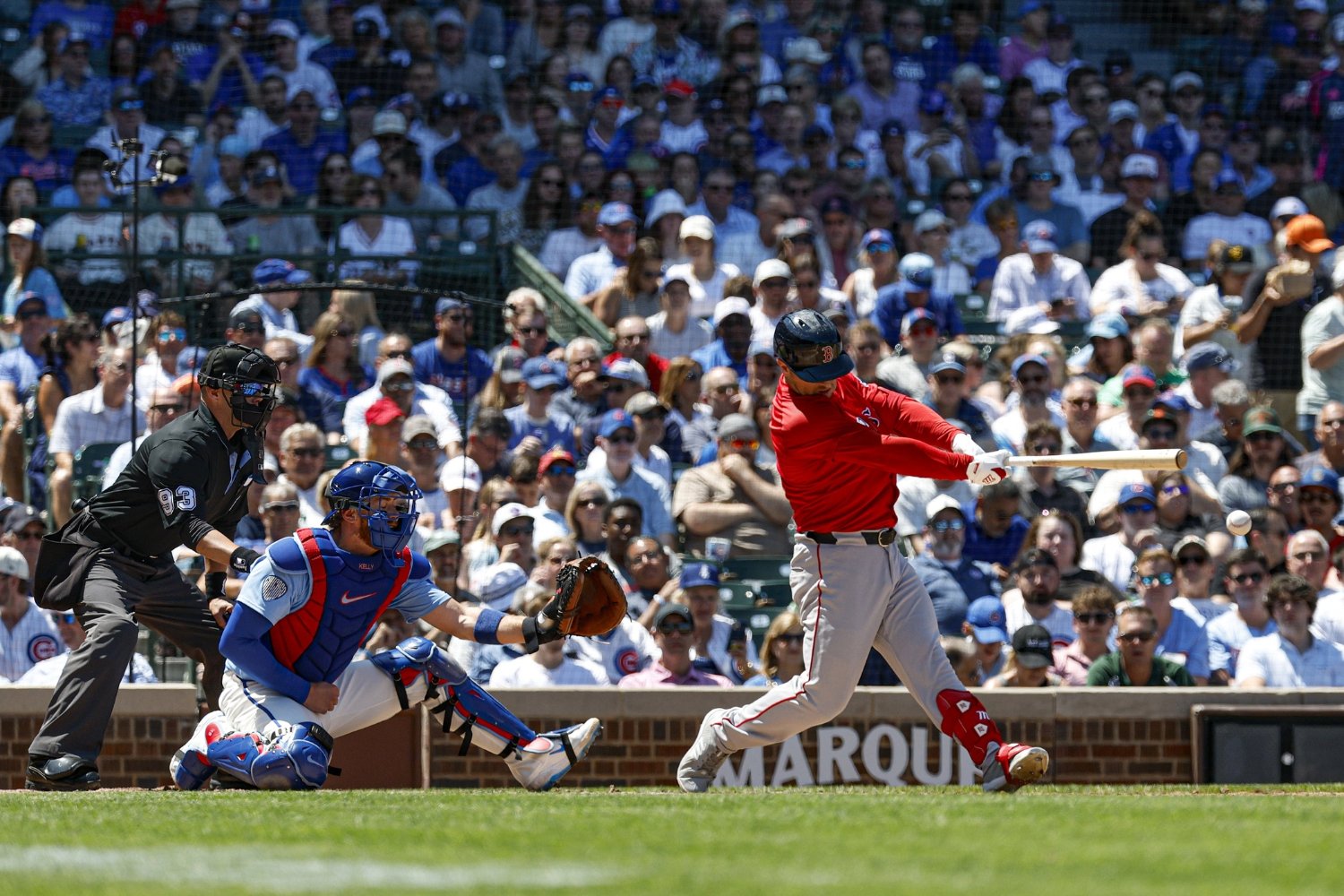
Thousands at Soldier Field on Saturday night gathered and cheered to celebrate the biggest news in Chicago sports: the Cubs signed Alex Bregman to a five-year, $175 million deal. I have since discovered that there was also something else going on at the time that resulted in that celebration at Soldier Field, but hey, I am sure this was a nice cherry on top for some.
This marks what could be a huge turning point for the Cubs and their front office. For one, Bregman just received the largest average annual value on a contract in team history. Second, a Jed Hoyer-led front office went out and outbid other teams for a guy that they wanted. Finally, they flexed some financial might.
It’s not just the use of financial resources that is encouraging, either. Per Mark Feinsand, the Cubs are deferring $70 million of the contract, which will bring the average annual value for luxury tax purposes down slightly. This could help the Cubs stay below the competitive balance tax for this coming season, and finally signals a willingness from the club to take advantage of a modern, club-friendly free agency tactic in deferrals.
What makes Bregman the guy that the Cubs were finally willing to do all of this for?
It was reported by Patrick Mooney of The Athletic that “although he will be 32 in March, Bregman still lit up the front office’s projection systems as a Gold Glove defender and an elite right-handed hitter.” There are reasons to think that the third-baseman has the type of profile that could age well. Clearly, the Cubs’ would agree.
For starters, plate discipline is one of Bregman’s premier skills, and this is a skill that a player typically retains as they age. Perhaps more importantly, a recent blog post at Driveline Baseball concluded that pull-air percentage is one of the skills that ages the best in an offensive player. Pulling the ball in the air has long been a hallmark of the former Astro’s game, including a 24.4 percent pull-air percentage just last year, which ranked 37th in baseball, per Baseball Savant. If Bregman can continue doing that, you have to feel pretty good about this contract.
On the flip side, swing speed and exit velocity, two skills that don’t typically age well, have never been highlight skills for Bregman. As noted by Davy Andrews at FanGraphs, he has never hit a ball 110 mph, which 308 MLB players did last season. One could look at that and conclude that the veteran is walking a thin line. If he loses even any bat speed, he’s toast. You could also argue that he already knows how to succeed without bat speed, or that he has no bat speed to lose. Clearly, and as reported above, we know where the Cubs’ projection systems stand on that debate.
As for the validity of the Cubs’ projection systems, well, let me go ahead and defend those. In the offseason after the 2022 season, the Cubs needed a shortstop, and all four of Carlos Correa, Dansby Swanson, Trea Turner, and Xander Bogaerts were available.
The Cubs, of course, signed Swanson. He received the least amount of total money amongst the four shortstops by a good bit. He’s also been worth 2.5 more FanGraphs WAR than Bogaerts since that offseason, and 3.8 more fWAR than Correa. Trea Turner is the only one that has outperformed him since the Great Winter of the Shortstop™.
Tying Bregman to Swanson brings me to the second thing the Cubs likely identified with Bregman: leadership and intangibles. According to Jen McCaffrey at The Athletic, last offseason, Bregman was heavily invested in the Red Sox winning, and went on to become a major leader in the clubhouse.
“A year ago, Bregman grilled the Red Sox front office with a 16-page document filled with questions on the direction of the organization, the development plan for the club’s top prospects and how Boston planned to invest and spend to bring the organization back to the postseason.” McCaffrey went on to write that “Bregman took a strong interest in mentoring the club’s top prospects like [Roman] Anthony and [Marcelo] Mayer, but he also offered insight to veteran hitters going through slumps and even to pitchers, suggesting how he’d attack them as an opponent to help them better game plan.”
Sound familiar? When Dansby Swanson signed with the Cubs, Jed Hoyer reported a similar concern with the direction of the club. “The thing that really stood out to me was that it felt like he was interviewing us. How are you guys gonna win? What’s your plan? What’s your philosophy? What players are you going to surround me with? Who are the prospects that are coming? It was very clear winning was the priority.”
After Swanson officially left the Braves and signed with the Cubs, Jeff Schultz of The Athletic noted that “Swanson exerted a lot of influence in the clubhouse, especially with younger players like [Vaughn] Grissom and Michael Harris II.”
It’s clear that the Cubs heavily value the leadership qualities that they see in Swanson and Bregman. They also, most likely, project him to age quite gracefully. Age aside, this is still a guy that posted 3.5 fWAR in only 114 games last season. He had a 125 wRC+, meaning he was a 25 percent above the league-average hitter.
This is a productive player now. Whether or not you agree with the Cubs’ rationale, whether or not you agree with the importance of Bregman’s apparent leadership abilities, and whether or not you think the contract will age well, the Cubs spent money to make the team better for this season. They identified a guy that they wanted and were willing to outbid others for him. That is not something they have done particularly often under Jed Hoyer, and I think we can all commend them for that.