
I politely envy the catharsis that many Chicago sports fans must be feeling this week. Just a few days before the Bears completed their comeback in the Wild Card round and the Cubs finally opened the checkbook to acquire Alex Bregman, Edward Cabrera was traded from the Marlins to Wrigleyville. This gives the Cubs some cost-controlled length in their rotation in exchange for a three-prospect package headlined by Owen Caissie, who was named second-best in the farm system by Baseball America just last month.
In terms of its alignment with Chicago’s pitching development processes, this trade is surprising on multiple fronts. Sure, they needed a high-ceiling addition to their crop of starting pitchers, but Cabrera is not the type of arm they usually go after. He’s a sinker-over-four-seam guy joining a team that had the highest four-seam usage rate and the lowest sinker usage in MLB in 2025. As well, the Cubs usually like guys who cut their fastballs when Cabrera (-0.5″ iVB above average, +2.1″ arm-side HB above average given arm angle) has one of the runniest heaters in the game. He has always thrown hard with incredible movement on all his offerings, and leaned into his sinker and slider more than ever a season ago. He dropped his arm slot, which was accompanied by the first single-season walk rate under 10% as well as the first single-season innings total over 100 of his career.
The sinker’s zone rate flew from 41% to 64%, becoming the first pitch type that he has been able to throw for strikes consistently. These adjustments allowed his disgusting 92-mph changeup and his sharp two-plane 84-mph curveball to stand out as the headliners of his arsenal (+12 combined run value). He has long had ace potential, but a shoddy track record of both health and command has held him back. Last year was the closest we’ve seen to everything coming together for him, and he’s in good hands for further refinement of his location. Cubs pitchers threw strikes more frequently than anybody in 2025, and their zone rate on four-seamers and sinkers was the ninth highest in the league. On four-seamers only, they had the third-highest rate of pitches over the heart of the plate, and the 10th-highest rate of pitches in the plate’s shadow.
Still, while strides were made, his fastball deficiencies are at the core of what Chicago will be looking to optimize. His -12 combined four-seam and sinker run value placed in the fourth percentile of qualified pitchers. Although they were commanded better than in years past, bat tracking data on the pitches suggests hitters are doing a great job of connecting on them.
The fact that opponents are achieving close to the maximum possible exit velocity when they make contact with Cabrera’s fastballs is a telltale sign they’re squaring it up, and the high attack angle indicates they’re rarely late, even though both offerings sit at 97 mph. The four-seamer was barreled at an alarming 21% clip; in other words, opposing hitters were basically Kyle Schwarber in terms of how often they barreled Cabrera’s heater. Meanwhile, the sinker only managed a 44% groundball rate, whereas the league average is 55%. These offerings are simply not missing enough bats and not suppressing enough damage, given how tantalizing they are from a speed/movement standpoint.
Curiously, some pretty gnarly handedness splits lie beneath the surface. The four-seamer was pummeled by lefties, but quite useful in a limited capacity against righties. Take a look:
His approach against righties was the very definition of the term “kitchen sink”, with four pitch types getting used between 21% and 24% of the time. The heater worked well as a rarely-used supplementary weapon. Maybe I’m reading too much into a small sample size here, but I’d consider ditching it completely against lefties while continuing to sprinkle it in ~10% of the time to righties: decreasing usage overall, but there’s clearly a time and a place for it in spurts.
What will he do instead of throwing four-seamers in those situations, then? Well, in case you’ve forgotten, he has a 92-mph changeup that ran a ~17% K-BB and a ~62% groundball rate, as well as a curveball with a K% and a miss% around ~46%, in weak-side matchups this year. There’s a perfectly fine argument for pushing those agendas more, considering that, combined, he only used them a tad more than half the time. If he wanted to go the learn-a-new-pitch route, which is admittedly a precarious situation given his lengthy history of injuries to his throwing arm, I’m unsure if I’d suggest learning a cutter even though everyone’s doing it and it would naturally make him look more like a Cub. He doesn’t spin his four-seamer efficiently, a common trait among pitchers who have mixed in a cutter recently, but there’s just so much tail on it.
What I would be curious about is whether he could pick up a sweeper. Despite having more of a natural affinity for generating arm-side movement, his curveball gets more glove-side action than average, while his gyro slider has more of a true bullet shape. The thinking behind this is mostly based on the progression of his sinker + slider combo in 2025. They tunneled well, as is evident by the fact that their average respective positions in space overlapped 225 milliseconds after release (widely considered the latest benchmark for when a hitter decides to swing) before diverging as they got closer to the plate. If he can learn a second slider shape that behaves similarly to his existing one early on in its flight path, it may add a layer of confusion for opposing hitters and would theoretically make the sinker and gyro play slightly up.
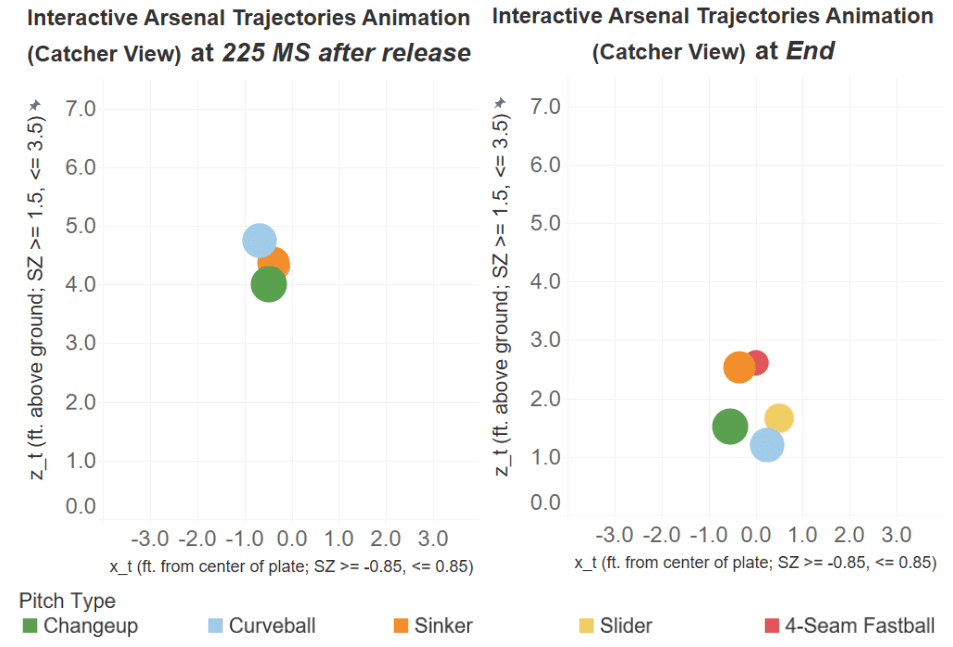
Edward Cabrera flight path by pitch type, 225 milliseconds after release vs at plate (2025).
Of course, on an arsenal level, Cabrera is tough to predict as it is. He didn’t throw his most-used pitch type to either side (changeup vs LHB, sinker vs RHB) more than 30% of the time. On a count level, though, that’s not the case. I won’t put it past the Cubs to simply pay no mind to his fastball usage as a whole because they like four-seamers, but at certain stages of a given at-bat, Cabrera has been prone to falling into usage patterns that are a little too easy to deduce. The degree to which he relies on fastballs is small compared to the rest of the league given how strong the changeup and curveball are, as well as the prominence his slider now has. Naturally, league-average fastball usage is higher both early in counts and when the hitter is ahead, and lower with two strikes, than it is altogether. Cabrera is an extreme example of this.
It seems possible that part of the reason his fastballs were ineffective has to do with the fact that hitters knew they could expect secondaries early and sit on velocity when they were ahead. An outsized portion of the fastballs Cabrera threw in 2025 came when he was behind in the count, which isn’t a great sign knowing how well hitters saw them, and it also inflates the walk rates (while deflating the strikeout rates) of both pitches. He’s in the zone plenty with the sinker in particular; using it more early in counts when the opposing batter isn’t at peak aggressiveness could get him more quick outs if he can get it on the ground more often, or get him early count leverage, both of which are vital to keeping the walks down.
Few things are more exciting than a young pitcher with ace-level stuff going to a contending team, especially when that team happens to boast one of the better pitching development infrastructures in MLB. Cabrera is coming off a career year and is by no means a finished product, bringing plenty of intrigue to the North Side of Chicago. In a division currently devoid of any other big spenders, this move, as well as the Bregman signing, substantially raises the Cubs’ ceiling for 2026.
Curiously, while the buyer in this deal strayed from their usual M.O. to snag an immediate impact piece, the seller stuck to their guns to accomplish the same task. Cabrera’s injury history likely limited the Marlins to an extent in terms of the prospect package they’d get in return, but the headliner, Owen Caissie, figures to play a big part in their lineup. With Kyle Stowers cemented in left field and Jakob Marsee showing upside on both sides of the ball in center, Caissie appears to be the better option in right ahead of Heriberto Hernández, rounding out a young and exciting outfield crop.
Caissie only got 27 plate appearances in a short cup of coffee at the big league level last season; he struck out 40.7% of the time and managed to make contact on just 71.1% of his swings in the zone (those rates were in the high-20s and low-80s, respectively, at AAA). There’s no question whatsoever about the pop in his bat – he hit a ball 116 mph at AAA in 2024 and was rocking a .265 ISO in 2025 when he got called up, making this an easy chance for Miami to take given how much they lacked power from hitters other than Stowers.
Furthermore, his swing mechanics show he’s exactly the type of hitter that Miami’s current regime has sought out in trades: Fast and short swing, high top-end exit velocity. I wrote about this trend over the summer as Stowers and Agustín Ramírez were experiencing breakout seasons. Caissie is the latest Marlin to possess these traits.
Swing acceleration formula created by Pitcher List’s own Kyle Bland.
There is thunder and lightning in this bat, which should be huge for a lineup that finished 27th in home runs. He had the seventh-highest swing acceleration among all hitters with at least 25 plate appearances; Stowers was first. Edward Cabrera is a special arm whose best days could very well be ahead of him, but this is sound business for Miami, which addressed a serious need while treading from an area of surplus. Even without Cabrera, their 2026 rotation will be led by Eury Pérez and Sandy Alcantara, featuring Ryan Weathers and Braxton Garrett on the back end, with potential promotions looming for consensus top-100 prospects in Thomas White and Robby Snelling. Not only could they afford to make this move, but it can also be argued that it was a necessity if they hope to build off some of their hot stretches from 2025 and dare to dream of contending for most of the upcoming season.
There aren’t many high-risk trades with clear mutual benefits, but I like this deal for both sides. The Cubs and Marlins are at different points organizationally, yet came together to exchange young players with high-end potential. Cabrera gets to pitch for a team that is becoming increasingly known for getting the most out of its pitchers, while Caissie suddenly has no competition in sight for the regular big league reps he needs. It’s probable that by the time Cabrera reaches free agency in 2029, both teams will have reaped some rewards from this fascinating swap.
All data from Statcast unless otherwise stated.