
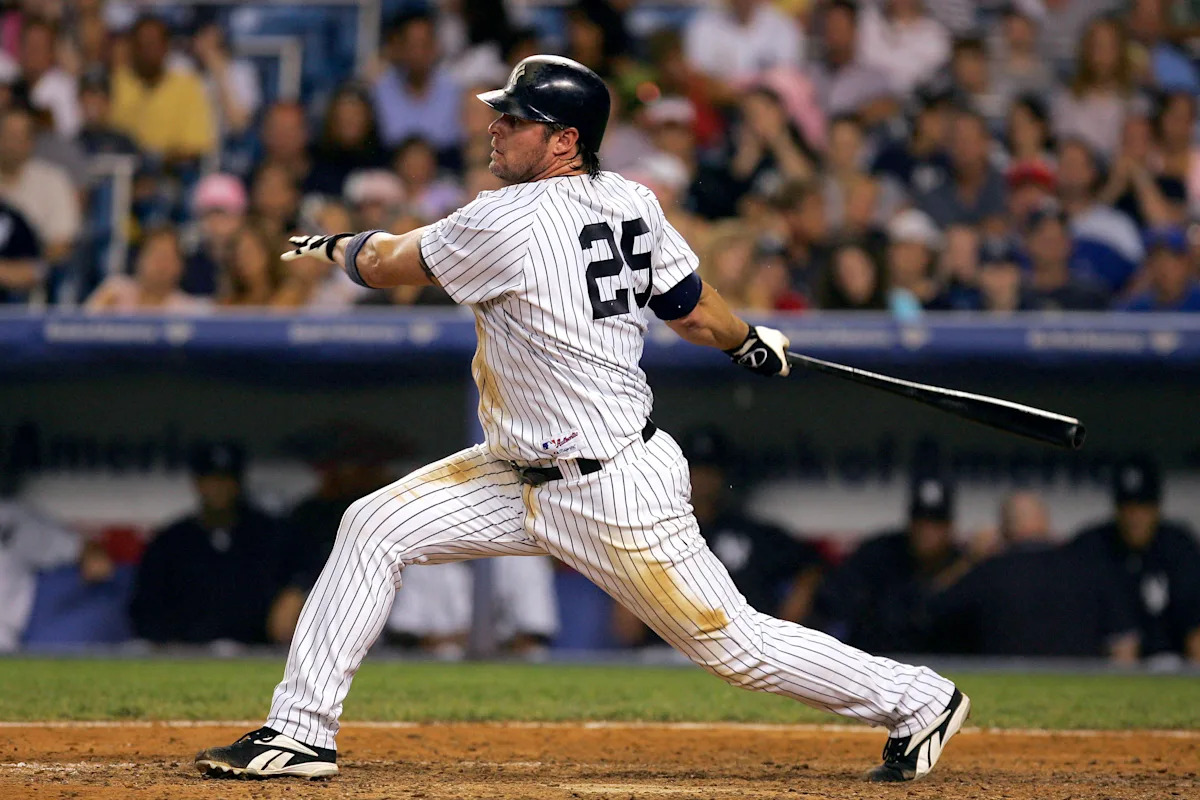
It seems like a lifetime ago, but once upon a time, recent Yankee teams of yesteryear trotted out a succession of consistent, even terrifying, offensive threats at first base. Donnie Baseball paved the way for Tino Martinez, who held down the fort admirably during the dynasty years. The last time the Yanks reached the mountaintop, switch-hitting Gold Glover Mark Teixeira manned first base.
Between Tino and Tex? Yet another first baseman with an outstanding pedigree. As the Yankees turned to Tino to replace Don Mattingly, so too they looked externally to find Tino’s successor. Luckily, it just so happened a former AL MVP who’d paced the Junior Circuit in bWAR was a free agent at the same time as Martinez. On December 18, 2001 the Bronx Bombers officially brought in the latest in a long line of outstanding first baseman, as Jason “The Giambino” Giambi migrated across the country from Oakland to don pinstripes.
Advertisement
Jason Giambi
Signing Date: December 18, 2001
Contract: 7 years, $120 million
The Oakland Athletics drafted Jason Giambi in the second round of the 1992 Amateur Draft. Giambi steadily climbed through the minor leagues and, as 1995 approached, Baseball America ranked him the #4 prospect in the Athletics system. When Opening Day arrived, he found himself playing in my metaphorical backyard in Canada, taking his hacks for the Edmonton Trappers of the Pacific Coast League, Oakland’s Triple-A affiliate.
He wasn’t there long. Giambi made his big league debut that season and played 54 games. Even as a rookie, he was far from overmatched, putting together a perfectly cromulent 107 OPS+. This despite splitting time at the hot corner (26 starts), first base (20), and designated hitter. On July 8th, facing the Toronto Blue Jays, he hit his first career home run off soon-to-be Yankee David Cone.
Advertisement
Giambi continued as a jack of all trades in 1996, playing first and third base and actually starting more games in left field than either corner infield spot. After the A’s traded Mark McGwire, Giambi moved to first full-time. The whole time, his bat continued to progress. He had a coming out season in ‘98, cracking 33 home runs and driving in 123, all while walking almost as much as he whiffed (105 to 106).
He firmly ensconced himself as one of the elite in 2000, however. That season saw him win the AL MVP, with a nigh-Judgian 187 OPS+ (yes, I am aware 2000 Pedro Martinez existed and him not winning AL MVP is baffling). This was great timing for Giambi, as free agency loomed for him following the 2001 campaign.
As spring training approached, he turned down a six-year, $91 million contract offer from Oakland. The New York Times reported that Giambi kiboshed the offer because it did not include a full no-trade clause. If results are any indicator though, he was not overly worried about his impending free agency.
He was even better in 2001 than he was before. This time, ironically, he was on the questionable end of MVP voting. Despite leading the AL in bWAR and putting up an eye-popping 199 OPS+, he finished second to Japanese rookie phenom Ichiro Suzuki, whom Giambi outpaced in OPS by 299 points. Seriously.
Advertisement
The Yankees had made their interest in Giambi apparent months before his free agency. In July 2001, the Times ran an article discussing that, in the aftermath of Giambi and the Athletics breaking off contract negotiations, the Yankees could attempt to trade for him, though the prohibitive prospect cost in addition to his contract demands combined to make a deal less likely. Clearly, however, the Yankees were tracking Giambi.
Once the 2001 season ended, for Giambi at the hands of the Yankees and for the Yankees in one of history’s greatest World Series, New York began its pursuit of Giambi, aiming to have him succeed Tino Martinez at first base. In late November, they deployed one of their big guns, having manager Joe Torre get directly involved in recruiting Giambi the way he had with Mike Mussina a year earlier.
It may not have made Giambi’s decision, but it evidently did not hurt. “Much like with Mike talking to Joe, it was a very positive conversation,” Giambi’s agent Arn Tellem, told Buster Olney. ”Jason was very enthusiastic after talking to him.” It probably helped that Torre assured Tellem that Giambi would hold down first base rather than play as the club’s DH.
Perhaps also helping the Yankees’ cause was that Giambi’s father was a rabid Yankees fan. Three weeks after the conversation with Torre, Giambi inked a seven-year, $120 million deal with the Yanks. Pointing to his father at this introductory press conference Giambi said “Look, Pop. It’s not number 7, but it’s pinstripes.” As so often happened during George Steinbrenner’s heyday, the Yankees got their man.
Advertisement
In the eyes of the Yankee faithful though, Giambi was far from their man at first. He’d displaced Tino Martinez, who’d earned a ton of street cred during the dynasty years. Giambi heard his fair share of boos at the start of the ‘02 season, exacerbated by a slow start at the plate. All that changed, however, in the final act of one of the greatest Yankees games in recent history. With the rain pouring down in the Bronx on May 17, 2002, Giambi came to the dish with the bases loaded in the bottom of the 14th inning and the Yankees trailing by three. The Giambino came through. He launched a moonshot into the rightcenter field bleachers, walking off an all-time classic game.
Those heroics also turned his season around. He went on a torrid hot streak and, by season’s end, he’d hit .314 with 41 home runs and finished 5th in MVP voting. It was his best season as a Yankee, though by OPS+, 2005 was pretty close.
Unfortunately, despite Giambi’s best efforts, the Yanks found themselves bounced from the ALDS by the Angels. I’ve gotta tell you, that was a shock. I, and likely much of Yankee Universe, had taken World Series appearances as our rightful due by that point.
Advertisement
A year later, the Yankees again found themselves on the verge of elimination, this time at the hands of the hated Boston Red Sox. Thankfully, Giambi would not be denied. Channeling his inner Thanos, he muttered “fine, I’ll do it myself” and single-handedly kept the Yankees within striking distance against Pedro Martinez in Game 7 of the ALCS, one of the greatest baseball games ever played. Aaron Boone ultimately won the game, but without Giambi, the Bronx Bombers were in no place to come back.
For his playoff career as Yankee, Giambi put together a .919 OPS in about one-fifth of a season (32 games). Not bad at all. Despite his contributions though, the Yankees famously failed to win a Fall Classic while he was in New York. After 2003, they never even managed to reach another World Series until Giambi’s tenure in New York had ended.
Giambi also found himself embroiled in baseball’s steroid controversy, beginning in the summer of ‘03. Most damning, his grand jury testimony leaked in December of 2004, wherein he had admitted to taking steroids, named them, and described how to administer them. The Yanks tried and failed to void Giambi’s contract, fearing he would not be the same player without steroids, a suspicion reinforced by his injury-prone and terrible 2004 season.
Advertisement
Making matters worse, Giambi came out of the gate slowly in ‘05, to the point Joe Torre demoted him to eighth in the batting order. But he rebounded and, thanks to leading the AL in walks and OBP, finished the season with a 161 OPS+ and won the Comeback Player of the Year Award. 2006 was more of the same, with The Giambino clubbing 37 home runs, and finishing a season with at least 100 walks for the seventh time.
Injuries cut short his ‘07 season, with Giambi playing in barely half the Yankees’ games. In 2008, his final season with the Yanks, Giambi showed he still had it, hitting 32 home runs, his eighth season with at least 30. He also provided one of my personal favorite Giambino moments, launching a majestic bomb to the upper deck in right to walk off the Toronto Blue Jays on June 5th. The follow through of his swing positively screamed “Are you not entertained!” as the ball soared through the air.
New York made no real effort to re-sign Giambi after 2008 and, in a real “circle of life” turn of events, brought in an external replacement to man first base in the form of Teixeira. History does not fully repeat itself, but it sure does rhyme sometimes. As he had arrived, so too did he depart.
Advertisement
For their seven-year investment in Giambi, the Yankees received a steady playoff performer, steroid drama, 4.0 bWAR/162 games at first base (if only Giambi was a steadier glove…), and a middle of the order bat who averaged a 143 OPS+ during his time in the Bronx.
Giambi was also the bridge who connected Donnie Baseball and Tino before him to Tex after. From the early 1980s through the mid-2010s, Yankee fans generally did not have to think too hard about who would be playing first base, nor worry whether that player would be productive.
References
Caola, Ralph. “Jason Giambi.” SABR.
Curry, Jack. “Torre Tells Giambi First Base Will Be His.” New York Times. November 28, 2001.
Advertisement
“Giambi tops Yankees’ arsenal of new additions.” ESPN. December 19, 2001.
Jason Giambi. Baseball-Reference.
Jason Giambi. FanGraphs.
Olney, Buster. “Baseball; Torre’s Role Is Familiar In Yanks’ Pursuit of Giambi.” New York Times. November 27, 2001.
Olney, Buster. “Baseball: Yankees Notebook; There’s Interest in the Bronx as Giambi and the A’s Break Off Negotiations.” New York Times. July 13, 2001.
See more of the “50 Most Notable Yankees Free Agent Signings in 50 Years” series here.