
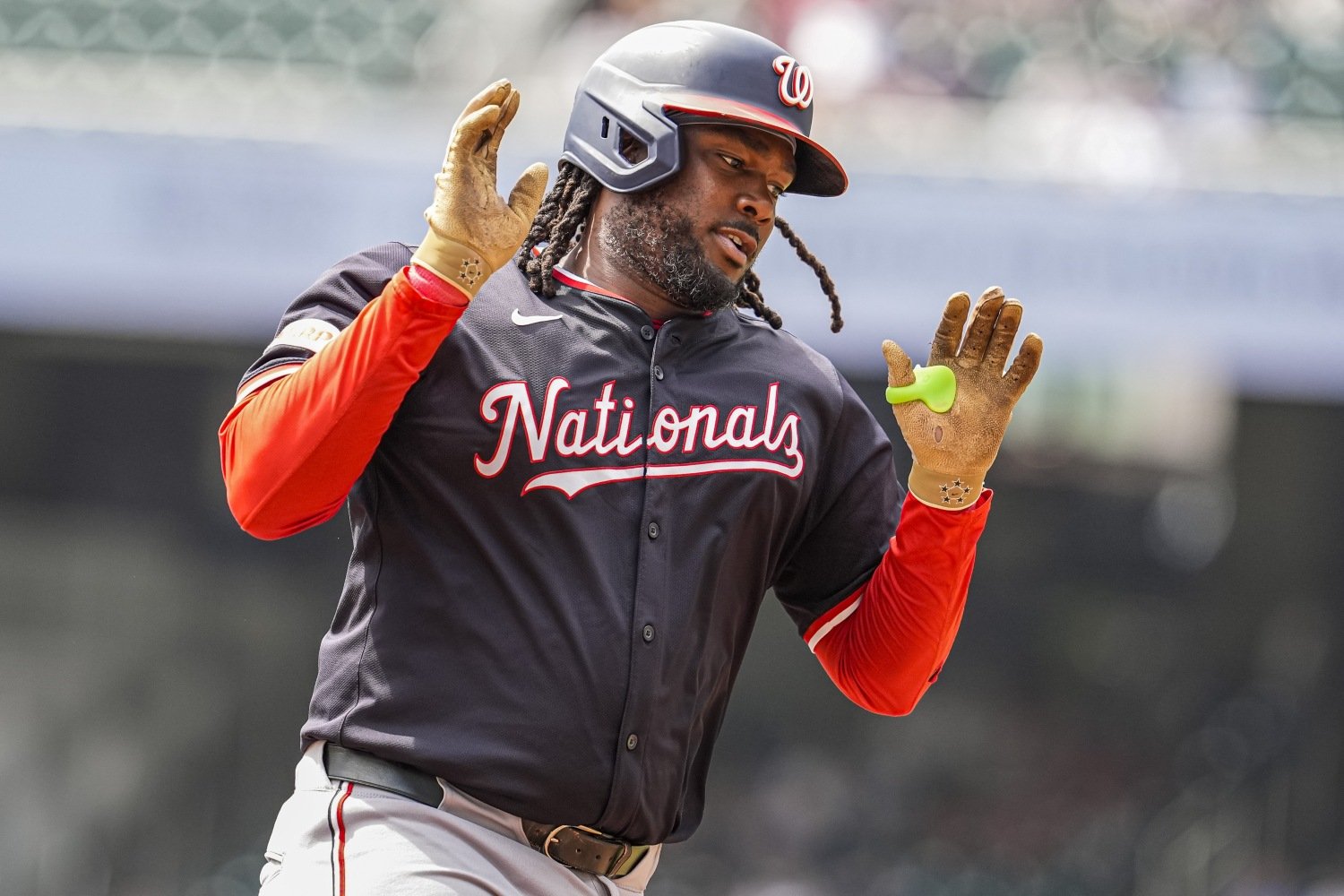
Often, ballplayers erect a bulletproof facade when talking to fans or the press. Baseball is a viciously difficult game, and admitting even a brief period of real self-doubt feels a bit like pointing to the weak point in your own armor before marching into battle. To be a successful professional athlete, you have to be an extraordinary competitor. To be a successful baseball player, you have to add some swagger to that fire. Otherwise, the inevitable failure the game heaps upon every player will block your path to victory.
That made it striking when, in a brief introductory press conference via Zoom last week, Josh Bell let a group of reporters he was meeting for the first time glimpse the way he’d grappled with doubt about his ability and his future, just a few months ago.
“I didn’t really know what to expect going into the offseason,” Bell admitted. “Had a g good stretch towards the end of the season that I was pretty pleased with, so, just talking with my agent, he said that it was a good chance that I was gonna get signed, just had to wait for some bigger names to get off the board.”
To an outsider looking at his full-season body of work, it might have been surprising that he’d ever worried about whether he would be signed. However, Bell had struggled throughout the first half, and for the first time in four years, he wasn’t traded at the deadline in July. Instead, he was left to ride things out with the lowly Nationals. A savvy veteran, Bell knew what it meant when no contending team would surrender anything of value to add him to their mix for the stretch run. At age 33, he was in real danger of seeing his playing career draw to a close.
However, as he noted, Bell finished the season strongly. He batted .257/.331/.486 in August and September. There were two related keys to his midseason turnaround: ironing out some bad habits he brought to camp, and improving his bat speed and lift with a tweak to his training and practice.
“[Nationals teammate] Amed Rosario had an unbelievable camp and started off the season really strong, and I just basically ordered the same bat program that he had,” Bell said. “I think he went to Driveline or something like that. He explained the drills that he was doing, and I tried virtually all of them, and I stuck with the sinker machine with the heavy bat because that’s when I started seeing results, on the field. It’s just one of those things where you play with veterans and then we start talking and, you know, it definitely helped out, and helped me extend my career.”
There, Bell is referring to hitting against a machine calibrated to fire sinkers at the batter, as opposed to the straighter launches from a typical hitting machine or the lollipops lobbed in by your average coach. He used a weighted bat for those sessions, which he found both a boon to his bat speed when swinging with his regular bat and a good way to practice getting slightly beneath the ball and generating more hard contact in the air. He also knows how to avoid the same sluggish start he had in 2025.
“I’m kind of kicking myself in the foot here. I tried golfing for the first time, last offseason,” said Bell, who has been a baseball-first athlete his whole life. He’s learned his lesson. “So I just won’t do that anymore, I think it kind of made me lose my swing over the course of the offseason. I’ve just been hitting from both sides. I told myself I’ll hang up the clubs until I hang up my jersey. Hopefully that helps.”
The Twins took note of Bell’s late-season resurgence, and they were the first team to call this winter. However, it was really new manager Derek Shelton—who skippered the last days of Bell’s tenure with the Pirates—who started the conversation.
“My agency said that he came up to one of our guys and was like, ‘Hey, we want Josh,’ day one of the Winter Meetings,” Bell said. “So I got a call from them and they said, ‘Are you interested?’ I said, ‘For sure.’
Shelton and Bell had a good rapport during their brief stint with Pittsburgh, though it was constrained by the strangeness of the COVID season. Shelton came away with conviction about Bell’s leadership qualities, though, and Bell hopes to bring that skillset to bear with Minnesota.
“Yeah, for sure. I mean, I did that last year,” he said. “I got to watch [CJ Abrams] and James Wood up close and tried to help when I could there. I’m definitely excited to continue that role and have that leadership in the clubhouse. It’s not always easy. First, you gotta get to know people, you gotta understand where people are willing to listen or if people are kind of set in their ways. But I’ll do what I can, and hopefully help people find different routines to help them progress here in the big leagues.”
Speaking of players who are sometimes set in their ways, the one current Twin whom Bell noted having a relationship with is Royce Lewis, whom he met through their agency and who now lives near him.
“We’re actually in the same area here in Frisco, Texas, so I think we’re gonna start getting together next week and taking grounders together,” Bell said. “I’ll watch him throw from across the diamond and get some reads there. But yeah, I met him, shoot, maybe the first or second year after he got grafted. I know he’s had a little bit of ups and downs with his career with injuries and whatnot, but hopefully I can help him out with that just a little bit, and we’ll see what he can do on the field if he can get up to 140 games.”
To create some early on-field chemistry between the team’s presumptive starters at the corner infield spots would be great, but if Bell can help Lewis embrace the mentality Bell takes—the focus on improvement, the openness to changes, and so on—it could be even more beneficial. Bell should also be a positive influence on players with more superficially similar skills to his, like Matt Wallner and Trevor Larnach.
The Twins will contend for a playoff spot in 2026 only if they’re able to get more out of Wallner, Larnach, Lewis and others than they’ve gotten in either of the last two seasons. Bell’s own hitting will matter a great deal, but his greatest impact on the team could come in the form of helping those players make sound adjustments or better respond to the input of the coaching staff. He’s an unusual player, not only in how intelligent and single-minded he is, but in how free of bravado or bluster he’s willing to be. If the Twins’ young core learns from his example, signing Bell could be remembered as a catalytic move by the front office and its new partner in the dugout.