
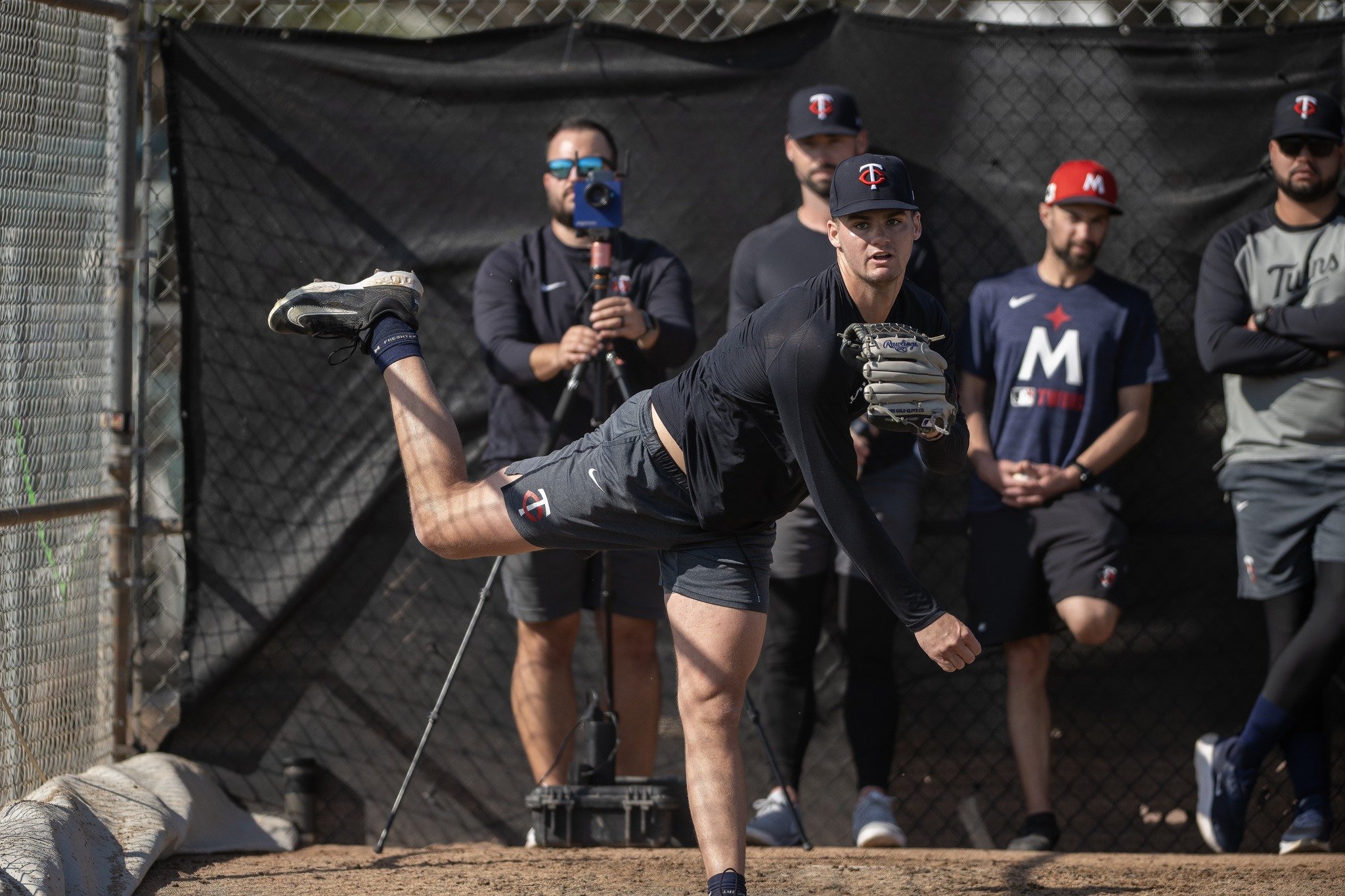
Image courtesy of William Parmeter (Photo of Riley Quick)
When the Twins selected right-hander Riley Quick with the 36th overall pick last summer, it was easy to see why there was so much internal excitement. College pitchers with polish, athleticism, and a starter’s arsenal don’t linger long on draft night. The question now is not whether Quick belongs in the organization’s long-term plans, but how aggressively Minnesota should move him during the 2026 season.
Twins general manager Jeremy Zoll addressed that idea earlier this offseason, striking a tone that leaned toward patience but left the door open for flexibility.
“Good question,” Zoll replied when asked about the possibility that the Twins would fast-track the 21-year-old right-hander out of the University of Alabama. “We had him throwing down in Fort Myers, post-draft, so we need to get him incorporated into affiliated ball and into a full season.
“But we’re really excited about Riley,” Zoll went on to say. “We were really pumped that he was available at that spot. We weren’t sure he was even going to be there, but we want to let him settle in, and we’ll go from there.”
President of baseball and business operations Derek Falvey echoed that sentiment, while also explaining why the development path for recent college pitchers has shifted.
“I’ll add to that,” interjected Falvey. “With where the draft is now in the calendar year, especially with those college pitchers who have thrown a decent amount, it’s hard for them to ramp back up. So, that first year is kind of an introduction to pro ball. The next year is when we have to see, ‘What does the season look like?’ It’s made the track on that a little different than maybe it’s been before. We’re not going to rush any of those guys. We’re going to make sure they get a good foundation.”
That foundation is essential for Quick, who has not appeared in an official game since signing. His junior season at Alabama was impressive, as he posted a 3.92 ERA, a 3.49 FIP, and a 25.9% strikeout rate while competing in the toughest conference in college baseball. On performance alone, it’s easy to see the argument for moving him quickly once he is fully integrated into affiliated ball.
There are clear pros to pushing Quick aggressively in 2026. He’s a mature college arm with experience against high-level competition and a clean, coordinated delivery that stood out to Twins evaluators. His fastball, slider, and changeup already give him three legitimate weapons, and Minnesota has a strong track record of helping college pitchers refine or add to their pitch mix. If Quick shows early command and durability, there is little reason to let him stagnate at lower levels simply for the sake of caution.
His athletic background only strengthens that case. Quick was a standout in both baseball and football at Hewitt Trussville High School in Alabama and drew attention from SEC football programs. That athleticism translates to the mound, where his repeatable mechanics and body control suggest a pitcher capable of handling challenges and adjustments quickly.
“I got my first SEC offer during COVID, and I was like, this is probably what I’m going to want to do,” said Quick. “Then COVID summer happened, and baseball started getting fired back up again. I started throwing, and I was throwing really good, and I was like, ‘Okay, I think I like striking people out a little bit more.’”
The cons of a fast-track approach are just as real. Quick underwent Tommy John surgery in February 2024, and while his return to form has been encouraging, the Twins have every reason to prioritize long-term health over short-term gains. A full professional season will be a new workload benchmark for him. Managing innings and ensuring recovery between appearances will matter more than his level assignment.
There is also the developmental side that goes beyond results. Quick is still learning how his stuff plays against professional hitters, and how to sequence his pitches consistently in multiple trips through a lineup. Rushing that process could limit the opportunity for refinement that turns a solid prospect into a reliable major-league starter.
Twins assistant general manager Sean Johnson emphasized that there is still more upside to uncover.
“We had a great combine interview with him, and it kind of synced up with what we saw on the field,” said Johnson. “And he’s a pitcher, we think there’s even more to unlock with the way he uses his pitches and his arsenal. Our pitcher development guys are just so excited to have him on board.”
In the end, the best path for Quick in 2026 likely lives somewhere in the middle. The Twins do not need to artificially slow him down if he proves he’s ready for the next challenge, but there is also no benefit to forcing an accelerated timeline simply because the talent is obvious.
Letting performance, health, and development dictate the pace allows Minnesota to balance the upside of a quick mover with the responsibility of protecting a valuable arm. If that balance is struck, Quick’s arrival will feel earned rather than rushed, which is exactly how the Twins want their next wave of pitching to emerge.
Should the Twins fast-track Quick in 2026? Leave a comment and start the discussion.