
With the 2025 Texas Rangers season having come to an end, we shall be, over the course of the offseason, taking a look at every player who appeared in a major league game for the Texas Rangers in 2025.
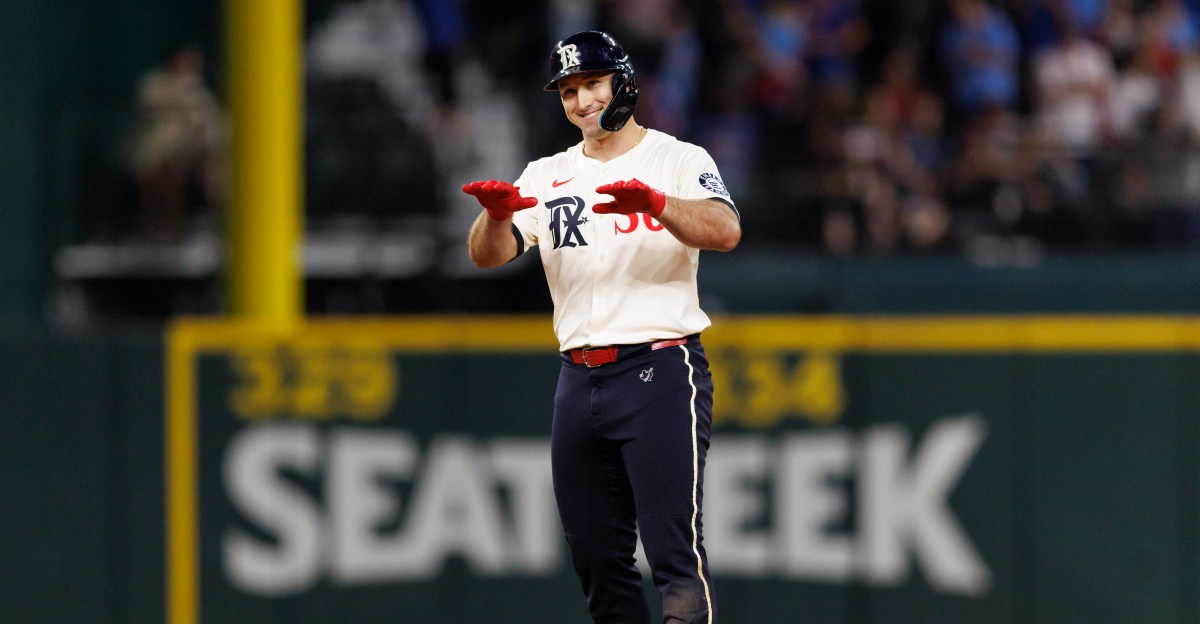
Today we are looking at outfielder Wyatt Langford.
There’s a couple of ways to look at Wyatt Langford’s 2025 season.
One way to look at it is as a mildly disappointing season.
After a quality rookie campaign in 2024, when he slashed .253/.325/.415 in 134 games, there were hopes that Langford would take a big step forward in 2025, particularly given that he ended the 2024 season with a .300/.386/.610 slash line in the final month of the season.
Instead, Langford’s sophomore campaign saw him improve somewhat offensively, but not hit at the level his superstar potential suggested was possible. He slashed .241/.344/.431 in, once again, 134 games. His walk rate went up, though his K rate did as well. He improved from 16 home runs in 2024 to 22 home runs in 2025, which is nice, but not the sort of power I think we were hoping for. It wasn’t the breakout performance that…I hesitate to say expected, but that we wanted to see from him.
Another way to look at Wyatt Langford’s 2025 season is that he established himself as a legitimate All Star caliber player in his second full professional season. He put up a 127 OPS+, which was 16th in the American League, right behind Julio Rodriguez. He stole 22 bases and played terrific defense in both left field and center field, resulting in a 5.6 bWAR, tying him for 8th in the American League among position players in bWAR. Here’s who he trailed:
If you prefer FanGraphs, Langford put up a 118 wRC+ (cue the arguments about the differing park factors for the Shed between B-R and FG), and was 16th in fWAR among American League position players.
Whichever way you look at it, it was impressive work for a guy who was 23 all season and who was playing college ball two summers prior.
Wyatt Langford has accumulated 9.5 bWAR through his age 23 season. The only position players to put up more bWAR through age 23 for the Rangers are:
Hell, if we drop it to just 5.0 bWAR through age 23 for the Rangers, the only guys who join the list are Jeff Burroughs (7.2) and Oddibe McDowell (5.5).
Such is the burden of great expectations.
When you peruse Langford’s Statcast page, there’s a lot to feel good about. He crushed fastballs, improving his xwOBA against four seamers from .357 to .394 and against sinkers from .355 to .371. He hit well against breaking balls, particularly sliders, where he improved his xwOBA from .318 to .375, and with his overall performance against breaking balls improving from a .325 xwOBA to a .340 xwOBA. He had issues with changeups both years, with his performance against offspeed stuff remaining stagnant — .235 xwOBA in 2024, .231 xwOBA in 2025 — and so that’s something to work on. That’s also the category of pitches a major league hitter is going to see the least often, though.
Langford hits the ball hard, with his hard hit %, barrel % and average exit velocity being in the 81th, 87th, and 82nd percentile, respectively. His walk rate is in the 90th percentile. He has speed, with Statcast putting his top speed at 28.9 ft/second, in the 88th percentile. Even his arm strength — which is seen as his weakest tool — was a shade above average, according to Statcast.
There were concerns voiced, particularly early in the season, about Langford’s approach at the plate, with complaints that he was too passive or getting himself in bad counts and then making bad swing decisions. Langford showed significant improvements in that regard in the second half of the season, particularly after he came off the injured list in early July.
From Opening Day through June 24, when he went on the injured list, Langford slashed .232/.308/.421, with 28 walks against 76 Ks in 292 plate appearances.
From July 5, when he came off the injured list, through season’s end, Langford slashed .252/.381/.443, with 46 walks against 75 Ks in 281 plate appearances.
Along with drawing many more walks, he made better contact as the season went on — after putting up an infield fly ball rate over 10% in both April and May, he dropped that to 2.9% from July 1 to season’s end. He cut the percentage of softly hit balls in half in the second half of the season, compared to the first half. His wRC+ from July 1 through season’s end was 135 — that would have had him tied for 6th in the American League if he did that over the full season. And if you think that the park effects FG uses are shorting him a few points by not properly taking into account how pitcher-friendly the Shed was in 2025, and set the bar at, say, 138 wRC+, the only American Leaguers with a higher mark in 2025 were Aaron Judge, George Springer and Cal Raleigh.
Wyatt Langford was really good in 2025. He showed improvements in the second half, which one would hope is a sign of things to come for 2026. He’s pretty clearly the second best position player on the team, behind Corey Seager, and should be one of the cornerstones for this team going forward.
We should all feel good about Wyatt Langford — what he has done so far, and what he will do going forward.