
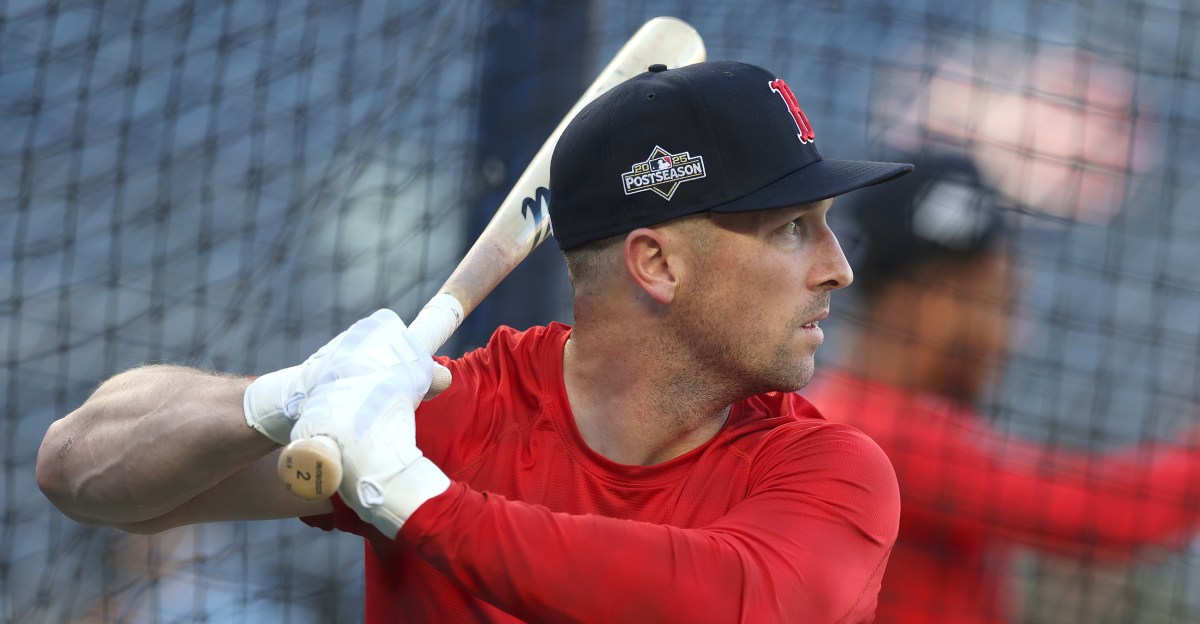
Over the weekend, the Chicago Cubs made a free-agent splash that they haven’t made in some time when they signed third baseman Alex Bregman to a five-year, $175 million deal. It is the largest contract by average annual value in the Cubs’ history, and the third-largest in terms of total value, behind the eight-year deal Jason Heyward signed in 2015 and the seven-year deal for Dansby Swanson in 2022.
It was enough for one national publication to ask if the Cubs were the “runaway NL Central favorite.” And it’s true: as we sit and wait to see if the Brewers are going to do anything, with the most likely big move being a significant subtraction from the top of their rotation, it seems fair, on the surface, to ask if the Cubs are moving forward while the Brewers spin their tires.
There are a few other factors at play, here, though.
First, let’s talk about the Cubs. Yes, Bregman is a good player. Even if the end of that contract gets a little ugly (he is signed through his age-36 season), Bregman has been reliable for 3.5-4.5 WAR for each of the last four seasons. In 2025, he was on pace for what might have ended up as his best season in years but finished with only 114 games played. If he’s healthy, he should produce, and Bregman is a guy who has played at least 145 games in six of the eight full, 162-game seasons that he’s played in.
But what Bregman is not is a superstar. He had back-to-back superstar-level years in 2018 and 2019 (I’d have voted him MVP in 2019), but while he’s been solid, he hasn’t approached that level since. And something that the Athletic’s article above doesn’t spend much time on is that while the Cubs added Bregman, they also subtracted Kyle Tucker—a better player. (Tucker hasn’t signed yet, but it would be a true shock for Chicago to sign both Bregman and Tucker.)
The Cubs have also traded for Edward Cabrera and made a couple of additions to their bullpen as well, and Justin Steele will be back healthy at some point. But when viewed with the knowledge that Tucker, a potential MVP candidate, is out the door, it’s difficult to say that the Cubs are improved over last season. They’ve probably done enough to mitigate the loss of Tucker (and his hypothetical replacement, top prospect Owen Caissie, who went to Miami in the Cabrera deal), but that’s about where I’d draw the line.
Should the Brewers worry?
So, one could then say that since the Brewers were better than the Cubs last season, they should be better this season, too. The Brewers haven’t had any major losses to their roster (at least not yet, as we continue to await news on Freddy Peralta), and with young players at several key positions, it’s reasonable to expect some internal improvement.
The counterargument here, though, is that at least the Cubs are doing something. The only move that Milwaukee has made so far this offseason that will affect the opening-day roster was the trade in which they sent Isaac Collins and Nick Mears to Kansas City for Ángel Zerpa. While I’m bullish on Zerpa and think he’ll be a good addition, a very reasonable person could argue that Kansas City is likely to get more value out of Collins and Mears than the Brewers will get out of Zerpa. Other moves have been for marginal players like Akil Baddoo and Sammy Peralta who may or may not play for the big-league club this year.
The Brewers may very well feel good about the options that they’ve got for their club. They might think that Joey Ortiz’s defense gives him a usable floor and his offense could bounce back. They might think some combination of Jake Bauers, Garrett Mitchell, Blake Perkins, Brandon Lockridge, and Baddoo will ably answer the “who’s the third starting outfielder” question. The pitching staff, as of this moment, looks to be a strength.
But there’s a concept that you hear about when people talk about the “big” European football (soccer) teams: you’ll hear pundits refer to “competition for places” in the preseason quite often. This tends to happen when a team acquires a player to challenge a more established player who may have seen a tick down in their performance. The thought is that it can motivate both players to raise the level of their game, and that if a player does not feel pressure from “below,” they can get complacent.
This does, admittedly, seem like a somewhat simplistic view of what motivates professional athletes, many of whom are not wired in such a way as to invite complacency. But there’s a larger point here, and it could be that “standing still” isn’t what good teams should do—they should always be searching for ways to improve. This could be viewed as particularly true about a team in the Brewers’ position, one in which they had the best record in the league last season but may have slightly over-performed and definitely showed some weaknesses in the postseason.
This is not me calling for a “keeping up with the Joneses” type of free-agent splash. The Brewers have correctly identified one of the central Moneyball notions: that if a team with an economic disadvantage tries to do the same thing that wealthy teams do, they will never be able to do that thing as well as the wealthy team does. Milwaukee cannot compete with the Cubs financially, so they should not merely spend their limited available funds (which may already be spoken for) on a player who isn’t as good as the one the Cubs just signed.
But even if the Brewers have a solid long-term plan (they do), and even if they think the team they’ve got right now can do more than just compete with the Cubs (they can), it’s going to feel especially deflating if Peralta is dealt for players who we’re not sure will help the major-league team this season. There’s a feeling that the Brewers have gotten away with something the last few years, as they’ve increased their win total even as established, good major league players keep leaving—that’s what led the Athletic to use the questionable “Midas-like witch’s curse” phrase. Milwaukee’s smart organization building has made it so they tend to have ready-made replacements when players leave, and they continue to be a team that finds unexpected value when they do acquire players.
For now, Milwaukee’s front office seems to be a step ahead. That will not last forever, and at some point the Brewers are going to need to face the fact that they can’t keep getting away with this, whatever “this” is. The Cubs will keep making moves for the Tuckers and Bregmans and Cabreras of the world and paying them sums that the Brewers cannot afford. Milwaukee can continue to stay a step ahead, but at some point they’ll need to find the balance between hanging onto prospect value, acquiring more prospect value, and smartly using that value to acquire players who can compete with the known quantities that teams like the Cubs can afford to bring in.
The short answer: the Brewers should keep doing their thing, and they should not feel pressured to do anything they wouldn’t have done otherwise simply because the Cubs acquired Alex Bregman. It’s also worth noting that rosters do not look the same on January 15th as they do on March 15th. But the Cubs splashing cash like this in the same week that they traded their top prospect for a high-potential starter should serve as a reminder: the Brewers simply cannot afford not to be constantly searching for ways to improve.