
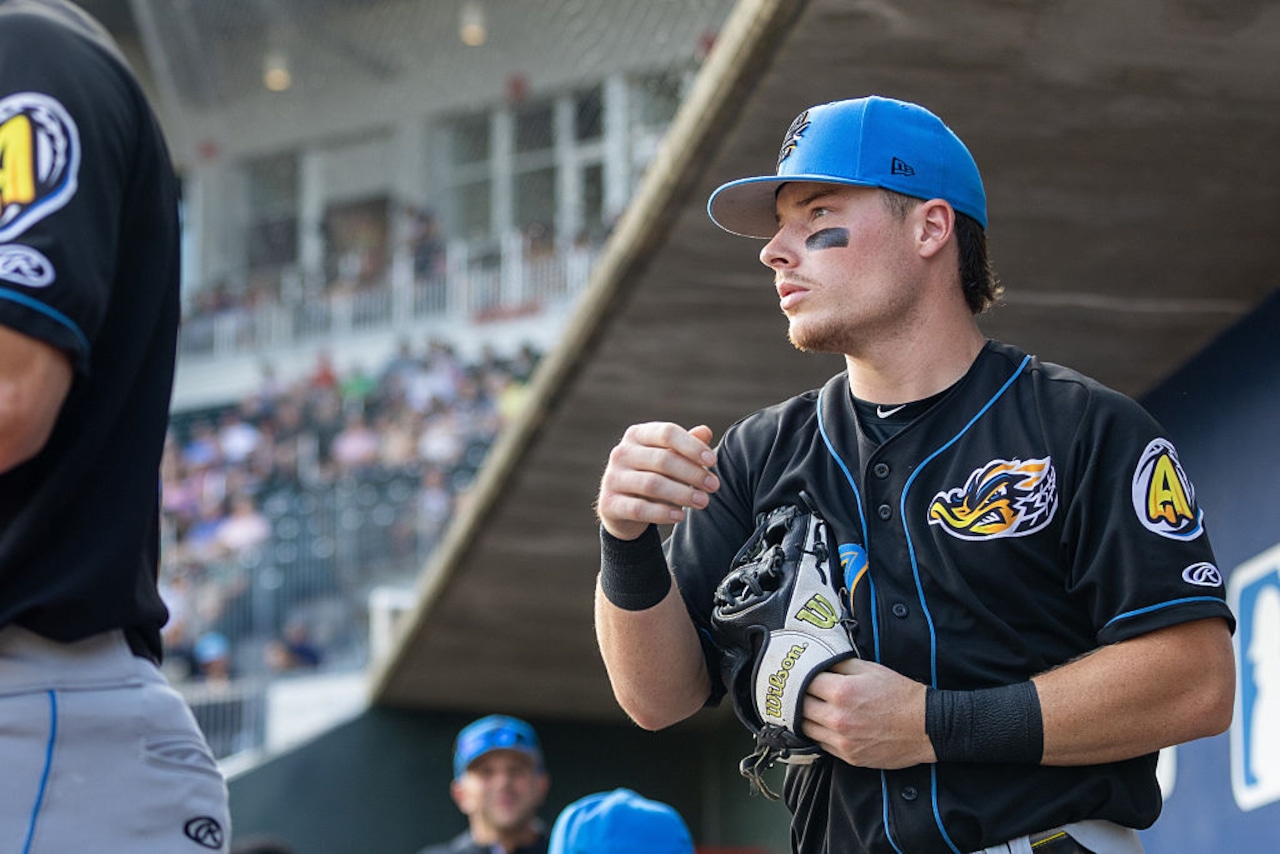
CLEVELAND, Ohio — Planning a spring training trip to catch a glimpse of baseball’s future stars can be tricky – timing is everything when it comes to seeing prospects and non-roster invitees in action. On the latest Cleveland Baseball Talk Podcast, cleveland.com Guardians beat reporters Paul Hoynes and Joe Noga offered invaluable insider guidance for fans trying to maximize their chances of seeing players like top prospect Travis Bazzana.
The discussion began with a practical question from a listener in Phoenix: “Are minor leaguers with big league invites more likely to play in games in the beginning, middle or end of spring training?”
For fans hoping to see the organization’s rising stars and non-roster invitees, Hoynes provided an insightful breakdown of how spring training playing time typically unfolds.
“They’re going to get a lot of playing time especially early in the exhibition season because the regulars are going to be eased in. The minor leaguers are going to eat up a lot of innings for those guys,” Hoynes explained.
This pattern makes perfect sense when you understand the progression of spring training. Veterans like José Ramírez typically begin with limited action – “start by playing a couple innings, and then you bring in the extra third baseman,” as Hoynes put it – before gradually building up their workload as Opening Day approaches.
However, if you’re specifically hoping to see top prospects like Travis Bazzana, Noga offered a more targeted recommendation: “I would say the middle and end of camp is best if you’re looking for Travis Bazzana. Middle of spring training would be best because by the end of spring training he’s going to be sent off to Triple-A camp to start getting ready for the season with them.”
The timing can also differ depending on the specific type of non-roster player you’re hoping to see. As Hoynes pointed out, there’s a distinction between organizational prospects and veterans trying to make the team on minor league deals:
“If you’re a minor league player from outside the organization that got an invitation to spring training, you’re going to get a lot of playing time,” Hoynes noted.
These veterans – like recent Guardians signings Stuart Fairchild and Carter Kieboom – often get extensive playing time throughout spring as they attempt to impress the coaching staff and earn a spot on the Opening Day roster.
“Those guys will be playing a lot because they’re trying to make the ball club. They’re trying to make an impression,” Hoynes added.
For the 2026 Guardians spring training, fans should also be aware that the World Baseball Classic will impact the availability of some top prospects, including Bazzana, who will play in Japan for Team Australia. This international tournament will pull some players away from camp during portions of spring training.
The expertise shared by Hoynes and Noga offers fans valuable strategic guidance for planning their spring training visits. By understanding the rhythm of how teams distribute playing time, fans can maximize their chances of seeing the specific players they’re most interested in.
Whether you’re hoping to catch a glimpse of the Guardians’ future in Travis Bazzana or watch veterans battle for roster spots, timing your trip for the right point in spring training could make all the difference in your baseball vacation experience.
Read the automated transcript of today’s podcast below. Because it’s an AI-generated transcript, it may contain errors and misspellings.
Podcast Transcript
Joe Noga: Welcome back to the Cleveland Baseball Talk Podcast. I’m Joe Noga, joined by Paul Hoynes. Hoynsie, some potential movement today in the US Government’s case against Emmanuel Clase and Luis Ortiz. Both Clase and Ortiz heading to court today for a status hearing in front of a federal judge. Possibility of hearing about potential plea agreements, resolution in the case, exchange of evidence. What, what can we expect out of the, the appearance today in court for Clase and Ortiz?
Paul Hoynes: I think, Joe, usually things are just about by the judge to make sure the case is moving toward trial, which is the trial date is May 4. There is a possibility for a plea bargain or some kind of a resolution to the case where the lawyers get together. Class A and Ortiz will both be there. You know, they’ll have, they’ve requested a Spanish speaking translator. You know, it’ll be interesting to see what comes out of this because, you know, when they first appeared in before, before, you know, at the Eastern District Court of New York, you know, at the end of the, of last year, there was no talk of a plea bargain. So this is maybe a step toward something getting settled. And I’m sure the guardians are very, very interested in this, Joe.
Joe Noga: Yeah, it’s something that the, the guardians should be keeping an eye on. Based on what MLB could come back and, and say if, if the case is resolved, if they don’t go to trial, if they, they reach then the process that Major League Baseball could come through with their side of punishments or suspensions or lifetime bans or anything like that could, you know, finally go into effect after the criminal case is resolved. So it’s definitely something that the guardians need to keep an eye on. You know, have we gotten any further sort of insight into maybe what was going on in the mind of, of somebody like Emmanuel Clase throughout this whole enterprise, this whole experience. What was, you know, what was said? I know that there was a story, I believe it was the New York Times that had a, a piece on it talking about how he was misinterpreting some of the investigation in regards to illicit cockfighting in the Dominican Republic, which is legal down there. I know that that’s, you know, something that a lot of folks keep their pay attention to here in the United States because of animal cruelty laws.
Paul Hoynes: Yeah. And in a recent, on some unsealed documents, one of the, the better one or better two that were identified in the indictment that federal investigators talked to said that some of the messages or text messages intercepted or read by federal authorities between, between Class A and these betters was about gay foul fighting in the Dominican and may have been misinterpreted about him, you know, supposedly throwing fixed pitches, pitches during games. So we’ll have to see how that all plays out. So that’s another element in this, you know, in this ongoing investigation and I’m sure it’ll be talked about at today’s court hearing.
Joe Noga: Yeah, it’s just something that, you know, when, when you read that and when you see that it, you sort of piece things together in your mind. Those of us who were, you know, in the clubhouse at various times over the last several years, we would always notice Emmanuel Clase sitting in his locker, usually on the phone with whoever it was, you know, we would assume back home on his farm in the, in the Dominican. And you would always hear roosters, chickens, you know, of animals coming through on the speaker on his phone. And you wondered about that and you know, not saying that there’s any evidence one way or another that, you know, we, we have, but it’s just kind of interesting to, to sort of piece together things in your mind and, and you know, when he’s making these claims to, to counter sort of the allegations from the federal government, I guess just what a weird situation. Yeah, Joe.
Paul Hoynes: I mean, you know, the federal authorities, I think they better not have gone to, to the, this length in the investigation and be fouled up, so to speak, by, by some, you know, alleged cock fighting down in the Dominican Republic. So, you know, I’m sure they have a little more evidence than that. You know, this, their investigation on Class A at least goes back to 20, 23. So, you know, this is a serious case. They’re facing 65 years each. Ortiz and Class A are facing 60, a possible 65 years in prison if they’re found guilty on all. And the MLB really holds the hammer here and could conceivably ban both these guys for life from baseball.
Joe Noga: Yeah, it’s, you know, very serious. You know, we don’t want to make it sound like we’re not taking any of this seriously. These are very serious charges. But you know, I of course had to figure out, you know, more palatable ways to describe the, what Emmanuel Clase was talking about. And in terms of the illicit cockfighting, a quick Google search of better ways to describe cock fighting, animal cruelty, illegal bird fighting, gamecock battle, you know, bloodsport they, they call it. And, and it just, I think game foul combat I think is an interesting way to describe that. So I can’t believe we’ve gotten to this point here that’s my favorite, Joe game foul combat. I think we’re going to go with that moving forward. Hoynsie Anytime we reference that throughout this case, it’s going to be game foul combat for the rest of the way out. So we’ll find out what happens in the Eastern District of New York and talk about that on Friday. But let’s move on and let’s talk about Rob Manfred coming out recently on in an interview talking about realignment and the possibility of Major League Baseball expanding, adding two cities, adding two clubs to, to the major leagues and then realigning. I think both of those go hand in hand. If you’re going to expand the league, you’re going to realign. If you’ve got if you get to 32 teams, which, you know, the NFL model is sort of ideal in that way and it sets you up for realigning geographically and all the things that go into that. What was your reaction to hearing Rob Manfred talk about expanding to 32 teams? What those, you know, what those locations could include and then what it could look like in terms of, you know, doing away with the traditions of the American and National League?
Paul Hoynes: Yeah, Joe Manfred retires has announced that he’s going to retire in 2029. By that time, I expect that the MLB will, you know, have expanded from 30 teams to 32 teams. I would imagine that’s a goal of his to and you know, so I’ve got no problem with that. The last time there was expansion was, you know, 30, I think 30 years ago. I mean, so there’s been a while and obviously, you know, if, if they can continue to grow the game, if they feel there’s an appetite for the Major League Baseball in, in two more big league cities, you’ll certainly expansion is is, you know, I have no problem with that. I wonder about doing away with the American and National League to, to realign perfectly. We’ in the NL for 125 years. I just don’t think you can just, you know, kind of crumple that up and throw it away and, you know, put it in the corner and start anew. What, where are the records? What happens, you know, just what, what happens to the history of the games? I think that really has to come into play. But there are reasons that, that, you know, what Manfred says makes sense.
Joe Noga: Yeah, I, I like what you’re, what you mentioned in terms of you’ve already eroded sort of the tradition of the by the universal DH and the umpires being across umpiring, across divisions and across leagues which, you know, that’s been in place for several years, many years now.
Paul Hoynes: Since 2000, 2000.
Joe Noga: Yeah. I mean it used to be the American League had their umpires and the National League had their empires and it wasn’t cross pollinate there, I guess. And you know, with that has gone away sort of, you know, the competitiveness of the, the All Star Game, that, that, that doesn’t take place anymore because you know, these guys jump leagues and jump divisions and jump teams so often now. So that’s going away. So I can see why there are reasons where it feels like you’re just holding on to tradition. But like you said, the statistics and the numbers and sort of what. The ways that we gauge some of this player performance, that’s changed over the years too. I don’t know, other than just like record keeping and award sort of presentation. You know, being able to have an MVP in both leagues as opposed to just one. I guess there’s, there’s reasons for keeping it, but you know, some of those reasons, you can argue your way through them. I don’t know as far as making it sort of one homogenous, you know, Major League Baseball League as opposed to an AL and an NL. Maybe we, maybe we get that. By the time Manfred leaves, we’ll see. Expansion could go to potential cities like Nashville or Portland. I even saw one in there about Salt Lake City. What would you think about a Major League Baseball road trip to Salt Lake City?
Paul Hoynes: Joe, can you drink beer in Salt Lake City?
Joe Noga: I don’t know, man. It might be hard. Yeah, that’s. I don’t even think you can drink coffee in Salt Lake City. So it might be tough. I can tell you, Zach Meisel would not like a trip to Salt Lake City if you can’t drink coffee before a baseball game. Because he would be a zombie. Yeah, Nashville, certainly a team that are a city that comes up as a big potential for expansion there. Portland, I would think that they would. That they do expansion to a city out west as well. So, you know, some really attractive options there for Major League Baseball if there’s interest.
Paul Hoynes: Yeah. What do you think about eight divisions of four teams, Joe? I mean, you know, I can see why Manford would like that. It cuts down to travel. It would be easier on players. This would perhaps be a way of easing the tension, the constant tension between owners and players. This would make us, you know, the season that it would ease the travel. You know, especially on teams like Seattle. They have to travel so much more than most of the teams in the Big leagues, you know, so I, I think that would, that, you know, there’s some, there’s some, you know, there’s some good things about that. But you know, you, then you also lose. You lose those rivalry type games. I think, I guess maybe the way you set it up and read one story where they would have. The Western division would include Seattle, Portland, if, you know, they, they were added to the, to the big leagues, the Giants and the Dodgers. So you keep the Giants Dodgers rivalry. Another Southwest would be Angels, Padres, the Athletics in Las Vegas, then Arizona. That makes a lot of sense. There was one, there was one alignment, the Northeast alignment, when it was the Yankees, Red Sox, Toronto and Pirates. Now if you’re the Pirates, you gotta be screaming about that one.
Joe Noga: Yeah. And it also has to do with, especially on the east coast, the size of the markets that you’re putting together. I read somewhere where Manfred would not be in favor of putting cities that have multiple teams like Los Angeles, Chicago and New York, not having those teams in the same division, even though you would have a natural rivalry there between the Mets and the Yankees. But you wouldn’t want to be in the same division competing for. They already compete for their own market share between the two of them enough that that’s something that he would probably want to try and avoid. So all of that is to ask the question, where would the Guardians end up in some sort of mix like this? And they would be in this sort of, you know, analogous Midwest Division with. You would hope that they would keep the Tigers in a, in a divisional rivalry type situation and the White Sox and you know, they might lose teams like the Royals and the Twins just because of geography there. But you know, maybe you would get. It would be nice to be able to go to Pittsburgh more than once every two years. I just, you know, you think about the ability to have, you know, fans from Pittsburgh and fans from Cleveland going to Pittsburgh. So that would be an interesting way to realign things. And also if Pittsburgh doesn’t want to spend money, they would be a team that you would want to compete against a lot.
Paul Hoynes: Yeah, definitely. You could maybe put Cincinnati in there too, Joe.
Joe Noga: Yep, for sure.
Paul Hoynes: That triangle between Cincinnati, Cleveland and Pittsburgh, that would, you could sell some tickets there, I think.
Joe Noga: There you go. Throw in Detroit and you’ve got, you know, no more than a three hour drive between, between any of the, the cities in the division. And you gotta like that. Yeah, that’s. That would be a. And, and if you were the Guardians, you would jump at that. The opportunity to play in that division, wouldn’t you?
Paul Hoynes: Definitely. That, that’s like, you know, when Dick Jacobs okayed the, the Indians flight from the AL east to the newly formed AL Central.
Joe Noga: Yeah, that’s, that would be a trans transformational move for the franchise, I’m sure. All right, Hoynsie, let’s shift over and we’ll start. We’ll do some. Hey Hoynsie. Questions. Some reader submitted questions from our Subtext subscribers. If you want to get in on subtext, it’s 3.99amonth. To subscribe, go to cleveland.com subtext and look for H picture. Click on that and subscribe and you can ask questions, get your questions answered and get, get insider texts from Hoynsie. And for me, throughout the season and the off season, only on cleveland.com subtext Hoynsey, there’ve been, there’s a bunch of questions in here. I’m going to jump in and, and just go right from the top. Here’s one from the 847-area-code. What’s your projected starting rotation for opening day?
Paul Hoynes: You know, Joe with Bibee, Williams and then I, let’s see. Slade Cecconi, I throw Joey Cantillo in there and what am I thinking? Logan Allen.
Joe Noga: Logan, Logan Allen’s your guy and not, and not the rookie, Parker Messick?
Paul Hoynes: I’m going to wait on Messick. I think, you know, he probably could, you know, it’s not going to hurt him if he has, if he has to open the season at Triple-A, he’s got options and you could bring him up when he gets hot like they did last season and he could really help out.
Joe Noga: Okay, next question. Here we go. Coming from the 925 area code Wednesday, what are the key issues regarding a potential work stoppage for next year? Bill in Tennessee asking the question, just quick hits, you know, what do you think the, the, the work stoppage the main sticking points are going to be?
Paul Hoynes: I think it all, all boils down to money. It’ll, it’ll come down to the age old question. Will, will the Major League Baseball players accept a salary cap? I do not think they will. And I think, you know, either there will, there will be a strike or the owners will lock the players out until they can try to find a way. The owners I’m speaking about can try to find a way to where, you know, where they can save money where they don’t have to spend as much. You know, either they look at arbitration, they, there’s, there’s gotta be either a salary cap or a salary floor or they, you know, they take a look at arbitration.
Joe Noga: Next question from Tony down by Athens says is Harrison Bader out of the Guardian’s price range?
Paul Hoynes: You know, from everything I’ve read, Bader, you know is, is after a multi year deal he turned down what a $10 million club option with the Phill he ended last season with. So you kind of know what range he’s looking at. And I’m just wondering if the Guardians would sign a guy to a two year deal right now with so much uncertainty after with the basic agreement expiring after the 2026 season.
Joe Noga: Next question comes from Andy Meese in Sandusky. Hey Hoynsie, will David Fry be ready to resume his catching duties as well as playing first base and outfield when the season begins?
Paul Hoynes: That’s a good question, Andy. You know we were going to talk to Stephen Vogt today, Thursday at the ballpark. He will give us an answer. But from all indications, the last time we talked to a Vogt at the winter meetings he was doing well, he was progressing well. You know he has to be able to throw. That’s the key. He was only able to swing the bat when he came back last season and he was making progress with his throwing program. But we’ll get an update today.
Joe Noga: Hoynsie, this next one come. Hey Hoynsie from Mar in Phoenix. Are minor leaguers with big league invites more likely to play in games in the beginning, middle or end of spring training? Marv’s looking to figure out what days he wants to buy tickets for out in spring training. I would get a better chance to see the, the players he wants to see. So that’s a good question. Minor leaguers with spring training invites. These are guys that are in the organization but not on the 40 man roster who are going to be in camp. We should be getting a list of those guys coming up pretty soon actually, if not this afternoon. But that would include a guy like a Travis Bazzana, right?
Paul Hoynes: Yeah. You know, and Joe, I think those guys, you know, most of those guys, you know either if you come from the organization it’s, it’s a little different. You know, if you’re a, you know, non roster invitee from Cleveland’s organization, you’re probably going to, you know, if you’re a guy like Bazzana, you’re, you’re not going to get that much playing time because you’re going to be playing in the WBC. But if you’re a guy like, you know, if you, if you’re a minor league player from outside the organization that signed a minor league deal and got an invitation to spring training, you know, you’re going to get a lot of playing time just as you are if you’re, you know, a minor league, minor league player from the organ from within the organization. I think you’re going to get a lot of playing time especially early in the exhibition season because the regulars are either going to, you know, they’re going to be eased into this, into the, you know, the exhibition season. So you’re going to eat up a lot of innings for those guys. I mean a guy like Jose Ramirez will probably start, you know, start play a couple innings, two or three innings, then you bring in the, the extra third baseman and your spring training. Those guys that are in camp trying to make the ball club, we’ve got a couple guys like who’s. They do’s a guy that, that just.
Joe Noga: Signed Stuart Fairchild and the, the first baseman from.
Paul Hoynes: Yeah.
Joe Noga: Carter Kieboom from, from the Nationals and the Angels.
Paul Hoynes: So yeah, those guys will be playing a lot because they’re trying to make the ball club so they, you know, they, they’re trying to make an impression. They, they don’t. They’re not going to the WBC. They’re here to make a ball club. So you know, they’re going to, you’re going to get a good look long look at those guys.
Joe Noga: Yeah. So to answer Marv’s question here, beginning, middle or end of spring training? I would say middle and end. If, if you’re looking for Travis Bazzana and to, to get the, the most games for him, middle and end of spring training would be probably the middle of spring training because by the end of spring training he’s going to be sent off to, to, to Triple A camp to start the season off with, with them. More than likely. But early on, like you said, WBC is going to be what, what’s going to occupy most of his time? Uh, all right, we’re gonna do one more here from the, the Hey, Hoynsie batch. We uh, we had a had a lively discussion the other day about Jose Ramirez and Francisco Lindor and their respective places on the ranking of MLB.com’s top 40 players we’re likely to see in 2026 and their hall of Fame chances. MLB.com ranking Lindor ahead of Ramirez in that poll. And you guys had some, you know, strong opinions about this, talking about the market size and Lindor chasing after the, the money and in terms of that. So some of your reactions here in this regard, Terry Richards from Peoria, Arizona, says is the preeminent player of his era. At his position, beyond the numbers and accolades we cited, he has consistently raised the level of his team and done more with less in Cleveland. Lindor, for all of his individual brilliance, doesn’t seem to impact anyone around him, let alone to set the standard the way Jose does in Cleveland. That’s from Terry Richards in Peoria, Arizona. You know, what do you think of the idea that, you know, Jose, as far as his hall of Fame credentials, he elevates the players around him?
Paul Hoynes: Yeah, I think that’s, that’s an excellent point. You know, we, all, we’ve heard this past off season is the turmoil that’s been going on in the, in the Mets clubhouse, you know, maybe the last couple years. Well, you know, if, if, you know, I think that’s probably a reflection on Lindor and, and, you know, the, the other veterans on that club, I mean, they’ve got to get along and we’ve never heard that from about Jose. And Ramirez does elevate the players around him because he has no choice. He’s the best player on the club and they haven’t surrounded him with, you know, he hasn’t had a player, you know, hitting behind him or, or in front of him like Lindor for a long time. You know, he’s, he’s usually the, you know, he still, he stands out in a, which is usually a young, young lineup and you know, he’s got to be the guy that, that carries the team and he’s done that year in and year out.
Joe Noga: Yeah. Lindor always struck me, you know, when we were around as the guy who sort of knew he was marketable and you know, the whole Mr. Smile thing and he, you know, he’s got the million dollar smile to go with the million dollar swing and always sort of did things to, did, did the right things to put himself in a position to be sort of that marketable face as opposed to Jose, who, you know, sort of lunch pail guy who does things behind the scenes, sort of a difference in the two personalities in that way. So. All right, that’s going to wrap up today’s edition of the Cleveland Baseball Talk Podcast. Hoynsie, we’re going to get a chance to talk to Stephen Vogt today and Hunter Gaddis and Austin Hedges. So we’ll have plenty to talk about on tomorrow’s episode and we’ll talk to you then.
Paul Hoynes: Good deal.