
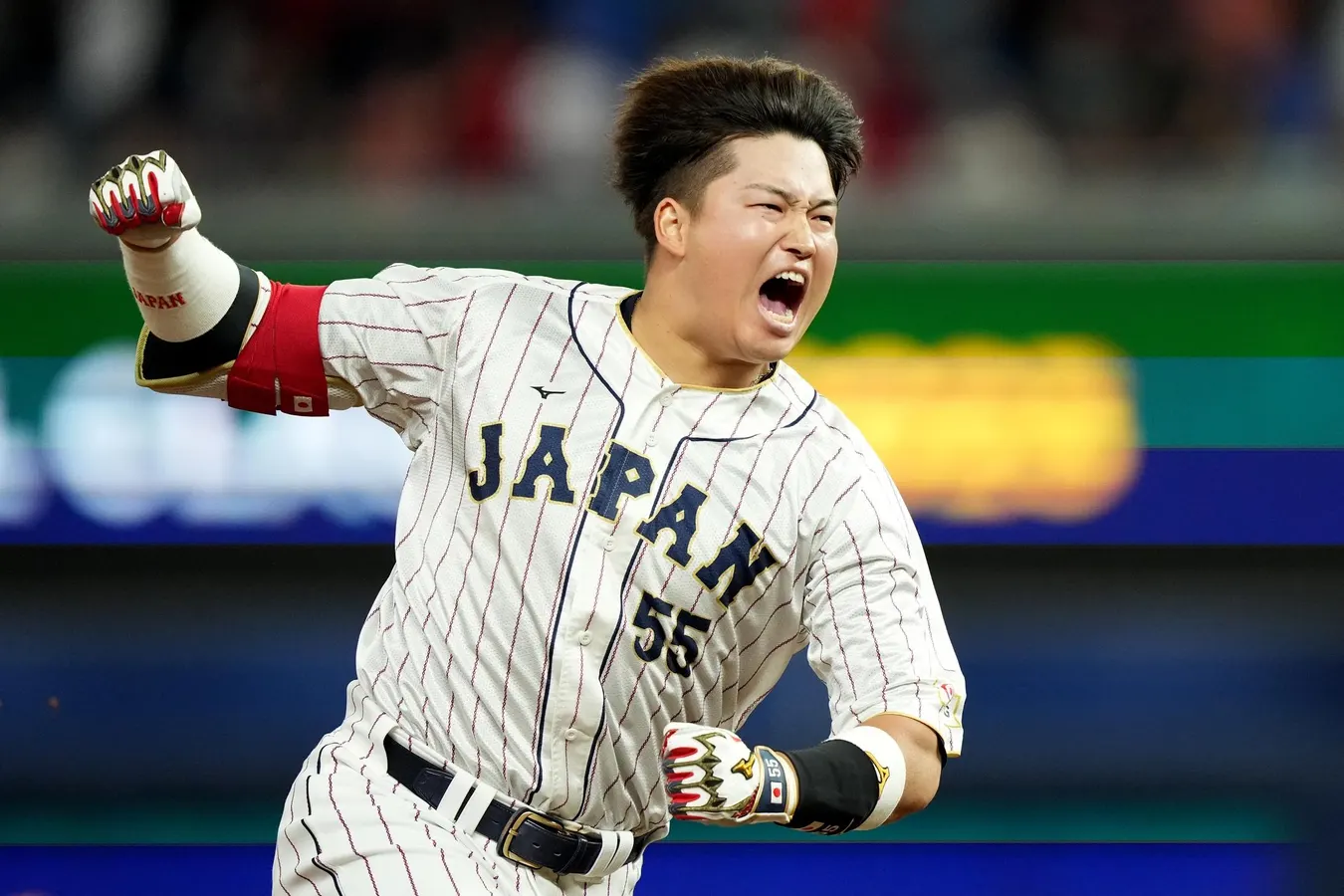
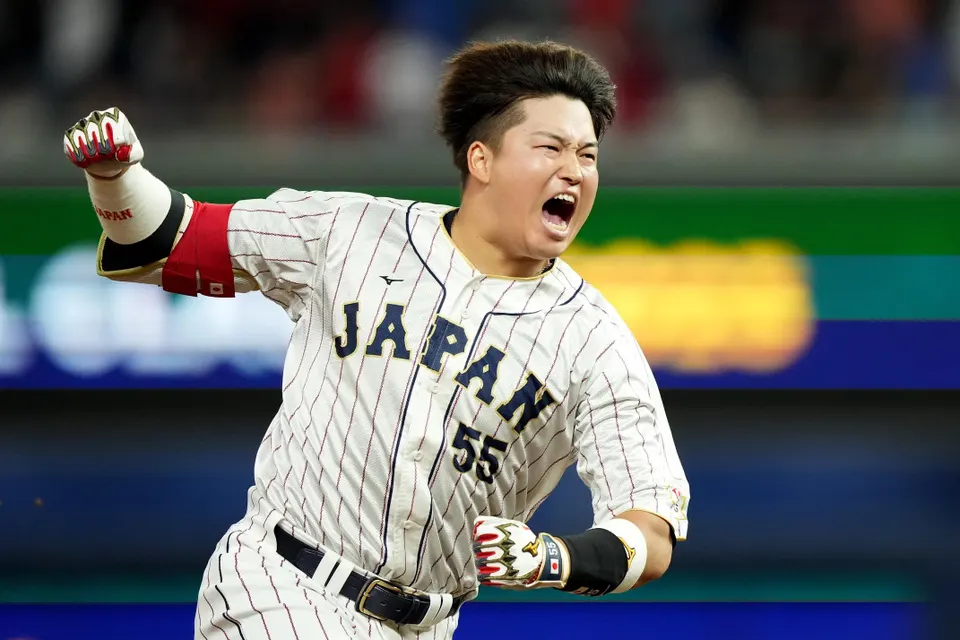
Hair-raising hitting by Munetaka Murakami has attracted the attention of U.S. teams that covet his power. (Photo by Eric Espada/Getty Images)
Getty Images
Although Kyle Schwarber has opted to remain with the Philadelphia Phillies (five years, $150 million), his Japanese alter ego remains in play as the best available free-agent slugger.
He has until Monday at 5p EST to sign with a major-league team or remain with the Yakult Swallows of Nippon Professional Baseball.
He not only smacked 246 home runs in eight seasons but hit a league-record 56 in 2022 to break the 58-year-old Japanese record of 55 held by the legendary Sadaharu Oh.
Japan’s Babe Ruth
Nicknamed “the Babe Ruth of Japan,” the 26-year-old Murakami would be the first power-hitting position player to jump from Japan to the U.S. majors since Hideki Matsui in 2003 – provided he finds a team willing to pay not only a posting fee but also provide a player contract rich in years and dollars.
The posting fee is determined by the player’s contract. It would be 20 per cent of the first $25 million, 17.5 per cent of the next $25 million, and 15 per cent of the total value over $50 million, with a supplemental 15 per cent on bonuses and options.
For example, an $80 million contract would also require the signing U.S. team to pay an additional $10-$15 million to the Japanese team that posted him.
Like Schwarber, Murakami is a left-handed slugger likely to produce plenty of home runs and draw a healthy share of walks but also strike out frequently.
Hideki Matsui, the last Japanese slugger to jump to a U.S. team, was Most Valuable Player of the 2009 World Series. (Photo by Ron Vesely/MLB via Getty Images)
MLB via Getty Images
Matsui, who also batted left-handed, played for four American teams after leaving Japan. A two-time All-Star in the U.S. majors, he once won a World Series MVP award.
Possible Negatives
Most American teams would love to land such a slugger but are wary of his defensive shortcomings at both infield corners as well as a propensity for striking out.
Teams that need power include the Cincinnati Reds and Pittsburgh Pirates, both of whom failed in bids to sign Schwarber. The Pirates reportedly made a four-year, $100 million offer before Schwarber decided to stay in Philadelphia.
Murakami, like Schwarber, might best be deployed as a designated hitter – negating the fielding issues and sparking interest in places like Atlanta, which lost DH Marcell Ozuna to free agency, and well-healed Los Angeles, which has no infield vacancies but could afford a high-priced DH.
Other possibilities include the New York Mets, seeking to replace free agent deserter Pete Alonso, and Boston, where the Red Sox have toyed with a revolving door of first basemen in recent seasons. The Chicago Cubs, like the Red Sox, play in a hitter-friendly ballpark and would need to replace the power bat of Kyle Tucker, a free agent outfielder entertaining a myriad of offers to leave.
Although Schwarber signed for five years, Murakami might need to sign for fewer years, thus betting on himself to earn a longer, more lucrative pact after establishing himself in the American majors.
Pitchers vs. Hitters
Since Masanori Murakami became the first player from the Japanese major leagues to reach the majors, with the 1964 San Francisco Giants, American teams have favored pitchers over hitters when considering players from NPB.
Ichiro Suzuki was inducted into both the American and Japanese Baseball Halls of Fame earlier this year. (Photo by Steph Chambers/Getty Images)
Getty Images
That began to change in 2001, when Ichiro Suzuki became the first man to win Rookie of the Year and MVP honors in the same season, and after Matsui made his mark with the Yankees several years later.
Since that time, Shohei Ohtani has established himself as a two-way player – the best in the United States since Babe Ruth – and won four MVP awards. He also earned the biggest contract in professional sports (10 years for $700 million) before Juan Soto topped it with a 15-year, $765 million deal last winter.