
While the order was a little jumbled on the first day of the MLB Draft, things were pretty much chalk all day. The top five players went in the top five. Only one player in my top 35 went undrafted, Roch Cholowsky, almost certainly for signability reasons, and the rest all went in the top 50. Sixty of the 70 players selected were in my top 100. There was just a lot more consensus this year around who the best players were, and a big reason for that is how strong the college position player class was.
Some Day 1 observations from a fun 2023 draft so far…
• I believe this marks the first time in MLB draft history that we had no left-handed pitchers taken in the first round. The college lefty crop was not strong, and only two college southpaws went at all on Day 1 (Joe Whitman and Sean Sullivan). The high school crop was better, but the industry has gotten much smarter in the last few years, and you just see fewer high school pitchers taken in the first round.
GO DEEPER
Law: Scouting the top prospects I saw at the Arizona Fall League
• The Reds really had a hell of a day for themselves, landing two of the best college right-handers in the draft (Rhett Lowder and Ty Floyd) and then grabbing a high school shortstop who was at least in consideration for a lot of teams in the 20s (Sammy Stafura), someone I considered a first-round talent, for whatever that might be worth.
• The Mariners also went for it in a huge way, going after three high-ceiling prep position players (Colt Emerson, Jonny Farmelo, Tai Peete) with their first three picks before coming back with a college senior (Ben Williamson) to save money in the second round.
• I love Boston’s two picks – a safe college position player who has some ceiling because of the bat (Kyle Teel), and then one of the most electric, high-upside high school position players (Nazzan Zanetello).
• The Dodgers’ picks mystified me, and I say that knowing full well that they have been one of the best drafting teams in baseball for a long time. I’m fine with Jake Gelof in the second round, but there’s more risk to him than is typical for a college bat because he has such an issue with high fastballs. To take him after taking a high school hitter with no power (Kendall George) with their first pick makes for a strange Day 1 combo.
• You laughed when the Mets took Brandon Sproat, right? I laughed. It’s funny. Maybe this time he’ll sign.
1. Pittsburgh Pirates: Paul Skenes, RHP, LSU
No. 3 on Keith Law’s Big Board
The Pirates take the one pitcher who had a credible argument to go first — or even top 5 — and choose the relative risk of an arm over any of the possible position players, including Skenes’s own teammate Dylan Crews. Skenes has top-of-the-rotation upside, with a fastball that holds upper 90s deep into starts and a plus slider. He’s huge and already built like a workhorse MLB starter. He does have to work on a third pitch and on his fastball command, but he’s probably already developed enough to go to Double A to start next year. I doubt we’ll see him pitch anywhere in 2023 except maybe in the Arizona Fall League.
Scouting report: Skenes is the hardest-throwing amateur starter I’ve ever seen, even beating out Hunter Greene and Gerrit Cole; when I saw Skenes pitch at the Box this April, he hit 100 or 101 seven times in the first inning and didn’t throw a fastball under 96. After transferring from the Air Force Academy, where he sat 92-95 mph as a sophomore with a 55 slider, the 6-foot-6, 250-pound right-hander has averaged about 98 mph this year with an easy plus slider, helping him strike out just over 50 percent of batters he’s faced; coming out of the regular season he had 164 strikeouts, 40 more than any other pitcher in Division I. His delivery is fairly compact for a big guy and he has at least above-average control, with the potential for more. He hides the ball extremely well behind his body, so the two pitches he throws should continue to play well even against better hitters, but I did see some guys cheat a little on the fastball because he barely uses a changeup. Other than the development of that third pitch, I don’t see much that can hold him back beyond the injury risk of any hard-throwing pitcher. If you’re going into the draft hoping you can find a Justin Verlander type, he’s your guy.
For the first time ever, two players from the same school have been drafted No. 1 and No. 2 in the #MLBDraft.
LSU’s Paul Skenes and Dylan Crews make history.@LSUbaseball | @LSU pic.twitter.com/k2zWFy1w3I
— The Athletic (@TheAthletic) July 9, 2023
2. Washington Nationals: Dylan Crews, OF, LSU
It’s funny because the word all spring was that the Nats’ preference was to get Skenes at No. 2, but instead they have to settle for … the No. 1 player on my board, at least, if not theirs, in Crews. This year’s Golden Spikes winner capped off a remarkable career at LSU where he hit .349 or better in every season and never had an OBP below .450 or slugging percentage below .660. He also played well enough in center field this year that the consensus is that he’ll stay there in pro ball, which wasn’t the belief when he was already a star as a hitter in high school back in 2019. Crews is such an advanced hitter that he should go to High A to finish out this summer so he can just jump right to Double A to start 2024, with an eye toward getting him to the majors by the summer. I know this isn’t exactly how the Nationals hoped it would play out, but I think they got the best player.
Scouting report: Crews was on scouts’ radar as early as his junior year of high school, when his ability to hit and potential for power and to perhaps stay in center marked him as a likely first-round pick when he graduated in 2020. He started that spring poorly, swinging and missing more than expected. After the pandemic, he decided to withdraw from the draft and go to LSU. As much as I dislike seeing kids forego a chance for an MLB team to offer them a ton of cash, Crews’ decision certainly worked out, as he’s the best prospect in this draft class, the most likely player to go 1-1, and going to get a decisively larger signing bonus than he could possibly have gotten three years ago. Crews has performed for three years in Baton Rouge, hitting for average, getting on base, posting solid contact rates and even playing above-average defense in center. He destroyed non-SEC pitching, and while he was worse within the conference, he still led SEC hitters in average and OBP through the end of the regular season, and ranked seventh in slugging, with more walks (27) than strikeouts (22). He’s a 55 runner who’s actually picked up some speed since high school, benefiting from LSU’s strength and conditioning program to get stronger without getting slower, and making himself a viable candidate to stay in center in pro ball, although he might be bumped to a corner by a truly plus defender. Even if he has to go to right field, he’d be a plus defender there, and the bat will play anywhere on the diamond. He’s put up numbers, with the underlying metrics to back it up, in the best conference in college baseball for three years. He should be the first pick, and should be in the majors before the end of 2024.
3. Detroit Tigers: Max Clark, OF, Franklin (Ind.) Community High
The Tigers pull a mild surprise, taking the high schooler rather than Florida Gators outfielder Wyatt Langford — which is not a criticism of the pick, as Clark would have been a 1-1 candidate in a lot of years and was supposedly still in the Pirates’ mix this weekend. Clark is probably the draft’s closest thing to a five-tool player, a dynamic athlete with surprising power from his six-foot frame and the promise of plus defense in center. He’s also a bit of a social media star who’ll probably be a fan favorite for a long time – but he’s also further away from the majors than Langford is, probably by two years.
Scouting report: Clark is an outstanding all-around athlete, a 70 runner with an incredible build and an easy, pretty left-handed swing that looks geared to drive the ball to all fields. He’s got bat speed and hand strength that should translate to plus power or close to it when he reaches his peak, even without the projection to add a ton of muscle between now and then. His speed translates to plus defense in center and he has the arm to play anywhere in the outfield. He’s earned praise from scouts for his competitiveness and his work ethic. My daughter was impressed by his Instagram follower count (more than 309,000). He’s a Vanderbilt commit, but his future is in pro ball, with real superstar upside.
4. Texas Rangers: Wyatt Langford, OF, Florida
Langford was No. 2 on my board, and No. 1 coming into the spring, as he’s a more explosive athlete than Crews with more speed, but doesn’t have Crews’ lengthy track record of performance going back to high school, and doesn’t play center field. He excelled in the SEC for the last two years, however, and has shown he can hit good pitching, enough to think he could move almost as quickly to the big leagues. With Texas now a contender with a core that’s signed for a long time but also not a young roster overall, Langford could reach the big leagues in time to help extend their window of contention.
Scouting Report: Langford only hit .250 as a freshman for Florida … because he went 1-for-4. Since then, he’s hit .373/. .480/.762 in 114 games for the Gators, with 42 homers and more walks (80) than strikeouts (78), while playing in, yes, the best conference in college baseball. He’s even outslugged Crews this year within the SEC. In a typical year, he’d be the no-doubt first pick, but this is an atypical year in all the best ways, with five players I think would reasonably be in the discussion for the first overall pick in the majority of draft classes. This year, he’s competing with Crews, who has a longer track record and slightly better performance, especially in getting on base, as well as maybe the hardest-throwing amateur starter ever and two elite high school outfielders. Langford is a 70 runner at full strength — he missed about two weeks this spring after fouling a ball off his … well, I don’t think he was wearing protective equipment, and while he didn’t have surgery, he wasn’t running quite as well after the injury. Despite that, however, he plays left for Florida, and hasn’t looked great out there, giving some Derek Fisher vibes (another 70 runner who just wasn’t very good anywhere in the outfield). That defensive question is what really puts him behind Crews for me in the end, even with a slightly higher offensive ceiling, with more power and speed.
5. Minnesota Twins: Walker Jenkins, OF, South Brunswick High (Southport, N.C.)
The Twins seemed to be much more interested in college hitters, so the pick of Jenkins is a mild surprise, especially since he is likely to require full slot. I know some scouts had him first on their personal pref lists and compare him to a young Larry Walker, seeing an athletic right fielder who has plus range and really, really hits. He has that build and a sweet left-handed swing that should produce hard contact and power. Like Clark, he hit well in showcases but was walked a ton in his senior spring while playing mediocre competition. This also means the top five were, in fact, the top five — the five players atop my board, and I think everyone’s boards, ended up going in the first five picks. No team decided to cut a deal to take a player outside of that quintet.
Scouting Report: Jenkins flew up boards this spring after a modest summer showing when he was hampered by a hamate injury. He looks the part of a top-of-the-draft hitter, 6-3, 205 pounds, lean and athletic and twitchy but with lots of room to add 20-25 pounds. He’s a plus runner, but I wouldn’t be shocked if he slid a little toward above-average as he filled out. He’s a left-handed hitter with a great swing that’s boosted by his outstanding bat control, allowing him to adjust mid-swing more than most teenagers can, and once he fills out he’ll probably have 30-homer power. He’s a center fielder now and a good one, although I could see him losing enough speed to move to right. He looks like he’ll hit like an All-Star right fielder, and maybe the UNC commit will end up staying in center, too.
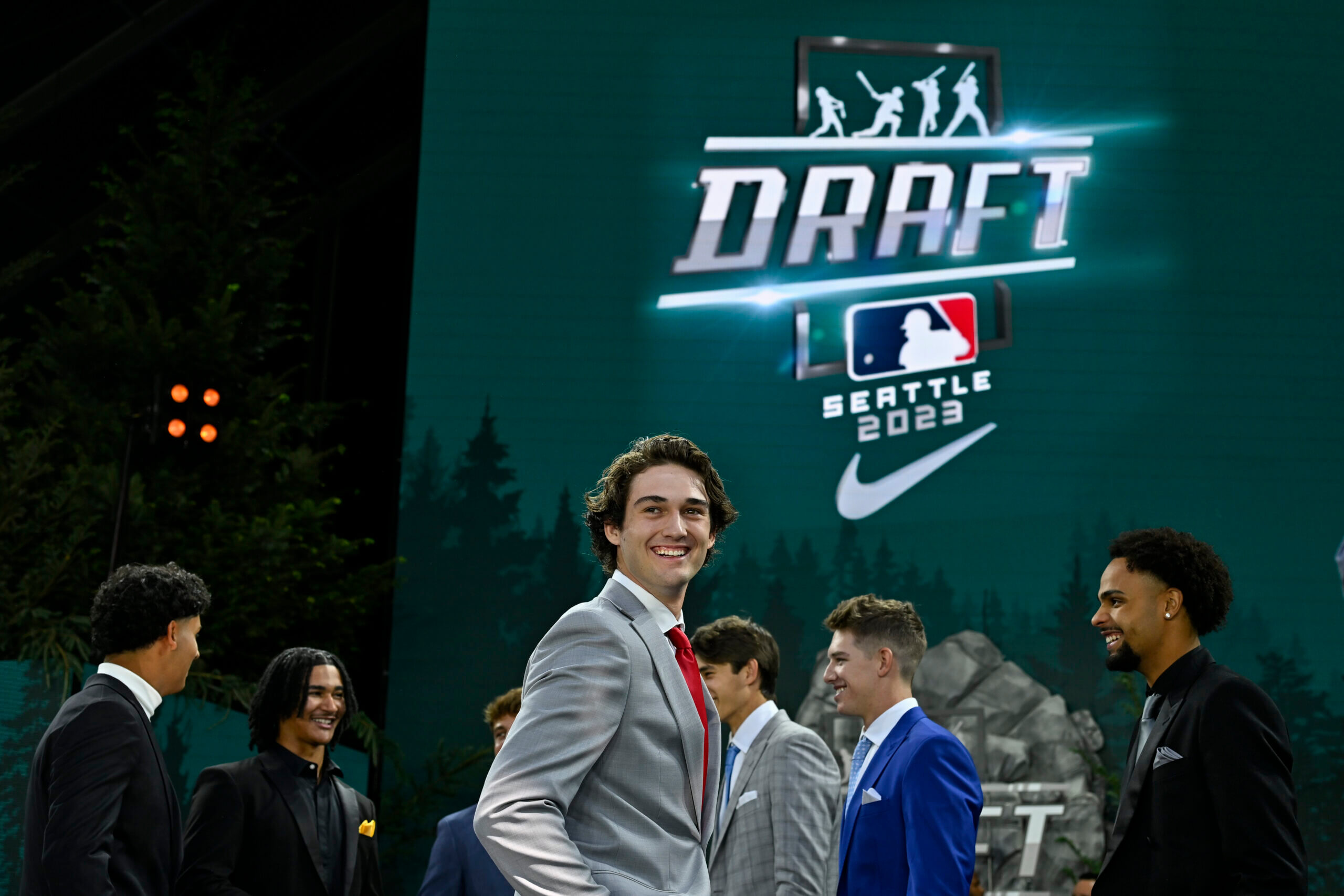
Jacob Wilson was all smiles before the draft. (Alika Jenner / Getty Images)
6. Oakland Athletics: Jacob Wilson, SS, Grand Canyon
This is a reach for me, although I know people who think Wilson is one of the safest big leaguers in this draft class. The son of former Pirates infielder Jack Wilson, Jacob’s a solid defender at shortstop with great instincts and the best contact hitter in this draft or in many drafts. He struck out less often in the last two college seasons (12) than most players do in a month. He also has grade 30 power, with very low exit velocities and a launch angle at or below 0 degrees. He’s not short, so there’s hope he can pack some muscle onto his slender frame to make harder contact, and maybe the A’s can help him adjust his swing path to drive the ball more, but right now he projects as a hitter for a decent average without power and maybe without a great OBP.
Scouting Report: Wilson struck out just seven times all of spring 2022, in 275 plate appearances, and this year punched out just five times in 217 plate appearances, finishing with a .412/.461/.635 line for the Antelopes and zero strikeouts in his last 100 trips to the plate. The son of former Pirates infielder Jack Wilson, Jacob is also a true shortstop, one of the better defenders in the college class. Despite an anxious approach at the plate – he never stops moving his hands or his legs – his hand-eye coordination must be off the charts. He gets all that contact by eschewing any attempt to hit for power, as he slaps the ball into play and will shoot it to the opposite field. He’s got a skinny frame that offers little projection. He doesn’t drive the ball at all or hit it hard, and his launch angle is barely over zero degrees, giving him one of the lowest of any college hitter who might go in the top-50 picks. He’s a fringe-average runner, as well. That’s a long way of saying that it’s a tough profile, albeit one we’ve seen go in the first round – Nick Madrigal and Kevin Newman are two recent examples. He is someone who projects to play in the big leagues with very, very high probability, but who may not have the ceiling of a regular.
7. Cincinnati Reds: Rhett Lowder, RHP, Wake Forest
I’m a big fan of this pick and thought Lowder was the No. 2 pitcher in this draft — and he certainly has the best hair. Lowder sits mid-90s with an out pitch in his changeup and saw huge improvement in his breaking ball this year, raising his projection from fourth starter to maybe a No. 2. His delivery has some funk to it but it plays, as he’s thrown plenty of strikes and shows great feel for moving the ball around the zone. He could move quickly through the low minors, as those two offspeed pitches might just be too much for A-ball hitters, but I wouldn’t project him to move quite as quickly as Skenes. The Reds continue to do well in the draft – it’s why they’re in first place right now.
Scouting Report: Lowder might have the best pure changeup in the entire draft class, if we separate it from split-changes and splitters, and his other pitches aren’t too shabby either. He’s 92-96 mph with that plus changeup, a pitch that has great deception, power at 86-89, and tailing action that makes it deceptive to hitters on both sides. He’ll use it in any count, even to get ahead. His slider is solid-average, 82-86, with some tilt, more a swing-and-miss pitch against right-handers than one he’ll try to throw for a strike. The delivery isn’t great, as he starts all the way on the first-base end of the rubber and lands too early, so he cuts himself off and has to come slightly across his body to pitch to his glove side. He also plants his front leg too soon, spinning off the front heel and putting more stress on his arm with the abrupt finish. None of these are reasons not to take him, but they’re things player development will probably want to address sooner rather than later, to make him more effective — he’s got fringy command at best, although he does throw strikes — and keep him healthy. It’s at least No. 3 starter stuff and he could end up a strong No. 2 for most teams with some delivery help, assuming that gives him another half-grade of command.
8. Kansas City Royals: Blake Mitchell, C, Sinton (Texas) High
I’m assuming the Royals cut some kind of deal here with Mitchell, as he wasn’t going anywhere near this pick otherwise — although he was the best high school catcher in the draft class by a wide margin. He’s a power-hitting catcher who should end up a plus defender, with a plus arm for certain, but he did have a little trouble hitting better quality pitching last summer. High school catchers are generally one of the riskiest demographics in the first round, which is why they’ve become rarer picks up there in recent years. The Royals have cut significantly with their top pick several times in recent years, including in 2021 with Frank Mozzicato, so they could go well over slot with multiple picks later, so watch for who they take in the second round.
Scouting Report: Mitchell is the best high school catcher in the draft class this year, which probably puts him in the first round automatically, although the potential as a left-handed-hitting catcher with power and plus defense also qualifies him. Mitchell starts with a very wide stance and still strides forward from there, which gave him some trouble with better quality stuff last summer and probably cuts off some of his natural power. His hands work well at the plate and he has the finish to his swing to drive the ball in the air, with 25-homer potential if he hits enough to get to it. He’s a plus defender with a plus arm who is a no-doubt catcher, which is good since he doesn’t have a clear alternative position. He’s nowhere near the same sort of prospect off the mound, but does work 90-94 mph, showing his arm strength, just lacking anything like an average second pitch.
9. Colorado Rockies: Chase Dollander, RHP, Tennessee
The Rockies always need pitching, and they’ve been linked to Dollander for months; he’s also a perfect pick for them because a year ago, if you’d said Dollander would go ninth overall, anyone involved in the draft would have told you that you were out of your mind. At his best, he’s 93-97 mph with a wipeout slider, but changed his slider grip this spring and saw the pitch back way up to the point where there were games where he wouldn’t get a single whiff on the pitch. He throws a ton of strikes and has enough changeup that there’s no concern about him starting. You just have to hope the Rockies can restore his 2022 slider, in which case they might have a No. 2 starter.
Scouting Report: Dollander will be one of the most fascinating names to watch on draft day, as he came into the year as the top college pitcher in the class but struggled all spring with command and never found the grade-70 slider he had as a sophomore. That slider was short and tight with what appeared to be very late downward break, and Dollander could throw it for a strike or use it as a chase pitch. This spring, however, it never had the same bite, and hitters whiffed on it less and chased far less, about two-thirds as often as they did the year before, so Dollander had to rely more on his fastball. His fastball is still 93-97mph and he throws it for strikes, albeit not quite as much as he did in 2022, so if some team can figure out what went wrong with his slider – Did Tennessee try to get him to change the pitch? Is he dealing with some injury or discomfort? – there’s a good chance they’ll get the draft’s best or second-best college pitcher. He had No. 2 starter ceiling or better last spring, and that pitcher might still be in here.
10. Miami Marlins: Noble Meyer, RHP, Jesuit High (Portland, Ore.)
The Marlins definitely draft their own way, reaching badly last year for Jacob Berry, and this year they take the first high school pitcher. Meyer is indeed the best high school pitching prospect this year, with huge spin on two breaking balls and a fastball that reached 101 mph later in the spring. There are mixed reviews on the delivery, although I don’t see any big problems with it, and his fastball plays down from its velocity. Really, though, they took a high school pitcher at the 10th pick, and all the available information we have says you don’t want to use a pick that high on anyone in that category. Just look at Jackson Jobe and Andrew Painter.
Scouting Report: Meyer is probably the top high school pitcher in this draft, certainly the top right-hander, and in some years he’d be looking at a sure top-10 selection and would be at least a little higher on my rankings, although new readers should bear in mind that I discount all high school pitchers based on the much higher attrition rates for such players taken in the first round. (They reach the majors at a much lower rate than other categories, and even if they get there, a lower percentage of them have sustained success.) Meyer has been up to 101 mph this spring, sitting 94-96 mph in most starts, with a hammer curveball that has huge spin rates and a power slider, barely using his changeup, perhaps because he just doesn’t need it yet. It’s a good delivery and good body for a starter, with a lot of projection left on his 6-foot-5 frame. I’ve heard scouts say they think the fastball plays down from its velocity, which is a fair concern but also a small one if that’s his biggest flaw. There’s at least mid-rotation upside here.
11. Los Angeles Angels: Nolan Schanuel, 1B, FAU
Schanuel might have rivaled Crews for the best performance this season by a draft prospect, although Crews did it in the SEC. Schanuel’s a disciplined hitter who can whack a fastball, and has both feel to hit and plus power. He’s limited to first base, though, so he absolutely has to continue to produce across the board. He walked five times as often as he struck out this spring and was one of the best hitters for contact in the country. I’m going to guess the Angels will push him very quickly, and start him in Double A in April to try to get him to the majors quickly as they did with Zach Neto.
Scouting Report: Schanuel’s stat line might be the only one to rival Crews’, with a hilarious .447/.615/.868 line and 71 walks against just 14 strikeouts. He’s done so in Conference USA, not the SEC, so he hasn’t faced the same caliber of arms, and he’s limited to first base, which seriously dents his draft stock, as does a mediocre performance hitting on the Cape last summer. He can hammer a fastball, even at good velocity, and rarely whiffs on heaters or chases anything out of the zone. He starts with his hands high above his head, except with two strikes, when he starts a little closer to the helmet, but it’s mostly just for show as he gets his hands into position in time. Otherwise, it’s a simple approach, and his hands and hips work very well together for solid contact … but it’s not elite contact quality or huge raw power, which might indicate there’s a lower ceiling for the bat. If he could play anywhere else, he’d probably sneak into the top half of the round.
12. Arizona Diamondbacks: Tommy Troy, SS, Stanford
Troy is a bat-first prospect who’ll have to find a position, although he could potentially work out either at third base or maybe even move to the outfield, not that the D-Backs need another center fielder at this point. He’s an outstanding fastball hitter and makes generally hard contact, although he needs to get the ball in the air more to turn those strong exit velos into real power. He’s athletic enough that you can just say you’ll figure out the position later because the bat will play anywhere.
Scouting Report: Troy is a very high-contact hitter despite a swing that sometimes looks like it’s going to take him right out of his shoes, occasionally generating very hard contact but with only middling power. He almost never misses a fastball, whiffing on only eight percent of them this spring (through the end of the regular season) even when he goes out of zone, and he clearly hunts those pitches, doing the vast majority of his damage there. He has shown a vulnerability to changeups both this spring and last summer on the Cape, although not enough to dent his overall line. He’s a 55 runner who’s played all over the field, mostly playing third this year for the Cardinal, but with some shortstop experience, enough that he should go out either at that spot or maybe even try center. Teams that have been chasing contact should be all over Troy, as he doesn’t just make a lot of contact, it’s solid quality contact, and if someone can get him to put the ball in the air more he might get to 55 power in time.
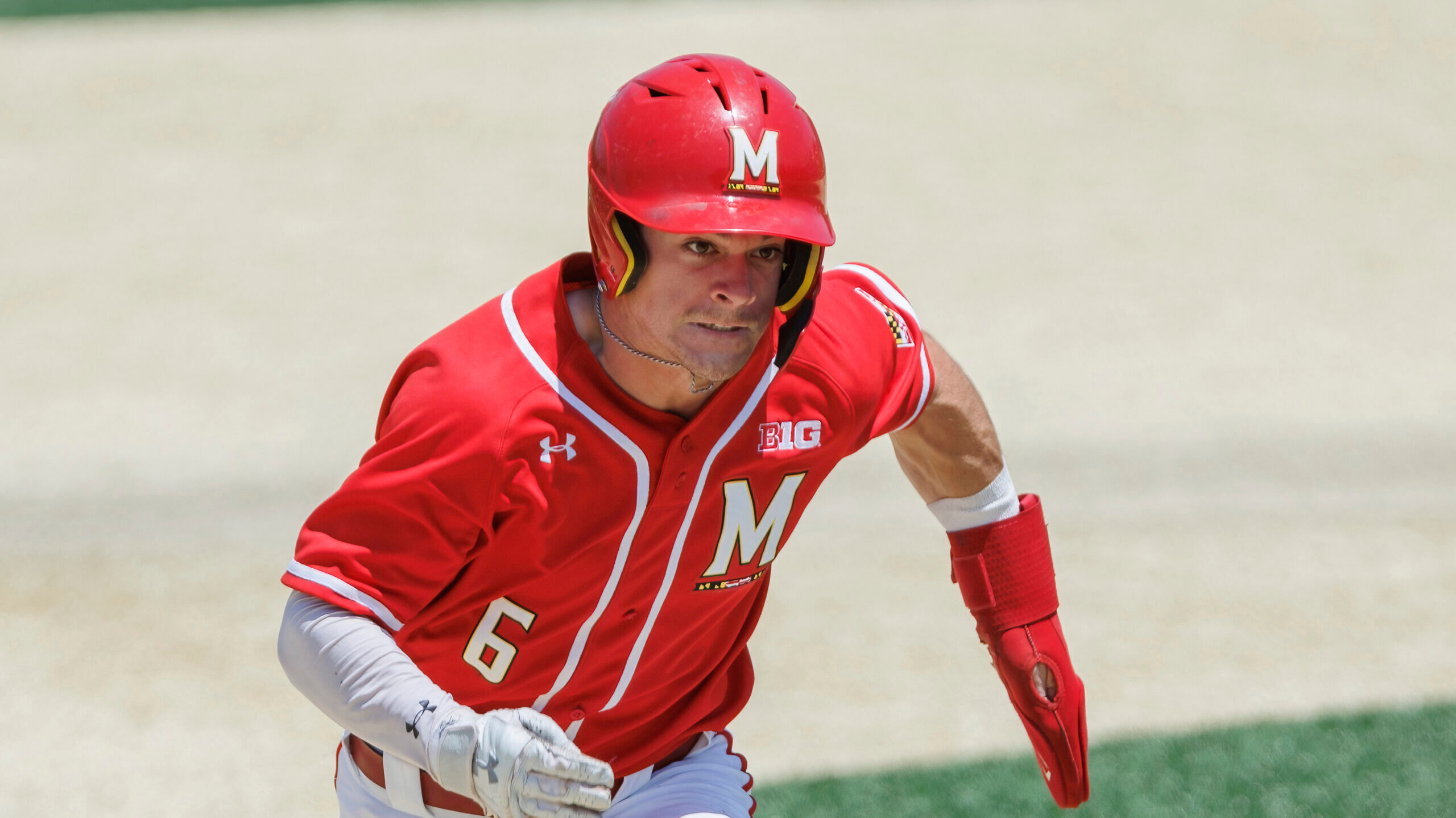
No Maryland player has ever been drafted higher than Matt Shaw. (Ben McKeown / AP Photo)
13. Chicago Cubs: Matt Shaw, SS, Maryland
Shaw was sort of a favorite of mine — I ranked him seventh in the class — so of course I love this pick, and he could be a quick mover to the big leagues if the Cubs just slide him over to second base. Shaw can flat-out hit, and makes hard contact with a swing that produces a lot of line drives, so there’s reason to believe the big power he showed for Maryland will carry over to 20+ homers when he gets to the big leagues. He had some of the best batted-ball data in the draft and hit good pitching the handful of times he saw it. We know from last year the Cubs value the data side heavily in the draft, and Shaw fits that, but also comes with a longer track record of strong performance.
Scouting Report: Let’s get the big thing out of the way first — Shaw is a shortstop now, but he is not a shortstop, and if he’d just played second base all spring I think he’d sail into the top 10 picks. So much of the conversation around him has centered on his defensive shortcomings, notably his below-average arm, that there’s been too little focus on the fact that this guy hits. Shaw makes consistent, hard contact, and his average launch angle of 26 degrees puts him right in line for a high Barrel percentage. He’s walked more than he’s struck out so far this year, and after hitting 22 homers as a sophomore, he hit 23 this spring before even getting to the Big Ten tournament — despite getting COVID-19 early in the season, which cost him a weekend when he looked exhausted and may have given some scouts a bad look. I think he’ll be an above-average defender at second, as he’ll show adequate range at short — it’s his arm that will move him off, not his hands or feet. Even at second base, he has All-Star upside because of the bat.
14. Boston Red Sox: Kyle Teel, C, Virginia
Teel sliding this far is a shock, really — a college catcher who stays at the position, has a track record of hitting, is a good athlete, and played for an elite program in one of the two best conferences in the country doesn’t go in the top 10? I’m shocked, but Red Sox fans should be ecstatic. He has some areas to work on, needing especially to improve his production against left-handed pitching, but he’s a great athlete for a catcher and it shows up in his running, his movement behind the plate, and even in the bat speed from his quick wrists. He might not have the upside of some of the bats who went before him, but I think he could still end up an All-Star at some point, and has a high floor because he can catch.
Scouting Report: Teel might have been a first-rounder had the 2020 spring season taken place, as he was already on everyone’s radar coming out of the previous summer and fall as a very athletic catcher who looked like he’d hit and would definitely stay at the position. He went undrafted in the five-round affair that June, then hit .335/.416/.526 as a freshman at Virginia, catching 20 games and establishing himself as a likely first-rounder for 2023 even that far ahead. After a slight dip in his sophomore production, he hit .414/.480/.668 through the regular season for the Cavaliers, with just a 12 percent strikeout rate, showing excellent bat speed and pitch recognition, with the bat control to even make some decent contact on pitches out of the zone. His swing produces a lot of line-drive contact and he might have another half-grade of power coming if he gets a little stronger. Behind the plate, he’s agile with a plus arm and receives well, needing some work on framing and handling pitches low in the zone, which he tends to catch by dropping the glove first before moving back up towards the bottom of the zone. I’ve compared his ceiling before to a left-handed-hitting Jason Kendall, a guy who puts the ball in play a ton, runs very well for a catcher, and is an asset on defense.
15. Chicago White Sox: Jacob Gonzalez, SS, Mississippi
Gonzalez came into the spring as a potential top-five pick, but had an underwhelming spring — not a bad one, just not one where he progressed in a way that would have kept him in the top 10 when so many other college hitters were producing. He’s a very safe pick, a shortstop who stays there and has the hand-eye to make a lot of contact and hit for average with solid OBPs. He did hit 18 homers this year for Mississippi, but I don’t think that power is going to hold up with wood bats unless the White Sox get him to use his lower half more.
Scouting Report: Gonzalez came into the year with a lot of top-five buzz, and he might very well still go in the top 10, but doesn’t offer the ceiling of the college hitters I have listed above him here. He’s a very solid player for what he is, but with limited potential for more. Gonzalez has excellent hand-eye coordination and strong bat control to make a ton of contact, moving the barrel around to meet the ball where it’s pitched so that he almost never whiffs on pitches in the zone. He hit 18 homers last year, but doesn’t project to hit for more than fringy power in pro ball as he doesn’t use his legs much, with no stride and a tendency to glide over his front side, with very little connection between how his upper and lower halves work. That might be his one path to upside, as his contact quality now is just fair and using his legs more might improve that. He’s hit .327/.435/.564 this spring, an improvement from his sophomore year but I don’t think enough to push him up into the Teel/Shaw/Troy tier of college bats. Gonzalez projects to stay at short with great instincts and soft hands, although he’s a fringy runner and some scouts use that as a proxy for a player’s ability to handle shortstop long-term. I think he’s a solid regular at short, not a star, and in some drafts that’s a top 10 pick, but this year it’s probably less.
16. San Francisco Giants: Bryce Eldridge, 1B/RHP, James Madison High (Vienna, Va.)
Eldridge wants to be a two-way player, although his future is much more likely to come as a hitter. He’s 6-foot-7 with a short swing for his size, generating power but also staying short enough to the ball that he might be able to cover more of the zone than most guys that height do — I’ve written many times about the high failure rate of hitters 6-7 and up. He’s athletic enough to play an outfield corner, but stayed at first base in high school to preserve his arm. He’s got the fastball and delivery to be a pitcher, but hasn’t shown any feel to spin the ball yet and would require so much more time as a pitcher that I worry it will hamper his development as a hitter. He also had a lingering ankle issue this spring that might delay his pro debut. The “American Shohei Ohtani” is pretty extreme hyperbole, but I really like Eldridge’s bat, and if that doesn’t work out, he does offer pitching as a fallback option.
Scouting Report: There was some buzz coming into the year that Eldridge would be a legitimate two-way prospect, but this spring created some separation and he’s much more likely to go out as a hitter than as a pitcher. Eldridge is 6-foot-7, 220 pounds, very tall for a hitter by historical standards, with no hitter that height staying a regular past his early 30s. But he does offer a short swing given the length of his arms and excellent bat speed, with the strong exit velocities you’d expect from a hitter his size. On the mound, he’s 91-93 mph and can bump 95 mph with a repeatable delivery, but doesn’t have great feel to spin the ball and would likely require far more development as a pitcher than he will as a hitter. He played first base for his high school, ostensibly to protect his arm, but seems more than athletic enough to play a corner outfield spot. The Alabama recruit did miss some time in April with an ankle injury that kept coming back. I don’t think he’s the next two-way prospect, but he does offer a ton of upside as a power-hitting right fielder, even with the risk associated with players his height.
17. Baltimore Orioles: Enrique Bradfield Jr., OF Vanderbilt
Bradfield is an interesting departure for the Orioles, who have done exceptionally well drafting hitters in the last few years — and that might understate it. He’s a plus-plus defender and 80 runner whose swing went way backward this year. But he’s athletic and has bat speed, enough that a team that’s good at helping hitters with their swings, which the Orioles are, has plenty to work with. Getting him to stay back and use his lower half to drive the ball should allow him to hit for average and gain some extra bases from his speed, although I doubt he ever gets to more than fringe-average power. He’s also incredibly fun to watch, and the floor is high thanks to the defense.
Scouting Report: Bradfield brings two elite tools to the table – he’s an 80 runner and at least a 70 defender in center, maybe an 80, thanks to that speed and very good reads on balls off the bat. He’s stolen 129 bases in three seasons with the Commodores, through the end of this year’s regular season, with just 13 times caught stealing, none as a sophomore when he was a perfect 46 of 46. At the plate, however, he comes with some questions, including a swing that needs a ton of help. He loads his hands very deep, takes a big stride, opens his hips early, and collapses his back side … it’s a wonder he hits as well as he does, but also opens a world of possibilities for improvement. He’s slight, but not weak, with exit velocities that point to average power if he can sync up his upper and lower halves and stay more upright through contact. The 14 homers he’s hit since the start of 2022 are a promising sign, and could still get him into the top-10 picks for a team that loves the floor his speed and defense provide.
18. Milwaukee Brewers: Brock Wilken, 3B, Wake Forest
The Brewers were supposed to be on college hitting all spring, and Wilken is one of the best still on the board along with Brayden Taylor. Wilken was among D1 leaders with 31 homers and posted a .506 OBP, although he punched out more than most of the other hitters you’ll see in the first round. It’s a great swing and he barrels the ball very often, enough to believe he’ll continue to do enough damage on contact to mitigate the higher strikeout rate. I’ve got him staying at third base, although there was some talk of him moving to right field.
Scouting Report: Wilken had an extended slump in ACC play this year that might push him out of the first round, finishing the year with a .269/.493/.548 line in conference that was a huge improvement from where he was just three weeks earlier. He has a very good swing with great balance and excellent hip rotation, showing 55 power right now, with improved exit velocities down the stretch and one of the best barrel rates among college prospects in the draft class. He’s at least a solid-average defender at third with a 55 arm and good instincts that make up for a lack of speed or lightness on his feet. I could see him getting to 25-plus homers, or staying more in the teens in home run output with a high average and a lot of doubles, either of which would make him a solid regular at third.
19. Tampa Bay Rays: Brayden Taylor, 3B, TCU
Taylor was the best college hitter left on the board. The TCU third baseman has a great swing that produces a lot of loud, line-drive contact, but a mid-year slump might have been the reason he went from a probable top-10 pick in February to the 19th pick now. It could be great value for the Rays if the higher whiff rate this year was more of a fluke than an indication of any change in skill, and he did end up with 23 homers in a supposedly bad season. He’s a no-doubt third baseman, as well.
Scouting Report: Taylor has a very pretty left-handed swing with good loft in the finish to drive the ball in the air, with some of the best batted-ball data in the college class, from launch angle to hard-hit rates and more. He had a low BABIP this year of just .307, inconsistent with how hard he hits the ball and how often he does so. He also slumped in the middle of the season, but had a huge Big 12 tournament, going 8 for 16 with four doubles and three homers, with a .305/.430/.650 line heading into the regionals, and a career-best 21 homers. He’s just an average runner but savvy on the bases, with a perfect 23 for 23 record on the bases his last two years at TCU. He’s a solid-average defender at third with a 55 or 60 arm, although he’s athletic and rangy enough to become a plus defender with the right coaching. Taylor projects as a solid-average regular, with a couple of ways he could turn into something more.
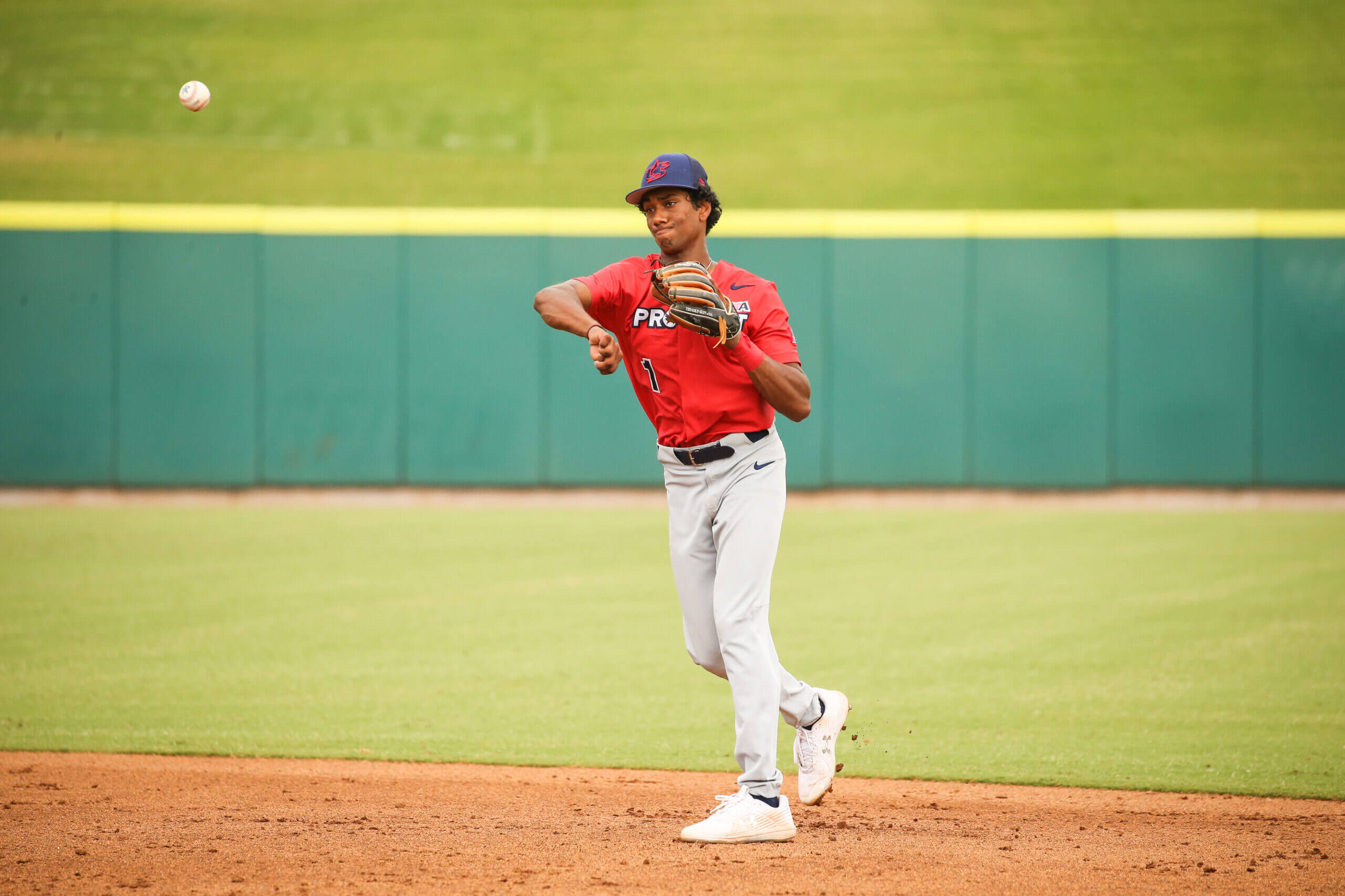
Arjun Nimmala, one of the youngest players in the draft, won’t turn 18 until October. (Courtesy of Team USA Baseball)
20. Toronto Blue Jays: Arjun Nimmala, SS, Strawberry Crest High (Dover, Fla.)
Nimmala is one of the youngest players in the draft class, so any team that uses a draft model that values age is going to love him — and there’s lots to love, as he’s a highly projectable shortstop who is going to end up with maybe 70 power, at least 60, and has a powerful right-handed swing. He’s very likely to stay at shortstop, with great instincts and a plus arm, although I could see a scenario where he just gets so big he has to move. I thought he was a top-10 talent, so this is a steal for Toronto.
Scouting Report: Nimmala is one of the youngest players in the entire draft class, certainly the youngest on my Big Board, as he won’t turn 18 until November, which will appeal to all the teams that value age in their draft models. But he’s also very talented and would still be a first-rounder even if he were 18 already. Nimmala is a lean 6-1 and already shows above-average power with a strong swing that makes excellent use of his hips to generate that contact quality. He’s a rangy shortstop with good hands and an easy plus arm, and although he’s probably just an average runner in the end, he’s certain to stay at the position long term. Where he falls short of the high school hitters above him is in his present hit tool, as he’s shown more propensity to swing and miss than his peers but seems to hit velocity fine. If he didn’t have that, he’d be in that uppermost tier of players, since he’d have the hit tool, power and defense at a critical position. Instead, he offers the potential for that sort of player with a slightly longer timeframe and greater risk around his ability to hit when he enters pro ball.
21. St. Louis Cardinals: Chase Davis, OF, Arizona
Davis belongs in the first round, although it’s only in the last week or so that his name really started to pop in this range. The University of Arizona outfielder made some real adjustments at the plate to cut his strikeout rate this year, boosting his average by 73 points and hitting for more power. He’s not a base stealer but moves well enough to at least start out in center field, and the Cardinals certainly have a history of improving outfielders’ range.
Scouting Report: Davis is one of the most improved players among the college prospects in this class, cutting his strikeout rate from 22.8 percent as a sophomore to 14.4 percent this year as a junior for the Wildcast, while hitting for more power. A good chunk of the improvement came from closing up the whole he’d shown on the inner-third as an underclassman; he still does most of his damage on stuff middle-away, but he doesn’t whiff as much on stuff inside, and if there’s any weakness here, it’s on velocity up. His game power is at least a 60, and he’s a 55 runner who plays center now and should at least begin his pro career out there, with the downside of an above-average defender in right if he can’t stay up the middle. I think he’s at least a regular and has more upside than some of the safer college bats who’ll go before him.
22. Seattle Mariners: Colt Emerson, SS, John Glenn High (New Concord, Ohio)
The Mariners were linked to Emerson a little this spring, but they were also supposed to go for a college bat at No. 22 to save some money for later picks – until all of the college position players who made sense here went before their pick. Emerson won’t turn 18 until next month and his hit tool was one of the best among the high school hitters this year, so this is probably not a discount pick at No. 22 with Cleveland apparently ready to take him at No. 23.
Scouting Report: Emerson is one of the better hitters in the high school class, with a chance to come into some power as well. He’s got a loose left-handed swing with the loft to drive the ball, although the swing is handsy and he doesn’t get much from his lower half. He’s strong for his size and age (he’ll turn 18 about two weeks after the draft), so there’s some hope he’ll get to average power with some swing work, while right now it’s definitely hit over power. The Auburn commit is a shortstop now but is going to move to second or third in pro ball, as he’s just an average or fringe-average runner and that added muscle has him looking less like what we see in pro shortstops. He’s got quite a bit of upside as a high-average, 15- to 20-homer hitter at second base if he gets to the ceiling.
23. Cleveland Guardians: Ralphy Velazquez, C, Huntington Beach (Calif.) High
Velazquez is a bat-first catcher who worked on his conditioning in the winter to move himself way up draft boards, showing up in February with a more compact build on his 6-foot2 frame, looking like a strong catcher whose power could make him an above-average regular. He’s a solid hitter for contact who already has above-average power, although he has to work on staying back on the ball for that to play regularly. Behind the plate, he’s a work in progress, but adequate enough to think that with work and time he can be an average defender.
Scouting Report: Velazquez showed well early this spring after working on his conditioning and his catching in the offseason, giving him a chance to go somewhere between the late first round and early second, especially in a draft without much catching. He’s a strong kid whose body looks compact for its listed size of 6-foot-2, and when he stays back he can show plus power, although his over-wide setup often leads to him drifting over his front side. He is a high school catcher, however, and unlike Mitchell, he has some work to do to get himself to an average defender. He’s committed to Arizona State.
24. Atlanta: Hurston Waldrep, RHP, Florida
Waldrep has one of the best pitches in the entire draft in his splitter, which has enormous tumble to it and looks enough like the fastball out of his hand that it can continue to be an out pitch as he moves up the ladder. He’s got plus velocity, although the fastball doesn’t have a ton of movement to it, and he needs to work on his command and control to allow him to get to the splitter more as it’s often out of the zone and not useful to him early in counts. He’s got enough breaking ball to project as a starter if the command and control get there, with a high floor as a two-pitch reliever.
Scouting Report: Waldrep might have been the No. 2 college pitcher coming into the spring, but a spring of inconsistent performance didn’t helped his draft stock, even with stuff that should have him in the top half of the first round. Waldrep’s splitter is one of the best swing-and-miss pitches in the draft, with hitters whiffing nearly two-thirds of the time they swing at it, and chasing it 45 percent of the time Waldrep throws it out of the zone. It’s got huge bottom to it at 85-89 mph, coming in like a fastball and dropping hard very late for the hitter, so he may already be committed to a pitch that’s no longer there. That’s also its weakness, as it usually finishes out of the strike zone – roughly 70 percent of them would be called balls, and the vast majority of those are below the zone. He’s got a hard curveball and a slider, both of which also generate misses but neither of which appears to be more than a fringe-average pitch because he doesn’t consistently finish them out front. I think batters are whiffing because they’re so geared up for the splitter, and that better hitters will pick up the spin and lay off the breaking balls. He has a very high arm slot, which may push him toward the curveball rather than the slider over the long term. Even if you want to call the breaking balls average or better based on the whiff rates alone, Waldrep has two things he has to improve: He doesn’t throw enough strikes, and his fastball gets hit hard for something that averages 95 mph. If you’re a hitter, you can go to the plate thinking mostly fastball versus splitter. If you think it’s a splitter, you take; if you think it’s a fastball, you swing hard, early, and this year the reward more than justified the risk, as Waldrep allowed a 4.83 ERA through the regular season with 12 homers in 15 starts. The whole is less than the sum of the parts, and that could represent an opportunity, because it’s a 70 splitter and plenty of arm strength that could make him a very effective closer, along with the history of durability as a starter.
25. San Diego Padres: Dillon Head, OF, Homewood-Flossmoor (Ill.) Community High
Head is definitely a Padres sort of player, a premium athlete who should stay up the middle and offers a lot of upside on both sides of the ball, but might be further away from the majors than some of his peers. He’s at least a 70 runner and a definite center fielder, while at the plate he shows bat speed, more hit than power, although when I saw him he had a hard time squaring up even a high school pitcher. He is uber-athletic, though, the sort of player who should be able to make adjustments more easily because he can do so many things easily. The Padres obviously trade a lot of prospects, and he’s the sort of kid who’ll show very well for pro scouts when he’s in Low A next year.
Scouting Report: Head is a premium athlete and at least a 70 runner who can really play center field, with some potential for power given his body and frame, garnering mixed views from scouts on how advanced his hit tool is and whether he’s ready to go out and face pro pitching. He’s listed at 5-foot-11, 180 pounds, although he might be an inch shorter, and he’s pretty muscular for that frame. He has plenty of bat speed thanks to quick wrists, definitely geared up for fastballs, but I’m not sold on the pitch recognition and think he’s going to have to improve his ability to pick up offspeed stuff when he gets into pro ball. Some of this might just be that he loads his hands very high and deep, so he’s got a longer path to the ball and has to commit sooner, rather than just a straight recognition issue. The defense/speed and ability to hit a fastball should get him first-round money, but perhaps as someone’s second or third pick. He’s committed to Clemson.
26. New York Yankees: George Lombard Jr., SS, Gulliver Prep (Miami)
Lombard is a shortstop who has a good chance to stay there and offers a ton of upside as a hitter, with a quiet approach and the bat path to come into plus power in time. I think he might be a longer development guy than, say, Anthony Volpe, but offers pretty comparable upside, even if he ends up in center field or at second base instead of staying at short. After the Yankees went with college hitters in the first round the last three years, none of whom has worked out so far, this might be a return to their previous philosophy of hunting for more long-term upside — and in that case they picked the right guy.
Scouting Report: Lombard is the son of the former Atlanta prospect, the team’s second-round pick in 1995 and now the Tigers’ bench coach, but Junior is taller, more athletic and an infielder with some real upside at the plate. He’s got a straightforward swing and quiet approach with good loft for future 65-70 power. However, despite plenty of bat speed, he has struggled with better velocity and can get locked into a single bat path. He’s a solid-average runner who’s a shortstop now, with widely varying views on whether he can stay there; some scouts think he’s a certain shortstop, while others see a move to second or center field. He’s a Vanderbilt commit.
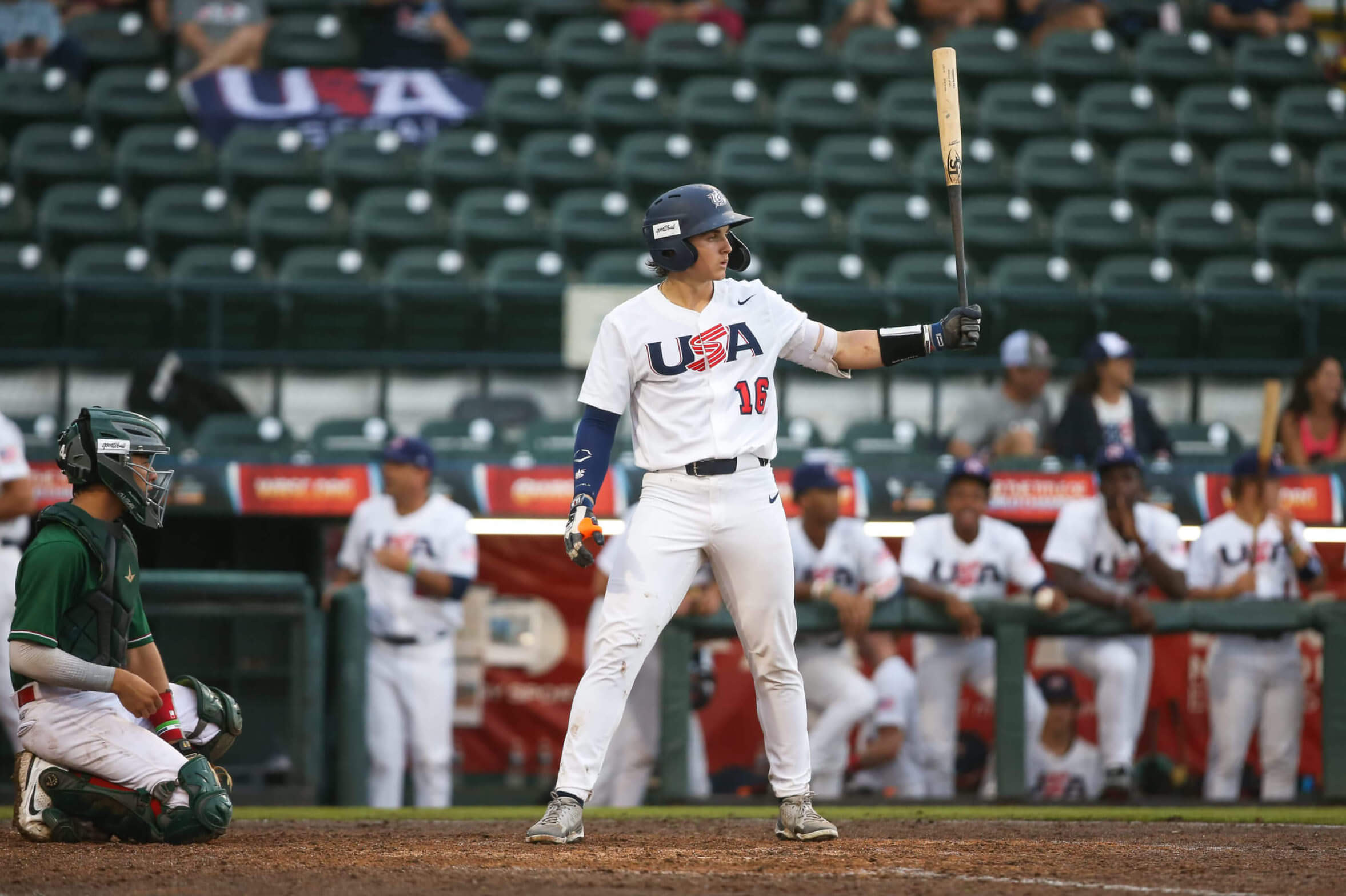
Aidan Miller’s older brother Jackson was a second-round pick in 2020 (Courtesy of Team USA Baseball)
27. Philadelphia Phillies: Aidan Miller, 3B, JW Mitchell High (Trinity, Fla.)
I’m glad Miller still ended up in the first round after his spring was ruined by a broken hamate bone, something that can linger for months and sap a hitter of his power – so even if he went to work out for clubs, there’s no guarantee he’d show the full extent of his abilities. He’s got 55 to 60 power already, at least when healthy, and showed good feel to hit when he could get his hands extended, although stuff on the inner third gives him some trouble. He’s a third baseman now and should be able to stay there. This seems like a great value play, because most folks believed he’d be a top-20 pick going into the spring.
Scouting Report: Miller, whose older brother Jackson was a second-round pick in 2020, is a big, strong high school third baseman with above-average to plus power already, showing good feel to hit in showcases last year but missing a big chunk of this spring due to a broken hamate bone. He’s got a simple swing beyond a big hand movement to get started, preferring the ball middle to away but struggling badly on anything on the inner third. He looked slower in his return this spring from the injury, and as expected had less power – broken hamates or other wrist/hand bones can sap a hitter’s power for months, so he may not be 100 percent until the fall or even next spring, but the previous power should still be there. Miller’s a third baseman now with plenty of arm and the footwork to stay there, with fringe-average speed that will probably trend down to 45 as he fills out. If you’re willing to bet that the Aidan Miller of 2022 is still here, you might get a regular at third with plus power, with some risk as he has to adjust to pitchers working him inside.
28. Houston Astros: Brice Matthews, SS, Nebraska
Matthews is the lowest-ranked player on my board to go in the first round because of concerns about his hit tool. He’s got a dead-pull approach and likes the ball down, so fastballs up and in already give him trouble, and that’s not going to get any easier in pro ball. He’s a shortstop for now, but may end up at another position, possibly center field. There’s definitely power here, as he hit 21 bombs for the Huskers this year, but college position players with hit tool questions are pretty high-risk as first-rounders.
Scouting Report: Matthews exploded this year for 21 homers for the Huskers after hitting 12 total in his first two years in Lincoln. He finished the year with a .359/.481/.723 line, ending the year fourth among Big 10 hitters in homers and second in walks. The power itself is real, but it comes from a dead-pull approach where he looks for the ball down, which has left him vulnerable to fastballs, especially those up in or just above the zone. He’s an excellent athlete and plus runner who would probably be able to move to center if he can’t stick at short, so he offers some floor where he should play a premium defensive position or could serve as a utility player who can fill in across the infield and in center. The hit tool is a real concern, probably projecting to a 45 at best, but the power, defense and positional value might help it all play.
29. Seattle Mariners: Jonny Farmelo, OF, Westfield High (Chantilly, Va.)
The M’s were connected to Farmelo all spring, as they’re hunting tools, clearly, and he’s got ’em. He’s a plus-plus runner who can play center, and he’s got great hand-eye coordination, so he showed feel to hit even with a swing that needs a lot of help, from the way he bars his arm to the silly launch-angley finish that someone gave him to try to force power instead of letting his ability to hit just carry the day. I’ve put it this way to scout friends: If he can hit as well as he does, including against Eldridge’s 91-93 mph, with a swing that bad, then I think he can flat-out hit.
Scouting Report: Farmelo does it all wrong at the plate, with an arm bar and a bizarre launch-angly finish, but he’s so good at fouling stuff off that he performs anyway – and if someone just loosens him up and lets him hit freely, he might really take off. He had no trouble handling low-90s stuff from right-hander Bryce Eldridge in one of their matchups this spring, with exceptional hand-eye and a clear idea of what he needs to do at the plate to get a pitch he can hit hard. He’s a superb athlete and 65-70 runner who can definitely stay in center field, and should come into 55 power. He’s considered a strong commit to UVA, but that might be the worst choice for someone who needs this kind of swing adjustment, as UVA’s track record there is not strong. He’s a big upside play because even small changes to the swing could make him one of the best hitters for contact and average in the class.
30. Seattle Mariners: Tai Peete, SS, Trinity Christian High (Sharpsburg, Ga.)
Peete’s another big tools guy, a true shortstop who can run, who has bat speed, and who did have a plus arm before something bothered him last summer, after which he gave up pitching. He isn’t as advanced a hitter as Emerson or Farmelo, though, showing some pitch recognition issues over the last year. With two pretty advanced high school bats already in their draft class, though, the Mariners could afford to go after a high-risk/high-reward guy like this.
Scouting Report: Peete is a tooled-out shortstop who pitched some as a junior before he got hurt at East Coast Pro last year, after which he hasn’t returned to the mound. He’s a left-handed hitter with bat speed, but tends to get uphill with a very firm front side, leaving him with a swing that might end up putting the ball too much in the air. His plate discipline does lag behind his peers, and he had trouble with fastballs even in-zone at showcases last year, getting a little benefit of the doubt from being young for his class, turning 18 in August. He’s still had issues throwing this spring, although he did play shortstop rather than DH for his high school. He’s very athletic and twitchy with plus speed, so you can dream on the upside here, and he does project as a shortstop if there’s no further arm trouble. He carries more risk than the typical high school position player. He’s committed to Georgia Tech.
31. Tampa Bay Rays: Adrian Santana, SS, Doral (Fla.) Academy
Santana is a very undersized high-school shortstop who can really play defense and is a switch-hitter but can’t impact the ball at all right now, and his 5-foot-11 frame doesn’t offer a ton of room for physical projection. He’s on the younger side, turning 18 later in July, but unless he develops into an elite defender I’m not sure there’s enough upside to take him this high.
Scouting Report: Santana’s a young switch-hitting shortstop who won’t turn 18 until the week after the draft, with decent swings from both sides but nowhere near the strength to drive the ball yet. His left-handed swing shows quite a bit more bat speed than the right-handed one, but either way he has swung and missed too often in high school and doesn’t hit the ball hard when he does make contact. He’s undersized at 5-11 (at most) and about 150 pounds, with some room to get stronger and perhaps pick up some bat speed in time, although that’s a big ask even with his youth. He’s a plus-plus runner who should definitely stay at shortstop, so if he fills out and can improve his impact quality he could be a strong regular, while he has the downside risk of a Nick Madrigal or Kevin Newman type who doesn’t make enough hard contact to be more than a bench player.
32. New York Mets: Colin Houck, SS, Parkview High (Lilburn, Ga.)
Houck was definitely sliding this week after it seemed like he was going to go in the early teens for a good part of the spring, but the Mets end up getting great value here in that regard, pouncing on a player who should never have gotten near them. Houck looks like he’s really going to hit – it’s a quiet setup and swing with great hand acceleration, producing hard contact with excellent launch angles to foresee plus power. He’s not a shortstop but has the hands to stay on the dirt, probably at third base, although he’s going to be a big kid when he finishes filling out. It’ll come down to the hit tool and how good his approach is. If he shows some pitch and ball/strike recognition, the Mets may have gotten a top-15 talent without having a first-round pick.
Scouting Report: Houck is a two-sport star who is committed to Mississippi State for baseball only, giving up the gridiron in favor of the diamond, although he’s done well enough this spring that he’s probably never going to Starkville except as a tourist. Houck has a super quiet approach, with some present power now that projects to plus, as he uses his hips and legs well and generates good launch angles off the bat. He’s reasonably disciplined already, with some weakness against high fastballs. He has the arm and hands for short but he’s already big for the position and may end up at third base instead. He’s going to get some comparisons to 2021 first-rounder Brady House, also from Georgia, also a big shortstop who hit the ball even harder than Houck does, although I think Houck’s overall profile is quite similar. The bat is the real carrying tool here, regardless of where he plays.
33. Milwaukee Brewers: Josh Knoth, RHP, Patchogue-Medford (N.Y.) High
I said that Knoth was someone that teams that value pitch metrics would love, and the Brewers are one of those. He’s got ride on the fastball and spin on the curveball, but the delivery isn’t great and he needs a third pitch. It’s a little like their second pick last year, Jacob Misiorowski, who just hit 102 mph in the Futures Game on Saturday — tremendous fastball, plus-plus slider, bad delivery, not sure if he can start — although Knoth is still 17 and has a lot more time to work on smoothing out the delivery and finding a changeup of some sort. Also, Strong Island represent.
Scouting Report: Knoth is a Mississippi commit with huge spin rates on his breaking ball and a fastball up to 95 mph who had scouts racing — well, crawling — down the Long Island Expressway to see him this spring. He’s one of the youngest pitchers in the class, turning 18 about a month after the draft. His fastball shows good ride up at the top of the zone, and the curveball is a hammer with very tight rotation, two-plane break and a ton of depth to it. There’s effort to the delivery, with his arm a touch late and some head-whack at release, and he hasn’t shown much of a third pitch so far. Teams that value the advanced pitch metrics like spin rate and axis will love him, and there’s still some projection left here, although the delivery and below-average control make him a longer-term play and may limit his ceiling.
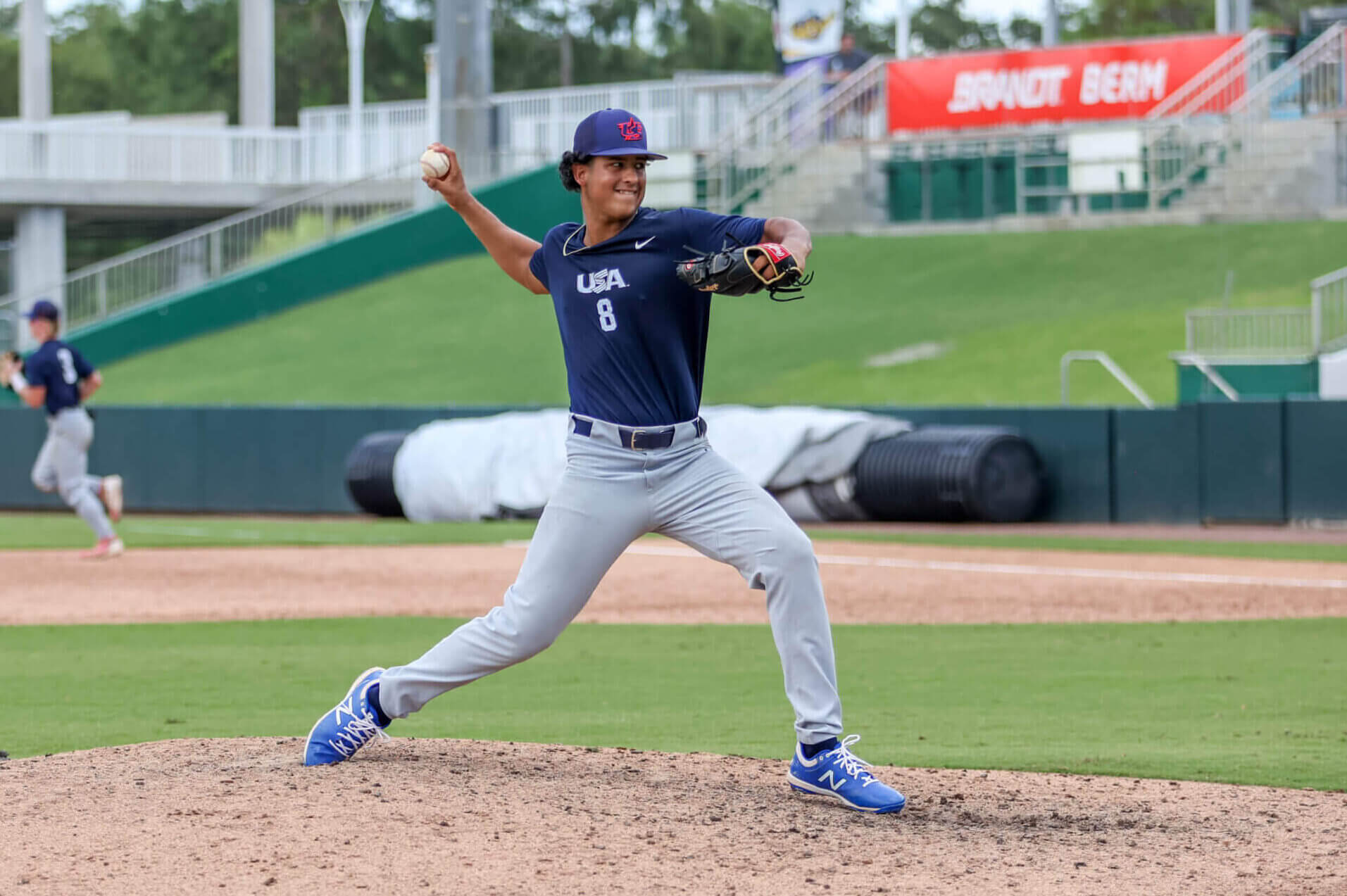
Charlee Soto has some of the best pure stuff in this draft class. (Courtesy of Team USA Baseball)
34. Minnesota Twins: Charlee Soto, RHP, Reborn Christian Academy (Kissimmee, Fla.)
Soto had some of the best stuff of any high school pitcher in the draft, three now pitches that could show plus, but he was a little tougher to see than most high school pitchers, sometimes going two weeks between starts. If he were 21, with exactly the same stuff and delivery, he’d be a top-10 pick, so the main question with him is whether he can stay healthy the next few years as someone who already throws pretty hard. But it all works pretty well and, beyond health, he mostly needs to work on consistency to the delivery and location.
Scouting Report: Soto has some of the best pure stuff in this draft class, with three pitches in his fastball, slider and split-changeup that can all show plus, along with a delivery he should be able to repeat for command. He’s been up to 98 mph with some riding life to the four-seamer, while the split-change has the sort of hard fading action you expect from that pitch and shows good separation and deception. His slider is more of a power slurve with a break almost straight down, but he seems to throw it for strikes and gets late bite on the pitch. He’s also one of the youngest pitchers in the draft, turning 18 at the end of August, and already is 6-foot-5 and listed at 210 pounds. Scouts found him difficult to see this spring as he’d often go two weeks between outings, and his command wasn’t where it was last summer on the showcase circuit. He’s as risky as any high school arm, but this stuff rivals that of White’s for the best among all prep pitchers this year.
35. Miami Marlins: Thomas White, LHP, Phillips Academy (Andover, Mass.)
The Marlins are all in on high school pitching, apparently, and they ended up with the top high school righty and top high school lefty in my rankings. (I did say all spring that I thought White would end up outside of the first round, not because of talent, but because of a combination of bonus demands, as he’s a super-talented Vanderbilt commit, and teams’ increased reluctance to take high school arms in the first round.) He’s huge, close to 6-foot-7 and maybe 250 pounds, showing three potentially plus pitches, although he doesn’t repeat the delivery that well and hitters get enough of a look that the fastball might play down a little. I see huge upside here, but also a ton of risk, with which the Marlins appear to be comfortable.
Scouting Report: White, not to be confused with LSU sophomore Tommy “Tanks” White, is the top left-handed pitcher in the class right now, with injuries and poor performance taking out a few college names who might have been ahead of him. White is listed at 6-foot-5, 210 pounds, but has bulked up since that and might be closer to 6-foot-7, 250 pounds now, while he sits 93-95 mph with a plus curveball and plus changeup. His delivery isn’t great, as he has a long arm stroke that’s very visible to hitters and that he doesn’t repeat well, so his command is still well below average. The arm stroke and the ease with which he can get to plus velocity reminds me a little of Sean Newcomb, another lefty who did it very easily but whose delivery offered nothing to “fix” to improve his command. White is a fair athlete and probably will need some fine-tuning of the delivery, but you can point to those three pitches and hope for a No. 2 starter ceiling. He’s a Vanderbilt commit and I can’t imagine he’ll be an easy sign.
36. Los Angeles Dodgers: Kendall George, OF, Atascocita High (Humble, Texas)
The Dodgers take the first player who wasn’t on my top 100. The high school outfielder is an 80 runner and switch-hitter with well below-average power, maybe grade 30, between limited strength and a flat, slappy swing that puts the ball on the ground way more often than in the air. He’s an Arkansas commit and I thought he’d head to school, since he might have a much better draft profile in three years if he fills out some and has a few years of SEC production. But the Dodgers — who do have an excellent track record in the draft — obviously like the defense/speed combination enough to buy him out of that.
37. Detroit Tigers: Kevin McGonigle, SS, Monsignor Bonner High (Drexel Hill, Pa.)
McGonigle’s best tool is the bat, as he’s hit good pitching well, and has the swing and understanding of the strike zone to keep that going in pro ball. He’s a shortstop now but has to move, probably to second base, where he’ll be fine. The one knock I heard on him this spring was that you can’t project much more power here than there already is, although I think he’ll get to average power in time. It’s a real bet that he’s a .300-plus hitter and will do enough of everything else to make him an above-average regular. I’m in the camp that says he’ll do it, or is at least likely enough to do it to be picked here.
Scouting Report: McGonigle is one of the better pure hitters in this year’s high school class, which is saying something because this year’s high school hitter group is historically strong. He showed very well on the showcase circuit last summer and on his school’s trip to play in a tournament in Las Vegas this spring, which helped his cause substantially as he hasn’t seen quality pitching at home, playing mostly other private schools in the Philly suburbs. He’s a left-handed hitter with a clean, simple bat path and quick wrists, and he’s shown excellent ball-strike recognition between last summer and this spring. He hasn’t faced much good velocity, especially not this year, so there’s some projection to the hit tool based on the bat speed and the swing itself. He doesn’t always land strongly on his front side – he transfers his weight well, but his front leg isn’t always in position to “receive” it, so to speak, which I think will cost him at least a half a grade of power until it’s remedied. McGonigle, who is off the case, is committed to Auburn, and he’s the sort of player who could launch himself into the top five with some strong batting lines for three years in the SEC.
38. Cincinnati Reds: Ty Floyd, RHP, LSU
The Reds, man. They land Floyd, who you might know from such hits as “ties College World Series record for strikeouts in one game,” or maybe you just know as “that LSU starter who isn’t Paul Skenes.” Floyd is fascinating because he does it almost all with his fastball, which might have been called an invisi-ball 10 or 15 years ago but now we talk about pitch shapes, which is certainly better and more accurate, although I think “invisi-ball” is way more fun. He will have to develop his other pitches, as he’s got a bucket of 45s beyond the fastball, but the one thing Floyd has is both very hard to teach and something that has worked well for pitchers for as long as there’s been a mound – a fastball that misses bats.
Scouting Report: Did anyone help himself more in the college postseason than Floyd, who finished his year by setting a CWS record with 17 strikeouts against a strong Florida lineup? Floyd’s fastball is elite — he got 26 swinging strikes on the pitch against Gator hitters — as hitters don’t see it at all, coming in 94-97 with great ride and some added deception from a short and lightning-quick arm stroke. The knock on Floyd is that he doesn’t really have an average second pitch — he throws a slider and curve but neither is better than a 45, without great spin or break, and his changeup has good separation but not a ton of action. He walked just under 10 percent of hitters this spring for LSU, which he’ll have to bring down in pro ball regardless of the development of his offspeed pitches. Scouts are already comparing him to Spencer Strider for his ability to miss bats with his fastball alone, and I think you can project him as a starter given how well that pitch plays and the way the delivery works.
39. Oakland A’s: Myles Naylor, 3B, St. Joan of Arc (Mississauga, Ont.)
Naylor is a reach for me even here, as he’s not the hitter either of his brothers – both first-rounders – was at the same age, and doesn’t have Josh’s raw power or Bo’s positional value. He’s got a ways to go at the plate, and the A’s have some work to do to clean him up, while they already announced him as a third baseman.
Scouting Report: The youngest of the three Naylor brothers, and the only right-handed batter of the bunch, Myles has a very different profile than Josh or Bo, with some ceiling to his bat because he shows some power. He has a super-wide stance with no stride and is off balance too often, lacking the pitch recognition Bo had at that age to compensate. He’s a shortstop now but has to move to third base if he’s going to stay on the dirt at all. He’s committed to Texas Tech.
(Top photo: Alika Jenner / Getty Images)