
Sport: MLB
One of my favorite in-season pitching metrics to use in my analysis is SIERA. It is excellent for measuring a pitcher’s current performance versus their expected performance. It attempts to focus on what is solely in the pitcher’s power, and ignore much of what comes from the hitter. Let’s dig in.
What?! Your fantasy baseball league wasn’t hosted on Fantrax last season? Preposterous! Check out what the Fantrax MLB Commissioner has to offer and we think you’ll be singing a different tune for the 2026 MLB season.
What is SIERA?
It stands for Skill Interactive ERA, adjacent to ERA, FIP, and xFIP. Similar to FIP and xFIP, SIERA offers a slightly different look into a pitcher’s ERA to help determine whether or not a pitcher is performing how he should. Fantasy baseball managers can consider it somewhat of an ERA predictor or estimator.
SIERA considers a few factors, including a pitcher’s strikeout rate, walk rate, and groundball rate – elements over which a pitcher has significant control. Striking batters out, for example, takes a lot of arm talent. Limiting walks is also a skill for pitchers, a measure of their command and control. Groundball rate also connects to a pitcher’s location, another pitching skill.
One thing that separates SIERA from FIP and xFIP is that it considers the type of ball that gets put into play and adjusts for the results. A pitcher may have a higher xFIP than SIERA if he induces a high number of grounders, especially if some lead to runs. Both ERA estimators would penalize the runs scored, but SIERA rewards the pitcher for the grounders, which would lead to a lower SIERA than xFIP.
The same can be said for high flyball pitchers, who get rewarded by the statistic for inducing flies, which turn into outs at a higher rate than line drives.
Perhaps most importantly, SIERA adjusts for the different ballparks, making it one of the most complete and accurate ERA estimators available.
To simplify for fantasy managers new to SIERA, here is what you want (ideally): high strikeouts and low walks, with more grounders and flyballs than liners. Those things all connect to a lower SIERA and can help pinpoint a pitcher’s true performance better than other stats.
Why is SIERA Important?
In fantasy baseball, strikeouts are sexy. But you can find value in pitchers who do not strike out a ton of batters, but who induce grounders and limit walks.
Unsurprisingly, seven of the top 10 qualified pitchers in SIERA from 2025 had K/9 rates over 10. They were Tarik Skubal, Garrett Crochet, Cristopher Sanchez, Paul Skenes, Sonny Gray, Yoshinobu Yamamoto, and Joe Ryan. All except Skubal and Ryan owned groundball rates above league average, on top of being a high-strikeout-rate pitcher.
Those seven are widely considered among the best in real life and fantasy baseball, and are typically among the top pitching targets in fantasy drafts. But there are plenty of others to consider as well, based on their SIERA.
Outside of the top 10 in SIERA from last season are pitchers like Max Fried, Framber Valdez, Kevin Gausman, Chris Bassitt, Jose Soriano, Merrill Kelly, Luis Castillo, and Ryan Pepiot. Each of them had a K/9 rate under 9.0. Only Gausman, Pepiot, and Castillo had GB rates below league average.
Brandon Pfaadt is a great case study in SIERA. His 4.8% BB rate was the third-best among qualified starters last season. He also owned an above-average GB%, but struggled at striking batters out. His ERA last season was an ugly 5.20, but he produced a 4.12 SIERA. This could make him a huge sleeper heading into 2026. If he could put together a high K/9 rate as he did in 2024, while also maintaining a low walk rate and high groundball rate like last year, he could improve his ERA significantly.
This works the other way too. Take Mitchell Parker, who had the league’s worst SIERA at 5.20 and a 5.68 ERA. Among qualified starters, his 5.6 K/9 rate was the worst. He also owned a below-average GB% and a barely above-average BB%. He truly was not doing anything to help himself out last season, and his poor SIERA reflected poor skills and production, nearly matching his ERA.
Because factors like BB%, K%, and GB% are relatively in a pitcher’s control, they are also relatively repeatable. This makes analyzing not just SIERA, but these other data points, important for draft prep. It also makes SIERA something you should check in-season.
How Can SIERA Help Me With Draft Prep?
Because SIERA deals with factors mostly in a pitcher’s control, we can look at a pitcher’s projection for 2026 and determine how legitimate we think it might be.
Similar to Pfaadt, these other pitchers had higher ERAs than SIERA’s, meaning they performed worse than expected:
Sonny Gray
Sandy Alcantara
Dylan Cease
Shane Baz
Andre Pallante
Jake Irvin
Zac Gallen
Kyle Freeland
Jesus Luzardo
Mitchell Parker
Will Warren
Jose Soriano
David Peterson
Joe Ryan
Tanner Bibee
Logan Webb
Chris Bassitt
Kyle Hendricks
Among this group, Luzardo, Gray, and Bassitt all owned strikeout and walk rates better than league average, suggesting that their SIERAs being better than their ERAs could be legitimate.
Soriano, Pallante, Peterson, Baz, Alcantara, Bibee, and Gray all had groundball rates better than league average, including Soriano’s league best 65%. Ryan, Bibee, Baz, Soriano, and Pallante also limited line drives at a better rate than league average. This also bodes well for these pitchers legitimately pitching better than their ERAs show.
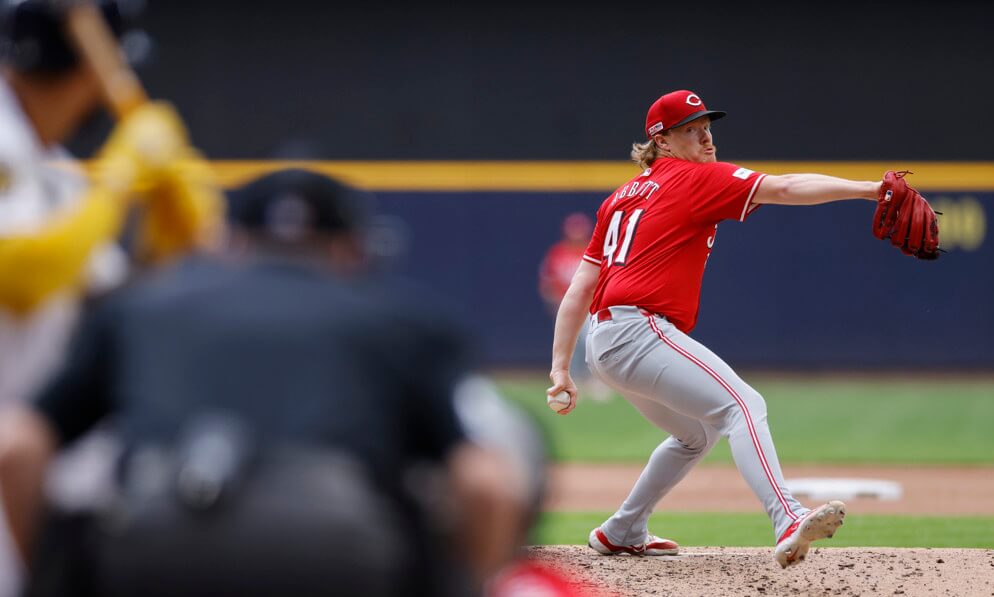
This method of analysis can be used the other way as well. Take Andrew Abbott, for example. He finished 2025 with a 2.87 ERA but a 4.31 SIERA, the largest gap in baseball. His 8 K/9 rate and 21% strikeout rate were both below league average. His 31% GB rate tied Jeffrey Springs for the league’s lowest.
Another player of concern is Clay Holmes. He finished 2025 with a 3.53 ERA but a 4.43 SIERA. His K% and BB% were both worse than league average, as well as a weak 7 K/9 rate. He produced a LD% and GB% better than league average, but even still, his SIERA looks like his true performance, rather than his actual ERA.
Gavin Williams, Zack Littell, and Matthew Boyd present similar concerns as well, heading into 2026 after impressive, but perhaps fraudulent performances in 2025.
How Can I Use SIERA During the Season?
I tend to ignore FIP and look closely at xFIP and SIERA in conjunction with a pitcher’s ERA during the season.
During the 2026 season, keep an eye on pitchers who are performing well in key areas, particularly K% and K/9, BB%, LD%, and GB%.
Remember, SIERA rewards a low walk rate, a high strikeout rate, and a solid groundball rate.
Identifying a pitcher who perhaps has a higher ERA than SIERA, who is also performing well in those key areas, could be a buy-low candidate. Just as a high SIERA/low ERA pitcher performing poorly in those key areas would be a sell-high candidate.
Using SIERA this way is a bit of a cheat code in finding hidden gems and getting rid of players before massive blow-ups. Granted, in cases like Abbott or Pfaadt, the season never turned out how it was “supposed to” for them. But for the most part, this is how fantasy managers can use the stat in-season.
Good luck and happy scouting!
Fantrax is one of the fastest-growing fantasy sites in the fantasy sports industry, and we’re not stopping anytime soon. We are the most customizable, easy-to-use, and feature-rich platform in the industry, offering the greatest fantasy experience for your dynasty, keeper, redraft, and best ball leagues. Fantasy sports doesn’t sleep, and neither does Fantrax, with seasons running 365 days a year. Take your fantasy leagues to the next level now at Fantrax.com!