
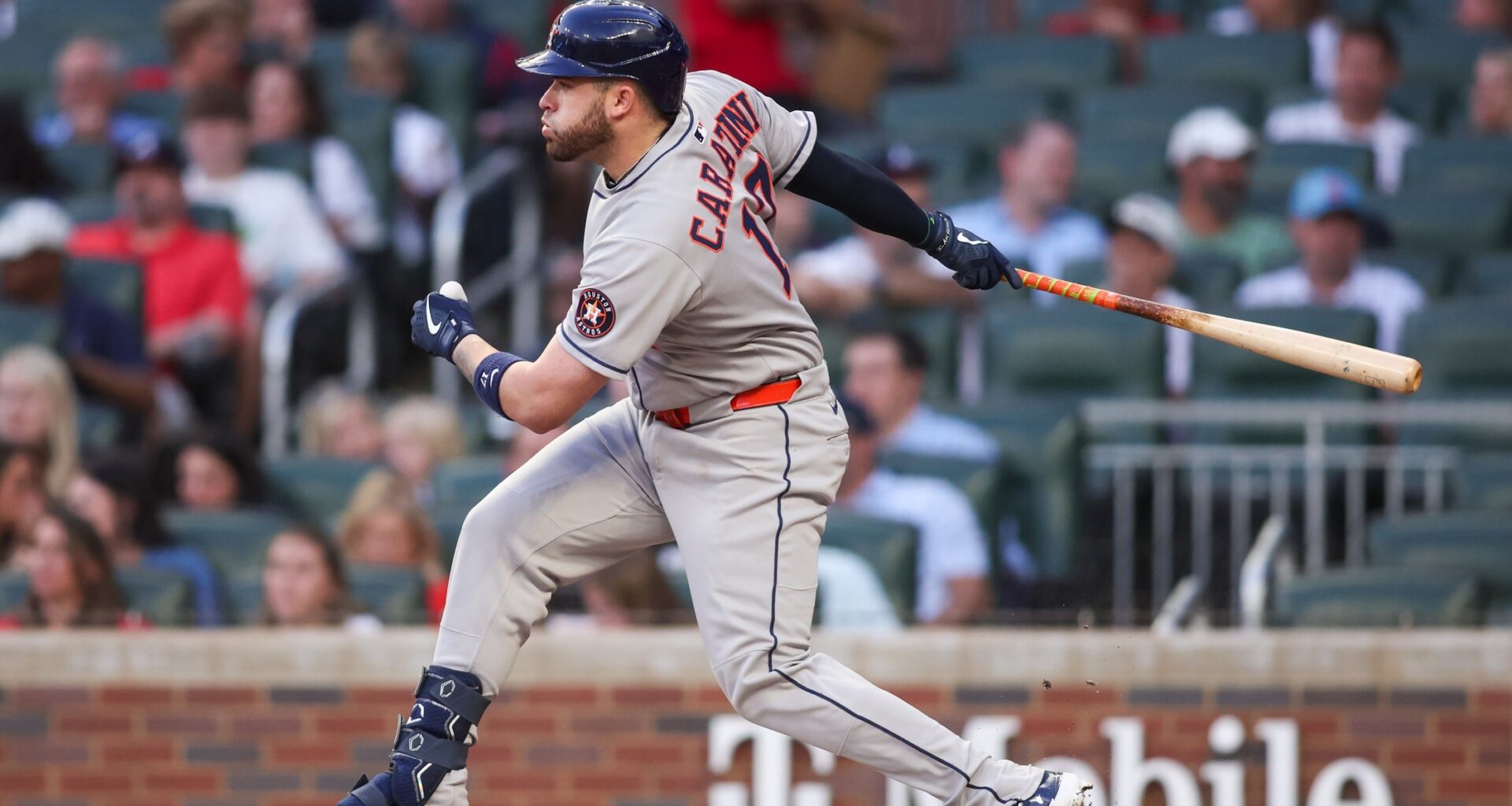
On Friday evening, Robert Murray of FanSided announced that the Twins had agreed to terms with 31-year-old free agent catcher Victor Caratini. Stop me if you’ve heard this one before: the Twins signed a 30-something Astros backup catcher to a multi-year deal to pair with Ryan Jeffers (this also describes the Christian Vázquez signing).
The signing comes as something of a surprise to many, given the Twins’ noted lack of financial flexibility (at least among onlookers), their current catching situation, and the other holes on the roster.
So, let’s discuss who Caratini is, what sense the signing makes, and how the Twins might use his services.
Who is Victor Caratini?
A former second-round draft pick in 2013, Caratini will start his tenth season in the big leagues come Opening Day 2026. He’s spent time with the Cubs, Padres, Brewers, and Astros before Minnesota, mainly in a backup or timeshare role.
Offense
Since settling in as a semi-regular in 2019, Caratini has been a roughly league-average hitter (.245/.323/.379, .702 OPS, 94 OPS+). Although a league-average bat doesn’t sound like much, among catchers — especially backup catchers — that number carries more weight. Since 2019, catchers as a whole produced a .690 OPS, meaning that Caratini’s OPS during that time was about five percent above the average catcher.
Over the past two seasons, Caratini’s .735 OPS (.263/.329/.406) is about five percent above the average hitter and 15% better than the average catcher. Those impressive numbers have come against both righties and lefties, as Caratini is a switch-hitter with pretty even splits.
It should be noted that his best offensive production has come over the past two seasons as a member of the Astros (his age-30 and -31 seasons). Those were the only two seasons that he’s recorded a slugging percentage over .400 in his career, so it’s natural to wonder if his numbers were aided by playing in Daikan Field, where the left field fence can inflate some hitters’ power production. However, Caratini is a switch-hitter (meaning that he only hits right-handed about a third of the time), and only two of the 20 home runs he hit over the past two seasons were aided by the Crawford Boxes. A lot of his recent improvements can be chalked up to very good strike zone control (despite not walking much) and pulling fly balls more (going from a very low rate to about league average)..
As noted, Caratini has roughly even splits as a switch-hitter. He has historically been more effective against righties (batting left-handed), but in both 2024 and 2025, he improved his production against lefties, and he was more effective as a right-handed batter—albeit in about 60 plate appearances each season. His 105 OPS+ against righties since 2024 still outpaces the incumbent Ryan Jeffers’s 95 OPS+ during the same stretch.
Defense
Caratini’s defense has been a mixed bag throughout his career — in more ways than one. First, he has never been a full-time catcher. He’s topped out at 87 starts at catcher in 2021 for the Padres. His next-highest number of starts at catcher in a season was 73 in 2022 in Milwaukee. Since then, he’s logged 54, 55, and 48 starts at catcher over the past three seasons. There’s room for debate about what the Twins ought to do with him, but it seems unlikely that he’s suited for more than a timeshare role.
However, Caratini has some flexibility beyond catcher, namely at first base. He’s played over there at least once every season of his career, and he’s started double-digit games at the position four times in his nine-year career. He doesn’t have the bat to be an everyday first baseman. Still, there are worse options, and Joe Espada indicated that he was comfortable playing Caratini at first, even when another first baseman like Jon Singleton was in the lineup as the DH. Caratini has also served as a designated hitter in his career, with over half of his starts at the spot coming last season.
But anyway, back to his catching. Caratini has had a shaky performance behind the plate from year to year. He doesn’t have a particularly effective arm, and teams will run on him. His strong skill at this point in his career is as a blocker. At one point in his career, he was lauded for his framing, but that slipped in 2025.
Speaking of framing, it’s unclear how much framing will matter in 2026, the first season that MLB will adopt an automated ball-strike (ABS) challenge system. Being a good receiver will still matter, but missed calls can be corrected, and we will learn in real time which catchers are effective at detecting balls and strikes, rather than making balls look like strikes. Perhaps, with this change, catchers who struggle with framing but can hit will be more valuable, and the Twins have two catchers who are above-average producers at the position.
Does This Signing Make Sense?
Yes, well, sort of. Maybe? It depends on what happens next.
As noted, the Twins are dealing with a nebulous payroll limit that has yet to be publicly disclosed. The team has many holes in the bullpen following 2026’s deadline fire sale, and it also wouldn’t have hurt to add another infielder beyond Josh Bell — either to split time at first base with Kody Clemens or to back up shortstop.
And yet, the Twins spent $14 million (seven million this season) on a second catcher, pairing Caratini with Ryan Jeffers, a quality starting catcher in his own right. And this signing comes after trading Payton Eeles for Baltimore’s Alex Jackson, whom the cash-strapped Twins owe $1.35 million. Their payroll is about $100 million right now, and 14% of that is dedicated to three catchers.
There should hypothetically be at least a couple more moves on the way as the Twins try to reassemble their bullpen, add infield depth, and sort through their surplus of big-league outfielders. Adding Caratini, even at a modest contract, raises more questions as to how they plan to fill out the rest of the roster.
But that’s a conversation for another blog. Let’s briefly touch on how Caratini might be used.
What Role Will Caratini Fill?
There are a few ways the Twins could deploy Caratini, and they all relate to the elephant in the room: Ryan Jeffers.
Timeshare
Jeffers has never taken the lion’s share of reps at catcher. He maxed out at 81 starts in 2024, and he’s been in a timeshare role every season of his career. He did get his first taste of an everyday role in 2025, and he has made comments suggesting that he hopes to finally be an everyday player this season, but that has not been Derek Falvey’s modus operandi with catchers.
Instead, Jeffers and Caratini can split duties behind the plate, even if Jeffers takes the bulk of starts. Caratini is a better hitter against righties, and Jeffers can take most plate appearances against lefties, whom he has hit far better than righties in his career. Actually, it would be possible to play both on any given day, but it would make more sense to do so against lefties.
Given Caratini’s recent success against lefties, the Twins could feasibly start one of the two at catcher and either stick Caratini at first base or Jeffers at designated hitter. It checks off a box — a platoon partner for Clemens — without using a roster space on the short side of a first base platoon.
Caratini is a Backup
Instead of splitting time, Jeffers could be relied on as a more everyday option, leaving about a third of games for Caratini at catcher. This strategy would work out to about 100 games for Jeffers and 50 for Caratini (which is right in line with the number of games he’s started at catcher over the past three seasons), with the switch-hitter mostly facing right-handed starters. Caratini could probably receive a start at designated hitter or first base each week and rack up about 300 plate appearances as Jeffers’s backup. He’s getting high-end backup money, and that’s the role he could play.
Jeffers is Traded and Caratini Starts Everyday
Alright, let’s address it. Someone here will address it in full soon, but it needs to be noted here. Jeffers is in his last season of team control and will be a free agent this offseason. He’s making a not-insubstantial $6.7 million this season, and cost-aware teams like to get something of value before letting a player walk for free in free agency.
Should Jeffers be traded, the team still has two catchers with MLB experience in Caratini and Jackson. Caratini could see the most starts of his life, with Jackson taking a quarter to a third of games himself in this scenario.
Caratini Will Primarily Play Elsewhere
Because the Twins do not have a clear picture at first base and designated hitter, it’s possible that Caratini primarily plays one of those two positions. Both Clemens and Bell have hit righties better than lefties, and Caratini’s recent performance has been better against lefties. Additionally, Clemens is no sure asset, and he also may be better suited for a utility role. Caratini would not be a good option at first or DH, but he might be preferable to the alternative. This may justify carrying Jackson as a third catcher.