
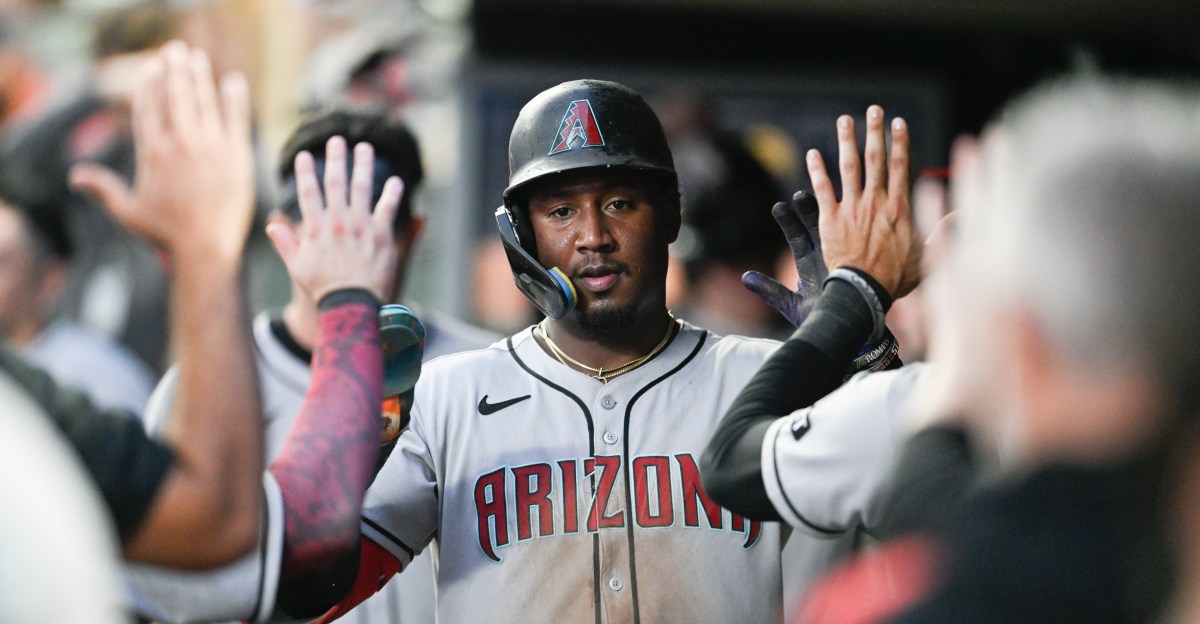
This was every bit the procession expected. Corbin Carroll did get some votes, and there was also a brave person who opted for Ryne Nelson. But this was a landslide, befitting a banana republic presidential election, with absolutely no doubt about the outcome. And deservedly so, because Geraldo Perdomo enjoyed a season for the ages. As mentioned in the nominations thread, it’s only the third time a position player for the Diamondbacks has posted a 7 WAR season – and that applies by both bWAR and fWAR. By either metric this was the best campaign in Arizona since Paul Goldschmidt in 2015.
That season saw Goldy finish runner-up in the National League MVP, and there’s a good case to be made that Perdomo should have been in the same place. I can’t honestly argue with the winner being Shohei Ohtani (and, believe me: if I could, I would). But Gerry deserved to finish ahead of both Kyle Schwarber and Juan Soto, and as documented at the time, some of the BBWAA ballots were utterly ridiculous. [Hello, Thomas Harding] Still, it’s water under the bridge, and Perdomo won’t mind too much since it earned him $7.5 million. He gets a nice bump of $2.5 million in his salary for 2028-30, and that increase would have been the same for second place.
ish95 already did a fine job in reviewing Perdomo’s season. There’s no point in my repeating that: go and read it. Instead, I’ll swerve to another, potentially intriguing discussion: whether Perdomo’s contract extension will end up being better value than the one Paul Goldschmidt signed in March 2013. To dig into that, there will be math involved, and I will be showing the working. If you’d rather avoid that and skip to the answer of what Perdomo needs to do over his extension, you can find it in bold, a couple of paragraphs down the story. For the rest of you, please have your pencils and paper ready.
For Paul, after the team exercised the 2019 option, it was worth a total of $46.5 million. Converting that into 2025 dollars using “baseball inflation” (the average MLB salary in 2013 was $3.386 million; in 2025, it was $5.160 million, a 52.4% increase), it comes out at $70.9 million, and covered the years 2014-19. It’s interesting to note that the two extensions were similar in a couple of ways. Both started with the player’s age-26 season, and kicked in a year after being signed, the player having already agreed to a contract for the season in question (2013 vs. 2025).
Neither player slacked off as a result of the new contract. Indeed, both players delivered breakout years, while they waited for it to go into effect. In 2013, Goldschmidt finished second in MVP voting too, posting 6.3 bWAR. That’s in the same area as Perdomo’s 7.0 bWAR this year. But over the six seasons of the extension, Goldschmidt put up a total of 32.4 bWAR, which using the inflation adjusted cost, works out at a remarkably team-friendly $2.19 million per bWAR. For Perdomo, his total price is uncertain, because of the $15 million team option for 2031. It’s either $45 million over four years, if the team pays the $3 million buyout, or $57 million over five.
Doing both possibilities – and welcoming back the math-averse – to match Goldy’s production cost, Perdomo needs to put up 20.6 bWAR in four years, or 26.1 bWAR in five. Let’s focus on the former figure from here on, to keep things simple. How many shortstops have been able to post that kind of production in their age 26-29 seasons? The answer is not many, and not recently. Only fourteen, in fact, the last such being Jimmy Rollins and his 21.0 bWAR from 2005-2008. However, there have been recent examples in the 15-20 bWAR range: Dansby Swanson, Francisco Lindor, Corey Seager, Carlos Correia. That might be a more reachable target for Perdomo.
While it’s likely Geraldo will come up short, not reaching the bar set by Paul in no way is a failure. It simply indicates what amazingly good value that contract was. It certainly ranks as the best move of GM Kevin Towers tenure in Arizona. Indeed, it might be the best deal in franchise history. Though I’d have to crunch the numbers on Curt Schilling’s contract extension and Randy Johnson’s free agency to be sure. It’s still true that Perdomo may well have paid off the entire cost of the contract before it even starts. At $8 million per WAR, this year alone was worth $56 million. Jack reckons the price now is nearer $11 million. You do that math. Or not. S’up to you. 🙂
Finally, worth comparing Perdomo’s value against the other players to have put up very good seasons last year. Just using the value for salary quoted on Baseball Reference, here are those who were worth 6.5 bWAR or better:
Aaron Judge: 9.7 bWAR, $40 millionCristopher Sánchez, 8.0 bWAR, $2 millionShohei Ohtani: 7.7 bWAR, $28.22 millionPaul Skenes, 7.7 bWAR, $875,000Cal Raleigh: 7.4 bWAR, $2.67 millionBobby Witt Jr: 7.1 bWAR, $8.11 millionGeraldo Perdomo: 7.0 bWAR, $2.55 millionJulio Rodriguez: 6.8 bWAR, $20.19 millionTarik Skubal, 6.5 bWAR, $10.15 million
That’s an interesting spread. Perdomo and Raleigh are very close in value, with Sanchez slightly ahead of both. But Skenes is far and away the best. I’m just glad he ended up receiving $3.4 million in bonus pay from this year’s pre-arbitration bonus pool, because otherwise it’d be daylight robbery. Anyway: we have Perdomo, he was fabulous last year, totally worth every penny and a lot extra ones. Here’s to more of the same from Gerry in Sedona Red this season.
That brings the 2025 awards to a conclusion. Thanks to all who took part in the process, with nominations, comments or votes. Here’s a full list of the awards handed out this year. Category goes to the nomination and ballot, player’s name to the announcement of their victory.