
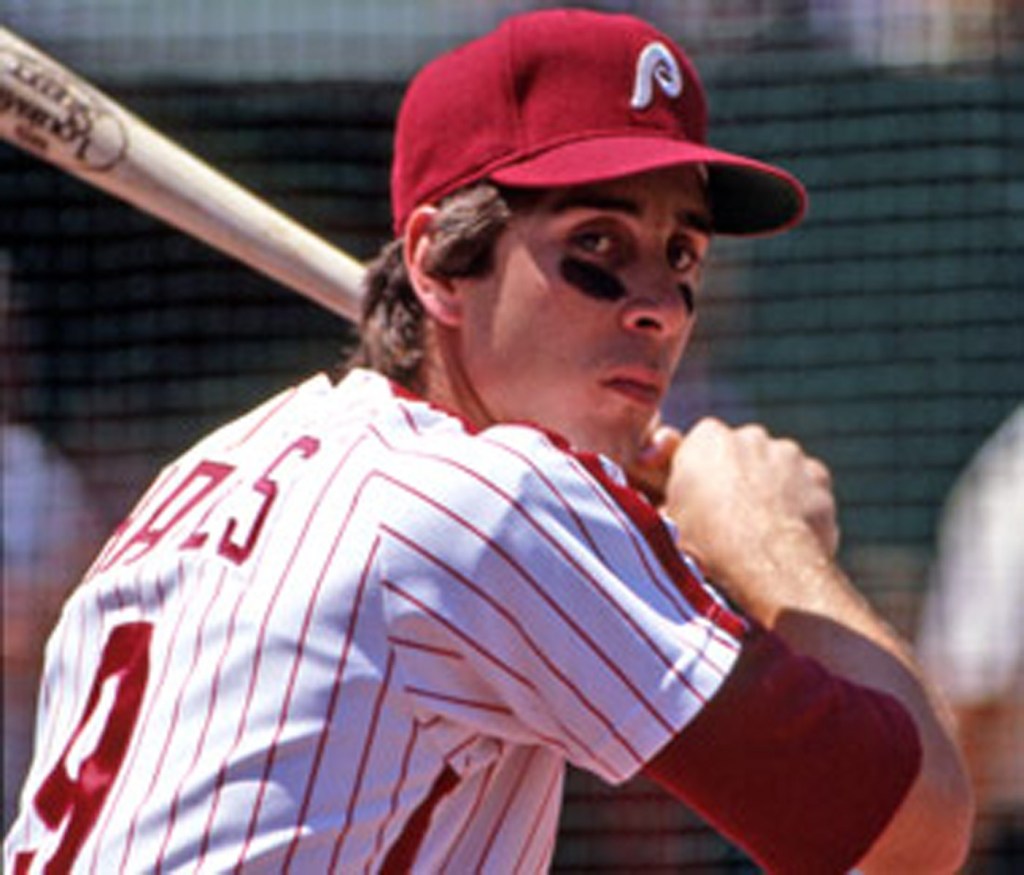
Versatility is the ability to adapt to many different functions or activities.
That attribute helped Von Hayes enjoy a lengthy 12-year professional career, which included a 1989 All-Star appearance and a minor-league coaching stint after his playing days.
The former Philadelphia Phillie was the keynote speaker at the 64th Annual Reading Hot Stovers Banquet on Thursday afternoon.
Hayes, who live in southwest Iowa, had not spoken at an event that large since the 1980s, but between himself and Hall of Famer Ozzie Smith, they have covered roughly 40 years worth of banquets in Clarinda, Iowa.
One thing Hayes loves to emphasize to younger ballplayers at events is the importance of excelling in all aspects of baseball, not just hitting.
“You always get that question, ‘What did you do differently than other guys?’ I like to say the No. 1 thing for me was versatility,” Hayes said. “I wasn’t just a baseball player; I learned how to play all the different positions. I played basketball and a little bit of football growing up, but eventually settled on baseball. Playing, and at least practicing, different positions is a big reason why I made it to the big leagues, and a big reason why I ended up in Philadelphia.”
Hayes talked about how many young players burn themselves out, whether by focusing only on hitting or by sticking to a single sport instead of becoming well-rounded athletes.
The 1989 All-Star encourages players and their parents not to have tunnel vision when it comes to improving as a baseball player, emphasizing the importance of working on more than just swinging the bat.
Hayes stresses versatility because it was the skill that made him part of one of the most infamous trades in Major League Baseball history.
The Trade
He earned the nickname “Mr. 5-for-1” after being traded from the Cleveland Indians to the Philadelphia Phillies in exchange for Julio Franco, Manny Trillo, George Vukovich, Jay Baller and Jerry Willard.
It was one of the first trades of its kind, a type that has become more common today, for example with Juan Soto being traded to the San Diego Padres for six Washington Nationals prospects, or in the NBA, when Rudy Gobert was traded from the Utah Jazz to the Minnesota Timberwolves for five players and four draft picks.
On Dec. 9, 1982, after 183 games in the majors with a .254 batting average, 160 hits, 99 RBIs, and 40 stolen bases, Hayes was headed to a star-studded Philadelphia team, hoping to be the final piece in another World Series run.
“Well, it came as a surprise to me,” Hayes said of the trade. “I was only in my third year as a professional. I was the No. 1 prospect in the minor leagues, and I really thought I was going to help turn that organization around. Chris Bando and I came up together through the minors, and he was another highly touted player. Together, we were hoping to change the organization, that was our goal. We had a pretty good start in 1982, but next thing I knew, I was traded to the Phillies.”
The 24-year-old Hayes joined a veteran Phillies team that included Pete Rose, Mike Schmidt, Steve Carlton, Joe Morgan, Gary Matthews, and Garry Maddox.
Hayes’ versatility made the trade particularly intriguing for Philadelphia, as he was expected to fill the final gap in the outfield for a deep playoff run.
“I played every game in the minor leagues at third base. People don’t remember that, or maybe even know it, but I didn’t play the outfield until I got to the big leagues,” Hayes said. “That versatility is what the Phillies were looking for, a left-handed bat behind Mike Schmidt. By showing them in the majors that I could also play the outfield, it opened up a world of opportunities for me, and it turned out to be a great thing.”
However, the 1983 season didn’t start well from the jump for Hayes, as he suffered an injury early in spring training that caused him to miss the beginning of the season.
After that setback, he never fully bounced back, which led to him losing his spot in the outfield during the biggest series of his career, the World Series against the Baltimore Orioles, which the Phillies lost 4-1.
Hayes batted .265 with 32 RBIs over 124 games that season, but in the postseason he appeared in just six games, had five plate appearances, and went 0-for-5.
“It was a frustrating year for me,” Hayes said, reflecting on the 1983 season. “To this day, it’s a big regret of mine, because we ended up in the World Series against a team that I had kind of dominated the previous year when I was with the Indians. I handled that team pretty darn well, and it was frustrating to have to sit and watch our team lose when I could have been much more of a help.”
In 13 games against the Orioles the previous season, Hayes batted .249 and drove in 18 runs, helping his team win the season series 7-6.
Despite that, Hayes understood why he wasn’t on the field to help his team in the World Series.
“I wasn’t playing well. It was completely warranted that I not play. Joe Lefebvre was doing great, he went in and helped the team. At that point, it was all about winning, and I understood that. Still, it was frustrating for me not to be able to help us win a World Championship.”
Throughout the rest of his Phillies career, which lasted until 1991, the team failed to reach the playoffs, but Hayes remained a key contributor in winning ball games.
In his nine years as a Phillie, he batted .272, compiled 1,173 hits, 124 home runs, 568 RBIs, and 202 stolen bases, showcasing both his power and speed.
In 1989, Hayes earned his first and only All-Star selection, posting a career-high 26 home runs and a 140 OPS+.
“There were a lot of great times and great moments for us as a team and for me as a player,” Hayes said, reflecting on his Phillies career. “I wish I had played in an era like today, with wild card opportunities, but back then you had to win the NL East to make the playoffs. It was a lot tougher. We had a lot of talented teams. It seemed like my entire career we could put runs on the board, but it got frustrating after a while. I know Mike (Schmidt) would probably agree with me that defense wins championships, not offense. We just didn’t have the overall pitching to compete with what the Mets were throwing out there during those years.”
After his stint in Philadelphia, Hayes played 94 games for the California Angels in 1992 before retiring.
The California native finished his career with 1,402 hits, 143 home runs, 696 RBIs, and 253 stolen bases.
Retirement and Minor League Coaching
After retiring, Hayes focused on raising his two children, Conner and Taylor, enjoying life off the road after spending nine months a year traveling.
Eventually, he got into coaching in the minor leagues, working within the Oakland A’s and Arizona Diamondbacks systems from 2002 to 2006.
He also spent time in the independent leagues, managing the Lancaster Barnstormers, Camden Riversharks, and Alexandria Aces.
While being a family man ultimately took priority, Hayes enjoyed his time managing before stepping away from the role.
Now 67 years old, Hayes still feels the itch to return to the baseball world, but only if the right opportunity comes along.
“I’ve turned down a few hitting coaching jobs, but if the situation is right, I’d think about it seriously, because I do love to teach. I think I still have a lot to offer. I also have some thoughts on teaching base running. I wasn’t the fastest guy, but the process behind stealing bases and base running in general, I think I could offer a lot in that area as well.”
Current Phillies Landscape
Even today, Hayes remains deeply invested in the team that believed in him the most, the Phillies.
“I watch them religiously,” Hayes said. “As long as they have Kyle Schwarber, Bryce Harper, and Trea Turner, they’ve got a chance to do something special. The starting pitching is fine, they just need to get Zack Wheeler back and rolling again. But they’re veterans. I’m pretty sure this next year is going to be do or die, and we’ll see some serious shake-ups. Hopefully they can get it together. But man, I like their team. I like their chances.”
Hayes also spoke about Harper’s versatility, praising him for successfully transitioning from the outfield to the infield, knowing it’s not an easy switch.
“I’m really proud of Bryce Harper becoming a first baseman, because I know how tough it is to transition to a new position in the big leagues. It’s pretty fast in there. I watch him closely with his footwork, and he’s done a great job.”
The 1989 All-Star also spoke highly of Alec Bohm.
Living in the Midwest, similar to where Bohm grew up in Nebraska and attended Wichita State University in Kansas, Hayes hears a lot about him through friends and has followed him closely, even saying he probably knows him better than his hitting coach.
Bohm hasn’t always had it easy in Philadelphia, but he has unquestionably contributed in recent years.
“It was frustrating to watch him go through what he did last year, but he’s going to bounce back and help them get where they need to be. I really believe in him if they give him a chance. In 2024, he had a shot at having his best year in Philly as a Phillie. He was looking at 120 or more RBIs, leading the team in everything. Then he gets hurt, comes back, and he isn’t the same at the end of the year. He’s a right-handed bat that they need.”
Whether it’s coaching, talking, or simply watching, once a ballplayer, always a ballplayer, Von Hayes will always be involved in the game of baseball in one way or another.