
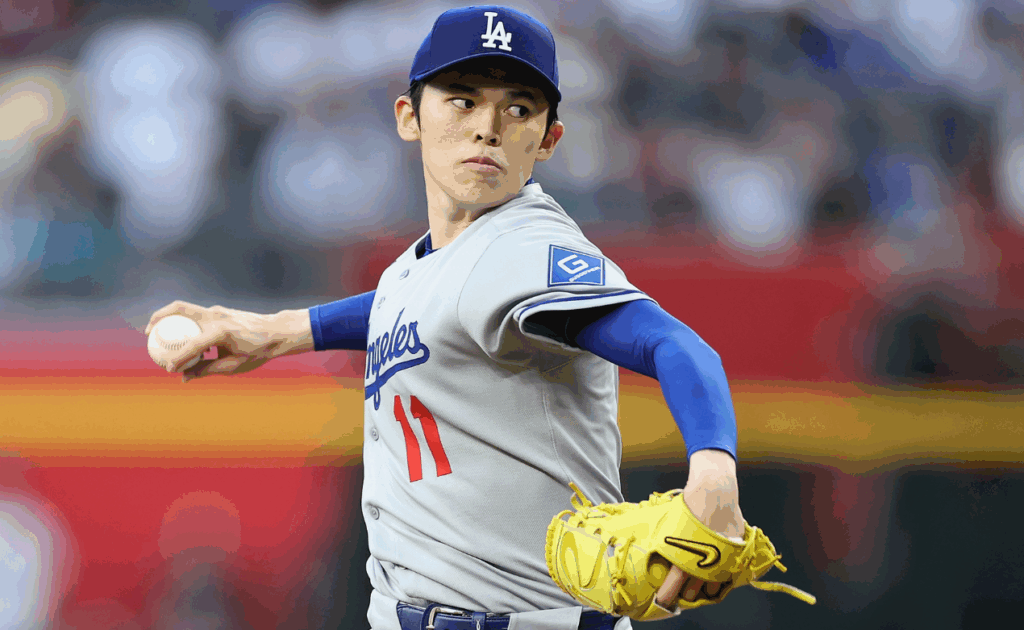
There are legendary pitches in Dodgers’ team history. Koufax’s curveball. Kershaw’s slider. Kenley’s cutter. Soon, we may have to add one more to the list: the Japanese splitter.
The split-finger fastball has been a pillar of Japanese pitching for decades, and it’s no accident you now see it woven into the arsenals of three Dodgers stars: Roki Sasaki, Yoshinobu Yamamoto, and Shohei Ohtani. The pitch’s history, the way Japan develops pitchers, the ball they use, and the strategic preferences of NPB all helped make the splitter a national specialty. In 2025, that legacy is showing up in Chavez Ravine.
The splitter 101: often confused with a forkball, the splitter looks like a fastball out of the hand, then drops off the table late. Technically, it evolved from the forkball; same family, different grip tension and finger spread. Although they are two different pitches, it’s worth lumping them together for this article, as they both are much more popular in Japan than in the United States. That gap—Japan as the splitter heartland, MLB as the wary adopter—frames everything that follows. (MLB.com)
Why Japan? Start with culture and strategy. For a long time, Japanese pro ball emphasized manufacturing runs and neutralizing hard contact rather than the American “challenge with heat” ethos. A 2014 New Yorker profile of Masahiro Tanaka captured the dynamic: in Japan’s more cautious run-prevention game, splitters and sliders see more action; the splitter in particular plays as a deception pitch that induces bad swings or weak contact when hitters aren’t selling out for lift. That piece also underscored the pitch’s reputation as nearly unhittable when tunneled off a four-seamer. (The New Yorker)
Development patterns matter, too. NPB typically runs six-man rotations with more rest between starts, which can encourage a broader pitch mix and give pitchers time to maintain feel for a grip-sensitive pitch like the splitter. FanGraphs’ look at Japanese pitch counts highlights the six-man norm and weekly off-days—structural differences that shape how pitchers train and recover. (FanGraphs Baseball)
Then there’s the equipment. While both leagues now standardize their own baseballs, multiple comparisons note that the NPB ball tends to feel tackier right out of the box. That tack and seam feel can make split-finger grips more comfortable, especially for younger throwers learning to deaden spin and create tumble. A 2024 side-by-side review observed the NPB ball’s surface is “tackier,” with conventional wisdom holding that grip is easier than on MLB’s famously slicker raw ball (before pregame treatment). Small difference, meaningful effect.
“The splitter was the single most difficult pitch for me to hit during my career,” Tony Gwynn once wrote for ESPN. “To hit a splitter, the hardest part was recognizing what it does. I always looked first for movement. It’s tough to adjust to a ball that comes out hard and suddenly drops. How am I supposed to track that pitch with my bat?”
Historically, the splitter’s popularity in the U.S. has waxed and waned. It surged in the 1980s (Bruce Sutter, Mike Scott, Roger Craig’s disciples), then fell out of favor amid concerns—perhaps overstated—about velocity loss and injury. In the 2020s, usage has rebounded, driven partly by the success of Japanese splitter artists and by modern pitch design that refutes blanket injury fears. Yahoo Sports chronicled that swing back toward acceptance, noting how individualized training is making teams revisit an old taboo. MLB.com likewise showed that, despite lower usage rates, splitters have been consistently effective across the pitch-tracking era. Japan never really left the pitch; MLB is rediscovering it. (Yahoo Sports)
Now, how this all lands in Los Angeles:
Roki Sasaki: the low-spin, gravity-knife splitter
Sasaki’s legend began in NPB with the 2022 when he was just 20 years old. He threw a perfect game (19 strikeouts) and an eight-perfect-innings encore the next start. Those outings showcased the power combo: upper-90s/100+ four-seamer and a vicious, late-dropping splitter. Independent analysis of those starts pegged his fastball averaging ~99 mph and touching 102, with the splitter as the finisher. More recently, MLB.com broke down his Dodger-era splitter in spring 2025 and found vanishingly low spin—spring strikeout splitters registering between ~400–580 rpm, far below MLB’s average splitter spin (~1,300 rpm). That low spin is exactly what produces the dramatic tumble hitters swing over. It’s the classic Japanese splitter profile, turbocharged. (Sports Info Solutions)
Yoshinobu Yamamoto: command, tunneling, and usage
Yamamoto, the three-time Sawamura Award winner in Japan before signing with the Dodgers, brought a polished splitter he throws in the high-80s to low-90s. Once in MLB, Statcast data shows how central it is to his mix—Baseball Savant’s arsenal page has his splitter as a top-two pitch by usage, a big share of his plan alongside the four-seamer and big curve. The pitch plays because it looks like the heater until the final few feet; Yamamoto’s command lets him live at the bottom edge and turn even hitter’s counts into neutral ones. (MLB.com)
Shohei Ohtani: the prototype who made MLB take notice
For those not already familiar with the ridiculous arsenal of Yu Darvish, Ohtani’s splitter helped introduce (or re-introduce) a lot of U.S. fans to the genre. In 2021, Sportsnet documented absurd performance numbers against the pitch—a .087 batting average against and a .113 wOBA, with a ~49% whiff rate. Even as his slider has become a swing-and-miss monster in 2025, MLB.com highlighted that the splitter was his top whiff pitch across multiple seasons (2018, 2021–23). It remains a core threat that shapes hitter decisions even when the slider steals headlines. Oddly enough, for all its effectiveness, it’s not a huge part of Ohtani’s plan of attack. According to Baseball Savant, he only throws the split about 8% of the time. Just enough to drive hitters crazy. Compare that to Sasaki, who throws the pitch nearly 40% of the time and Yamamoto, who goes splitter about 30% of the time. (Sportsnet.ca)
Why it works—especially against MLB hitters
Modern offense is built on lifting fastballs. The splitter preys on that: it looks like a belt-high heater and then deserts the barrel. Yahoo’s survey of the splitter’s resurgence made the point bluntly—when designed well, it’s devastating without necessarily carrying the injury baggage once feared. MLB’s own analysis this year showed splitters produce strong run-value results across the tracking era; the pitch just hasn’t been common. The Dodgers’ trio represents three different splitter “shapes”—Sasaki’s ultra-low-spin plummet, Yamamoto’s firm, late tilt at the knees, and Ohtani’s classic “trap door”—but the effect is the same: hitters swinging over where the ball used to be. (MLB.com)
The Japan pipeline—and what it means for L.A.
When you put the development ecosystem together—tackier ball feel, more rest between starts, a run-prevention-first mindset, and a long tradition of teaching the forkball/splitter early—you get a steady flow of pitchers who can deaden spin on demand. MLB’s glossary even calls out that Japanese pitchers “often bring a splitter with them.” The Dodgers are leaning into that competitive advantage. Sasaki’s and Yamamoto’s splitters arrive fully formed; Ohtani’s has been terrifying since his NPB days. It’s a rare case where a club can roster three different splitter archetypes at once, forcing postseason opponents to game-plan for a pitch they see less often across the league. (MLB.com)
A quick historical footnote: the U.S.–Japan crossover
While the modern MLB splitter’s rise is usually credited to U.S. figures—Chicago Cubs instructor Fred Martin and, later, Roger Craig’s evangelism—the “why Japan?” question isn’t about invention so much as adoption and optimization. Japan institutionalized the pitch while MLB debated it. As MLB teams reassess old dogma with hard data—and as Japanese aces thrive here—the league is catching up to what Japan has done for years. Think of the Dodgers’ staff as a living exhibit of that convergence.
Of course, there are plenty of American-born pitchers that feature a split in their pitch mix. Joe Ryan of the Twins uses one. Logan Gilbert and George Kirby of the Mariners rely on the splitter as well. The Blue Jays Kevin Gausman has a split that is close to legendary. And, right here in Los Angeles, Kirby Yates relies on about a 50/50 mix of four-seamers and split-finger fastballs.
But the Japanese seem to prize throwing the splitter above almost any pitch. Kodai Senga has the famous “ghost fork” splitter that he’s used to great advantage in MLB. Kenta Maeda threw a splitter more than any other pitch. And, the OG from Japan, Hideo Nomo, had a forkball/splitter that was a key component in his success in the 1990s.
If you’re looking for telltale signs at the park: when Sasaki starts a sequence with 100 at the letters, don’t be surprised if the two-strike ball disappears under the bat knob at ~90 with almost no spin; that’s the splitter. With Yamamoto, watch for four-seamers at the top quadrant followed by a knee-high parachute that freezes lefties. And when Ohtani needs a strikeout in traffic, the old favorite still shows up: splitter starting thigh-high, tumbling to the shins, with swing decision already committed. Three different routes, same dead drop.
For a franchise that prides itself on blending scouting with pitch design, the Dodgers didn’t just import stars—they imported a pitch identity. Japan made the splitter a craft. The Dodgers are making it a problem for everyone else. (MLB.com)
Have you subscribed to the Bleed Los Podcast YouTube channel? Be sure to ring the notification bell to watch player interviews, participate in shows & promotions, and stay up to date on all Dodgers news and rumors!
Related