
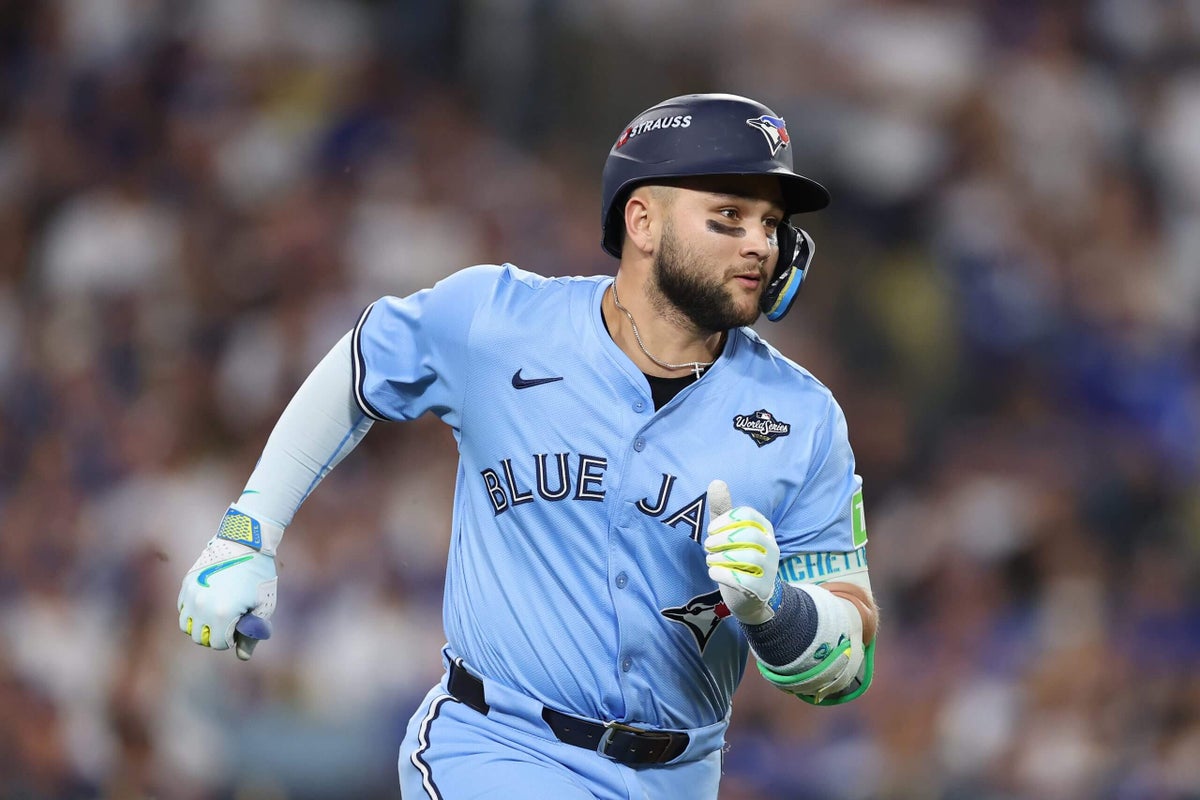
Bo Bichette’s ability to opt out of his deal with the New York Mets after one season perhaps best exemplifies how free agents do not fear the threat of a big, bad lockout in 2027.
Teams also do not seem to be operating differently in both the trade and free-agent markets, even though a lockout might force the cancellation of part or all of the 2027 season.
Bichette can earn as much as $47 million for one season with the Mets, $42 million in salary, plus a $5 million payment if he opts out. Barring injury, he is likely to reenter the market next offseason going into his age-29 season, the same position Kyle Tucker was in this winter. Bichette’s opt-out decision would come before the start of a potential lockout on Dec. 1.
But if games are missed, it will make no difference if he is a signed player or free agent. Either way, he will not be paid.
For Bichette, what exactly would be the risk of exercising the first of his two opt outs in his three-year, $126 million deal with the Mets?
In a weak 2026-27 free-agent class, he would be one of the youngest hitters on the market, and perhaps the best. He also is well aware that, prior to the last lockout in 2021, teams went on a spending frenzy, committing a one-day record $1.4 billion in salaries, including six contracts of at least $100 million.
Even the imposition of a salary cap, considered highly unlikely by many in the sport, might be only so detrimental. A cap likely would need to be phased in over time. And the accompanying salary floor not only would require teams with low payrolls to spend, but also might force certain stingy owners to sell their franchises – both good outcomes for players.
Three other free agents, San Diego right-hander Michael King, Houston righty Tatsuya Imai and Baltimore closer Ryan Helsley, have signed deals with opt outs after one year (King and Imai also have second opt outs in their three-year deals.) Some clubs oppose granting such provisions to free agents who rejected qualifying offers, but only because they are unwilling to lose draft picks and international bonus pool space for a potential one-year player, one agent said.
The last work stoppage to shorten a season was the strike of 1994-95. While a lockout of the players by the owners is considered all but inevitable, many player agents and club executives are skeptical games will be lost. The league, following the introduction of the pitch clock in 2023 and a spectacular seven-game World Series in ‘25, is riding a wave of positive momentum.
Yet one executive, granted anonymity for his candor, recently wondered aloud if the threat of a lockout was hindering trade talks on players with two years of club control. The exec pointed out that it was difficult to value such players when a lockout might turn those two years of control into less than two, or even one. The same might be true of those players at the deadline.
Only two players with two years of control have been part of significant trades this offseason – right-hander Johan Oviedo and second baseman Jeff McNeil. Others in that service class, including St. Louis infielder/outfielder Brendan Donovan, Washington left-hander MacKenzie Gore and Cincinnati lefty Nick Lodolo, have yet to move, and might not at all.
Officials with some of those players’ clubs, however, say the impact of a potential lockout on their discussions is minimal.
“I suppose it probably has some effect, but feels like teams are trying to use it more for leverage and negotiating strategy than anything,” one executive said. “The talks themselves have not felt that different.”
Said another, “My take is teams like musing about it, but very few (if any?) think that we’ll be missing a whole year. I don’t think the market is markedly different from past years, which is probably the best indicator.”
The structures of multiyear free-agent contracts, too, reflect a business as usual approach, with players taking salaries in 2027 comparable to those in their other years. Perhaps the biggest impact, at least to this point, is that fewer clubs are spending. Per Spotrac, 14 have invested more than $50 million in free agents, compared to 17 last year. But Opening Day is more than two months away. The San Francisco Giants ($37.525 million) and New York Yankees (29.775 million) still could reach $50 million.
The lockout is coming. Everyone in the sport knows it. But the answer to one of the big questions entering the offseason – will the threat of a work stoppage alter club behavior? – sure seems to be no.
A’s wanted Arenado
Last week, I reported that the San Diego Padres were the team besides the Arizona Diamondbacks to mount the “heaviest pursuit” of third baseman Nolan Arenado. But it turns out the Athletics also wanted Arenado and had a deal in place for him, according to people briefed on the discussions.
The A’s would have absorbed more money than Diamondbacks, who will pay Arenado $11 million of the $42 million he is owed the next two seasons, with his previous club, the St. Louis Cardinals, picking up the rest. But Arenado indicated he would not necessarily approve a trade to the A’s, a person familiar with his thinking said. He preferred the Diamondbacks or Padres.
With Arenado out of the picture, the A’s currently intend to use Max Muncy at third base, with Brett Harris and Darell Hernaiz also in the mix. They possibly could pursue a free-agent such as Eugenio Suárez or Yoan Moncada as well.
Padres still looking
The DBacks landed Arenado largely because they were willing to take on more of his salary than the Padres, according to those briefed on the talks. The Padres planned to move Arenado from third to first base.
While $11 million over two years for Arenado isn’t especially burdensome, the Padres prefer to invest more heavily in a starting pitcher, a person familiar with their thinking said. Ideally they would pounce on a starter who lingers on the market the way right-hander Nick Pivetta did last offseason. The Padres did not sign Pivetta to his four-year, $55 million deal until Feb. 17.
Nick Martinez, Lucas Giolito and Justin Verlander are among the free agents who could fall into San Diego’s preferred range at an $8 million to $12 million average annual value. The Padres also are among the clubs to check in with the Milwaukee Brewers on a trade for righty ace Freddy Peralta, whose salary this season will be $8 million.
As always, the Padres remain open to moving players off their roster for the right return. They still want to add a complementary bat, perhaps a right-handed hitting free agent to alternate with Gavin Sheets at DH, perhaps a left-handed hitter to share time with Ramón Laureano in left field.
What about the Buccos?
For all the talk of the Pittsburgh Pirates increasing their spending, their estimated 2026 payroll of $95 million is a mere $8 million above where it was at the end of last season.
Another would-be spender, the Miami Marlins, are at $69 million, $1 million below their season-ending figure.
The Pirates bolstered their offense by signing free-agent first baseman Ryan O’Hearn and adding second baseman Brandon Lowe and others in trades. They still could land a free agent such as Suárez to play third base. But Suárez, like others the Pirates have pursued on the open market, might prefer to sign with a team more likely to contend.
For the Pirates, another trade of pitching for offense might be ill-advised. In the past two offseasons, they have dealt four starters – Luis L. Ortiz, Quinn Priester, Johan Oviedo and Mike Burrows. As previously reported, they are willing to move additional young talent to upgrade their roster, according to people familiar with their plans. But they prefer to stay away from potential 2026 contributors unless they can backfill on the free-agent market, where the options are dwindling.