
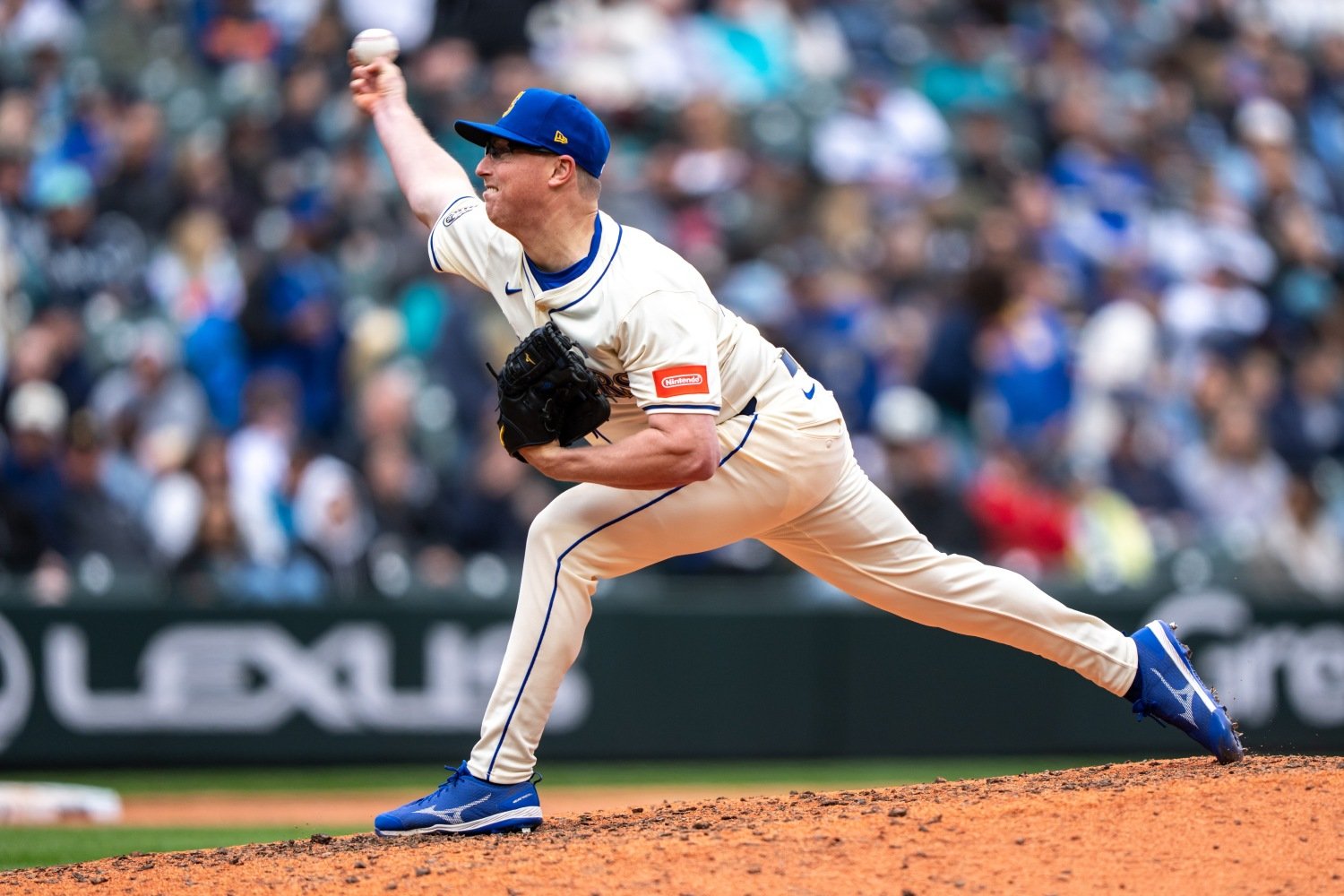
Let me tell you a story. Not long ago, a solid journeyman relief pitcher got hurt. He tore his Achilles tendon, in fact, which is a major bummer of an injury. Before being felled, he’d been an unspectacular but valuable reliever for two and a half years. Since the start of 2023, indeed, he’s appeared in 131 games in the majors and put up a 3.58 ERA. Most of that work came for the Mariners, who still had control of him for 2026 if they wanted it. Instead, though, they non-tendered him in late November. Guys who tear their Achilles in July rarely make it back to the mound before the following June, and the reliever wasn’t good enough to wait on that way.
Not even two months after being cut, he has a job again. The Cubs signed Trent Thornton to a minor-league deal after watching his pro day at Tread Athletics this month, and he’ll get an invitation to big-league spring training, a source confirmed. Thornton, 32, is already touching 92.5 miles per hour on the gun, and he threw six different offerings in a 23-pitch bullpen session before scouts at the facility in North Carolina. He’s making an impressively fast recovery from the injury, and sure looks like he’ll be at full strength by Opening Day.
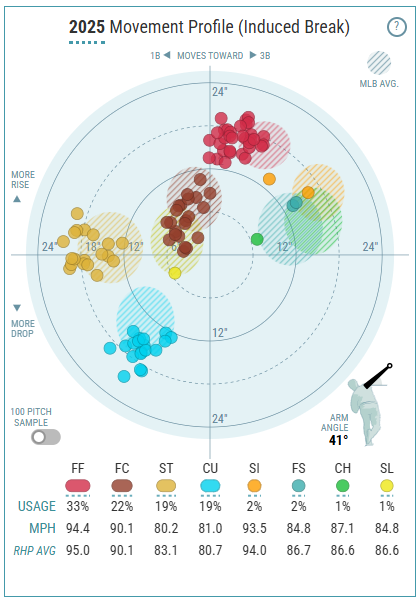
I have a little conspiracy theory to share with you, though. It has nothing to do with his injury; there’d be little incentive for anyone involved to lie about or obfuscate his real health status. Rather, I want you to consider this chart, showing Thornton’s pitch types and shapes for 2025, according to Statcast:
Now, here’s a clip of his session at Tread’s Pro Day and the data on his pitches, served up by the coach who worked with him directly at the facility.
The key to good detective work is seeing what’s missing from a picture, so spot what’s missing from that Pro Day outing by Thornton. He didn’t throw the changeup or splitter at all.
In fairness, he only threw those two pitches a combined 24 times in 2025 and 29 times in 2024. The tweet in which Tread announced that he was signing with the Cubs called him a “super supinator,” which is true. Supinators are pitchers whose mechanical preference is for the inward turn of the palm required to throw a breaking ball; they’re the ones who can produce elite spin rates on those pitches. Thornton is famous for having one of the highest-spin curveballs in the league, averaging over 3,000 revolutions per minute. Those guys tend not to throw many changeups, which generally require pronation (the outward turn of the palm through pushing the thumb down), instead.
Ah, but it’s possible the ‘generally’ in that last sentence is doing important work. The famous not-quite-new pitch of 2025 was the kick-change, whereby a pitcher who favors supination creates a changeup that works for them by using a spiked grip that “kicks” the spin axis of the pitch toward the arm side as they release the ball. Instead of having to pronate to create arm-side movement, the grip does the work for them. Jameson Taillon had a good season thanks to unlocking this very secret.
Thornton is an exceptional candidate for a kick-change, and Tread is one of the top proponents of that pitch in the independent pitching development sphere. They’ve tweeted that term 11 times since early August, alone.
The last two such tweets were celebrations of the progress made by two of the facility’s pupils in November, centered on their kick-changes. The coach overseeing each of those guys was Turner Givens—the same one who has worked with Thornton there.
If you wanted to take Thornton to the next level as a reliever, you’d give him a kick-change. It looks like he even tinkered with that pitch a bit in 2025, throwing a different flavor of changeup than he had in the past about 10 times before getting hurt. It’s unfathomable that, in a couple months of work with Givens at Tread, Thornton hasn’t been developing a kick-change. But he didn’t throw it at his Pro Day.
That might be purely because it’s not ready yet. Thornton’s extension at release was very, very low in this outing, because that’s one way pitchers modulate effort and because that major injury to his landing leg is still healing. Extension is key to executing a good changeup, so the pitch might not be ready for prime time. However, there’s another hypothesis worth our consideration. This is the conspiracy theory portion of the program.
Cubs vice president of pitching Tyler Zombro joined the organization after a few months as a coach akin to Givens, at Tread—and he didn’t stop working for Tread when he joined Chicago. Even after a big promotion to that VP role for Chicago in the fall, he maintains a role at Tread. Zombro is the Cubs’ new secret weapon of pitching development, and because of his work at Tread, almost any pitcher who passes through that facility will come into his orbit.
Thornton is the third pitcher signed by the Cubs coming out of Tread’s Pro Day, joining righthander Tyler Ras and southpaw Charlie Barnes. That’s probably organic, in that Tread’s philosophy of pitching both informed Zombro’s and now reflects it. A pitcher who works at Tread for a while will be molded to suit that philosophy, and Zombro can hardly fail to notice when they respond well to it. Tread isn’t quite an extension of the Cubs, but it’s sure become a likely place to find pitchers the Cubs will like. That doesn’t amount to a conspiracy.
If Zombro and the Cubs knew they’d have interest in Thornton, though, might Zombro have encouraged Givens and Thornton to keep the kick-change in the holster for Pro Day? That probably wouldn’t have been a tough sell, for the reasons we mentioned earlier. It certainly could help the Cubs keep Thornton below the radar, though.
This is a guy with 235 appearances and 401 innings in his big-league career. Getting him on a minor-league deal might not have been possible, if another team or two had seen the pitch that’s likely to round out his arsenal and help him get lefties out. Opposing lefty batters hit .271/.327/.442 against Thornton in 2024 and 2025, combined. Fix that, and he becomes a candidate for high-leverage relief work. The kick-change can do that. With that pitch established, he would merit a big-league deal with an immediate 40-man roster spot.
Instead, the righty will come to spring training with a chance to win a job, but the team will have roster flexibility to add higher-end talent for the balance of the winter—and he’ll cost them virtually nothing if he doesn’t pan out. Did Zombro help hide the most promising development happening for Thornton behind the scenes, to more easily steer one of Tread’s most accomplished auditioners to the team he works for? It’s unlikely, but not impossible. This is why many within the game are uncomfortable with arrangements like the one between Zombro, the Cubs and Tread—which is hardly unprecedented. It won’t matter unless Thornton really has a dazzling spring, but if he fights for and wins a spot in the pen and turns out to be a key arm, credit Zombro with (at least) being the relational conduit who helped the team snare him.