
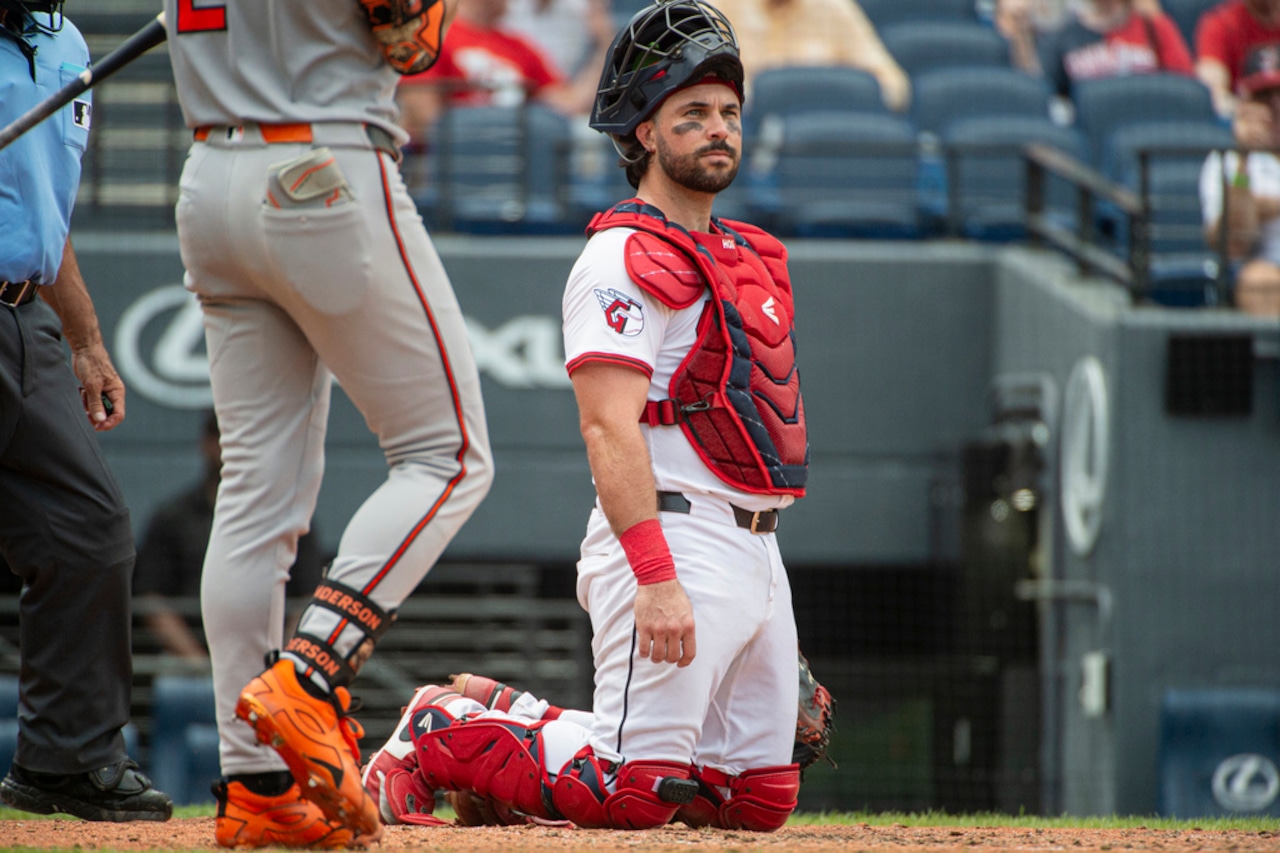
CLEVELAND, Ohio — As Major League Baseball prepares to implement its new Automated Ball-Strike (ABS) Challenge System, Guardians catcher Austin Hedges believes the teams that best master the technology will gain a decisive competitive advantage.
The system, which will be officially adopted for the 2026 season, allows players to challenge ball and strike calls on a limited basis while keeping human umpires as the primary arbiters behind the plate.
“The teams that are the best at it are going to have a competitive advantage that is going to result in wins and losses,” Hedges said, emphasizing how seriously the Guardians are taking their preparation.
Cleveland’s catching corps, including Hedges, Bo Naylor, and David Fry, have been developing specialized training techniques during the offseason. However, Hedges was careful not to reveal too much about their methods to reporters during a Zoom conference call last week.
“I don’t want to give away too many of the secrets because there’s definitely going to be a competitive advantage to training in a way that hopefully other teams aren’t at our level yet,” he explained.
The introduction of the challenge system fundamentally changes a catcher’s approach to receiving pitches. Traditionally, catchers focused on “framing” – the art of making borderline pitches appear to be strikes through subtle glove movements. Hedges, a veteran of 11 big league seasons behind the plate, had positioned himself as one of the rare masters of the technique, which now threatens to fall by the wayside with the debut of ABS. With technology having the ultimate say on challenges, Hedges’ hard work and developed skills must be redefined.
“In the past, obviously you want every strike to be a strike, but you also wanted those balls to be strikes. I want to manipulate the umpire,” Hedges said. “Now it’s just about not ever losing strikes. So now it’s like, balls are balls. Fine, I can live with that. But every pitch that is a strike either needs to be called a strike or I need to challenge it, because I know it was a strike.”
This shift requires catchers to develop an unprecedented awareness of the strike zone’s exact dimensions. The Guardians have been using a Trajekt machine – a pitching robot that can simulate any pitcher’s delivery and release point – to build this awareness among both catchers and hitters.
With teams limited to just two challenges per game, every decision becomes critical. “The fact that it is only two, I like that it’s starting there because it really makes you have to be very convicted in your challenge,” Hedges said.
He compared the experience to tennis matches, where challenges are relatively infrequent but exciting for fans. “Fans are going to be excited to see the challenge thing on the scoreboard, but they don’t want to see it 32 times,” he noted.
The Guardians’ emphasis on preparation reflects their belief that mastering the system could provide a meaningful edge in a competitive division. Several Cleveland players have been training together at Progressive Field during the offseason, suggesting a team-wide commitment to adapting to the new system.
Baseball will continue to evolve through technological integration, but the Guardians appear determined to turn the ABS Challenge System into a competitive advantage rather than just another rule adjustment. It’s one that could potentially make the difference in crucial game situations throughout the season.
“There’s been a lot of guys coming into Cleveland for training this year, which has been really cool,” Hedges said. “I think we’re in a really good spot right now, and I’m really excited to get to spring training to get the whole group together and really start getting after it.”